The Three Assumptions of a Card: A Terminal, a Credential, and an Interchange Fee
Part I · Why an Alternative Exists at All (Chapters 1–2) Builds on: none New concepts in this chapter: acceptance cost, long-tail merchants, the acceptance gap, the costs on both sides of a two-sided market
1. Two Stallholders
A morning market in Jakarta. Two stalls, side by side.
The one on the left sells phone accessories and turns over the equivalent of five million rupiah a day. The one on the right sells vegetables and turns over two hundred thousand.
A salesperson from an acquirer comes round selling POS terminals. He will talk to the stall on the left. He will not talk to the stall on the right.
Not out of prejudice. Do the arithmetic and it is obvious: the cost of a POS terminal — hardware, installation, connectivity, maintenance, receipt rolls — is fixed, whether the machine runs five million a day through it or twenty thousand. Spread across volume, the one on the left can carry it and the one on the right cannot. The salesperson cannot carry it either — the cost of his time on that visit has to be earned back out of years of future fee share, and the stall on the right will never earn it back.
So the stall on the right takes cash only. Not because he doesn't want electronic payments. Because nobody is willing to come and sell them to him.
The concept this section establishes is acceptance cost: the money and the hassle a merchant must put up before he can take a single electronic payment. When acceptance cost is high, a group of merchants gets left outside. And that group is usually the majority by count. They are called long-tail merchants.
Remember this scene. The whole course starts at that stall.
2. The Card Machine Stands on Three Pillars
Start with why cards work at all. Three assumptions, and none of them is optional.
Assumption one: there is a terminal at the merchant's end.
That machine has to read the card, get online, run a security specification, reconcile, and print a receipt. It is the physical entrance to card acceptance. Without it, a card is a piece of plastic.
Assumption two: the consumer holds a card a bank issued.
Behind that card there must be a bank account or a credit line, and a bank willing to verify this person's identity and carry the risk that he doesn't pay. Someone with no bank account cannot get a card.
Assumption three: an interchange fee feeds the whole chain.
The largest single piece of the percentage the merchant pays is interchange, which flows from the acquirer to the issuer. That money pays for the issuer's costs: identity checks, fraud losses, bad debt, customer service, and the cashback and points given to the cardholder.
Interchange is not merely "a fee" here. It is the reason the issuing business can exist at all. Without it, banks have no incentive to issue, and assumption two collapses. And because the salesperson selling POS terminals earns a share, he is willing to make the trip — assumption one is fed by it too.
The three pillars hold each other up: interchange grew the cards, the cards grew the acceptance network, and the acceptance network is what makes interchange collectable.
This structure works extremely well in a market with money, bank accounts, and shopfronts. Every assumption holds, and once the virtuous circle is turning it never stops. The US, western Europe, Japan, Korea, Australia — cards won there completely.
3. Where Each of the Three Pillars Breaks
Now ask it the other way round: under what conditions does each assumption fail?
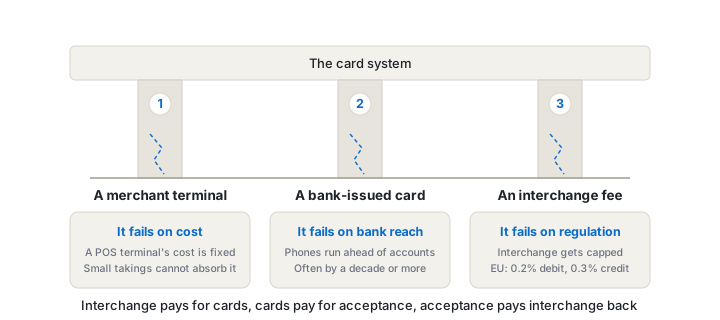
The first pillar breaks on cost.
Back to the vegetable stall. The cost of a POS terminal is not "expensive," it is fixed. A fixed cost meeting a tiny volume produces an absurd percentage. Most merchants in the world are small merchants, so most merchants in the world have never been covered by a card acceptance network. That blank space has a name: the acceptance gap.
The second pillar breaks on bank coverage.
To have a card you must first have a bank account. In many countries, far more people have phones than have bank accounts. A person can have a smartphone, a connection, and an ID document, and still have no account — no branch nearby, or turnover too small for a bank to want him — and therefore no card. Phone penetration runs ahead of bank penetration, and in many countries that gap is more than a decade wide.
The third pillar breaks on regulation, and it gets kicked out deliberately.
This one is the least intuitive. Interchange is the engine of the card business, so the moment a regulator decides it is too high, it caps it. The EU capped consumer card interchange at 0.2% for debit and 0.3% for credit.
The direct effect of a cap is that merchants pay less. But there is a second-order effect, which the chapter on the conditions for displacement will come back and price: when interchange is squeezed very low, cards are already cheap enough for merchants, so merchants have no incentive to push an alternative. What the regulator did to discipline the card networks also drained the fuel out of their challengers.
The three pillars break in different ways, and what grows afterwards is different in each case. That is why every country's answer looks different.
4. A Two-Sided Market Has Costs on Both Sides; Cards Solved One
The card networks solved a genuinely hard problem: how to get merchants and cardholders onto the bus at the same time. The answer was the four-party model plus interchange — make the merchant side pay, and subsidise the cardholder side.
But notice the direction of that subsidy. It subsidises the cost of a consumer holding a card, not the cost of a merchant accepting one. The merchant side is not merely unsubsidised; it is the side paying.
So in this two-sided market, the two sides' costs have looked like this the whole time:
| Consumer side | Merchant side | |
|---|---|---|
| What you must have | A card (needs a bank account) | A terminal (needs a fixed outlay) |
| Who pays | Free, and often paid to use it | Pays a fee, plus the terminal cost |
| Who the barrier locks out | People with no bank account | Merchants whose volume is too small |
Cards pushed the consumer side's cost below zero. The merchant side was never solved.
That leaves an unmistakable opening: whoever can push merchant-side acceptance cost to near zero as well takes the merchants cards never took.
That vegetable stall is not an edge case. In many countries stalls like it are the majority of retail. Whoever can take their money has a market the card networks never entered.
5. Why Cheaper Terminals Won't Fix It
There is an obvious objection: technology keeps improving, so won't POS terminals just keep getting cheaper? Bolt a card reader onto a phone and you're done, surely?
They will get cheaper. Cheaper does not solve it, because the hardest part of the cost is not the hardware.
Before a terminal can accept a card, the merchant has to become a "verified merchant": sign an acquiring agreement, pass due diligence, get a merchant ID, accept a settlement cycle, take on chargeback liability. The cost of that process does not fall when hardware gets cheaper, because it is not a hardware cost. It is an institutional cost.
And the institutional cost is part of the four-party model, not a flaw in it. The reason a stranger's shop in another country can accept your card at all is precisely that every merchant went through that process. Capability and barrier are two sides of the same thing.
So genuinely crossing the acceptance gap does not need a cheaper machine. It needs a way to get paid that does not require the merchant to be verified at all.
That thing exists. It was invented in 1994, and it was not designed for payments.
6. The Question This Chapter Leaves Open
The three assumptions of a card fail in a lot of markets, and what they leave behind is an acceptance gap: a huge number of merchants electronic payments never reached. Filling it means pushing merchant-side acceptance cost to near zero, and it cannot be done by making hardware cheaper.
So what does a way to get paid look like when it needs no terminal and no merchant verification? And where does it move the cost to?
Because cost does not disappear, it moves.
7. Self-check questions
- The cost of a POS terminal is fatal for a small merchant and not for a large one. Which property of that cost creates the difference?
- If interchange were merely "a fee," capping it should have no structural effect on the card system. Why does it in fact have one?
- Why can't a person with a smartphone but no bank account get a card? Which of the three pillars is the one that breaks?
- "POS terminals will keep getting cheaper, so the acceptance gap will close on its own" — where does that reasoning go wrong?
- Which side of the two-sided market did the card networks subsidise with interchange? What did the unsubsidised side leave behind?
8. Answers
Answer for yourself before reading on.
- It is fixed. The cost does not move with volume, so the percentage it works out to is decided entirely by how large the volume is. A stallholder doing twenty thousand a day and a shop owner doing five million a day pay the same terminal cost, and for the first one the effective rate is impossibly high.
- Because interchange is not just a fee — it is the revenue the issuing business runs on. It pays for the issuer's identity checks, bad debt, fraud, and cashback. Squeeze it, and banks have less reason to issue, so the assumption "the consumer holds a card" itself starts to loosen. It also feeds the people who go out and build the acceptance network.
- The second pillar. Cards must be issued by a bank, and a bank issuing a card must first open an account for this person and take on his credit risk. In many countries smartphones spread far faster than bank accounts did, and the gap between the two can be more than a decade.
- It mistakes the cost for a hardware cost. The hardest piece of acceptance cost is the institutional cost: the contract, the due diligence, the merchant ID, the settlement cycle, the chargeback liability. None of that gets cheaper when hardware does, because none of it is hardware. And it is not a defect — it is exactly what lets a stranger's shop be trusted.
- It subsidised the consumer side (free to use, plus cashback and points). The merchant side was not subsidised at all; it is the side paying, and it also covers the terminal cost. The consequence is that the barrier on the merchant side never came down, and merchants with too little volume were left permanently outside the system — which is the acceptance gap.
Previous: (none — this is the starting point) Next: Chapter 2 · A Sticker Beats a Terminal: What a QR Payment Actually Is