Payment Systems · The Course Map
A learning route: a 29-chapter main line + a 2-chapter extension Main line: US domestic + cross-border. Destination: seeing exactly which square stablecoins and CPN (Circle Payments Network, the cross-border payment network built by stablecoin issuer Circle) occupy in the larger framework of payments. Extension: what is changing in 2025–2026 (agentic payments, the messaging changeover, rail interlinking, CBDC (central bank digital currency), Pay by Bank).
1. Where This Course Is Taking You
By the time you finish the main line, you should be able to answer these five questions without looking anything up:
| Question | Which chapters solve it |
|---|---|
| When money moves from A to B, how many ledgers actually get edited along the way? | Chapters 1–3 |
| Why does a merchant give up 2% on a card payment, and who ends up with that 2%? | Chapter 6 |
| Why are cross-border remittances slow and expensive — slow at which step, expensive on which line? | Chapters 13–14, 18 |
| Which piece of the old chain do stablecoins actually replace, and which piece do they not? | Chapter 27 |
| Who is CPN competing with — SWIFT, Visa, or Wise? | Chapter 28 |
These five questions are the course's skeleton. Every chapter in between exists so you can derive the answers yourself rather than memorize them.
Beyond the main line, Chapters 30–31 put the changeovers under way on both sides — the payer and the rails — on the radar, judged with the same tools the main line teaches.
2. The Panorama: Four Scenarios
Payment has exactly one job: get money from A to B. And the method has never been hauling money anywhere — it is changing two lines in a ledger.
Once money moves between accounts, there are only two possible directions. The industry's names for them are push (credit) and pull (debit):
| Dimension | Push (credit) | Pull (debit) |
|---|---|---|
| Who initiates | The payer: sends the instruction that delivers money into the other side's account | The payee: on authorization the payer gave in advance, takes money out of the payer's account |
| Typical scenes | Transfers between friends, remittances, payroll | Card purchases, subscription charges, utility auto-debits |
| What risk control guards against | The payer not having the balance — or being scammed into pushing the money out themselves | Unauthorized debits — which is why every pull must leave the payer a return window |
Each direction comes in two scopes:
- Domestic — payer and payee are in the same country, both sides answer to one rulebook, and the money finally lands on one and the same ledger.
- Cross-border — the two parties are in two different countries, each with its own rules and its own ledgers, and between those ledgers there is no direct connection.
Two directions times two scopes gives four scenarios: domestic push, domestic pull, cross-border push, cross-border pull. The figure below lays them out as a 2×2 grid.
Everything in this course lands either in one of these four squares or in the foundation all four share — and the foundation is the three things Part I builds: money is an entry in a ledger, crossing institutions takes the two steps of clearing and settlement, and different kinds of money sit at different levels of a hierarchy.
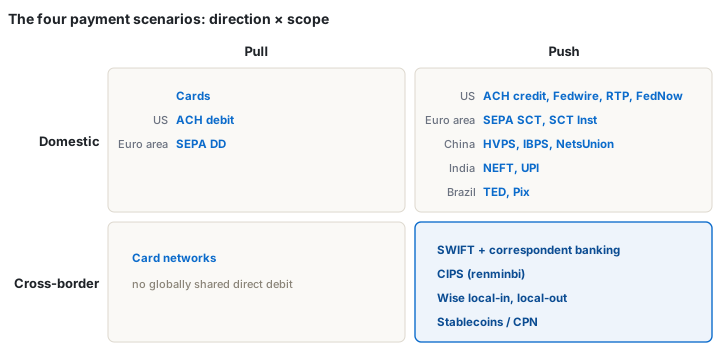
"Rails," the figure's word and one of this course's most-used, means a complete system for getting money from one account to another — the rules, the participants, and the technical pipes included. Cards are a rail. Bank transfers (ACH in the US, SEPA in the euro area) are a rail. On-chain stablecoins are a rail too.
Looking at this figure, three things are worth saying out loud now:
First, pull does not mean cards. Cards are pull, but pull exists with no card in sight: direct debit — the payee, holding the payer's standing authorization, debits the payer's bank account directly; subscriptions and utility bills run on it (the US implementation is called ACH debit, the euro area's SEPA DD). The dividing line is who initiates, not what medium is used.
Second, cross-border push — bottom right in the figure — is this course's center of gravity. The domestic routes are all reasonably cheap; cross-border push costs far more — a small remittance sent through banks gives up more than 13% on average. Expensive is why most of the past decade's innovation is crammed into this one square: Wise, stablecoins, and CPN are all fighting over it.
Third, cross-border pull — bottom left in the figure — is missing half of itself. The direct debit from point one cannot cross out of a region with a single rulebook — every country or currency zone runs its own direct debit scheme, and no globally shared one exists. Which leaves cross-border pull exactly one road: the card networks.
The seven parts, mapped onto the squares:
| Part | Chapters | Which square it lands in |
|---|---|---|
| Part I · Foundations | 1–3 | The base shared by all four squares: the nature of payment is editing ledgers |
| Part II · Cards | 4–8 | Pull × domestic: how the most successful payment network on earth grew |
| Part III · Bank Account Rails | 9–12 | Chapter 9 erects the push–pull axis; Chapters 10–11 fill in push × domestic (the US, then the world); Chapter 12 covers the ecosystem above the pipes and the two global channels |
| Part IV · Cross-Border and Regional Clearing Rails | 13–19 | Push × cross-border, the source of all the pain: there is no global central bank; the three chapters in the middle open one central bank ledger each (euro, renminbi, pound) |
| Part V · Players and Risks | 20–25 | Cuts across all four squares: who makes money, what kind, and how not to lose it |
| Part VI · New Rails | 26–28 | Push × cross-border again — with a different settlement asset |
| Main-line wrap-up | 29 | A full review, one question per chapter, all with answers |
| Extension · Frontier (optional) | 30–31 | Cuts across all four squares: the payer is turning into an agent, and four base layers are mid-changeover |
The Part VI row deserves a second look. Stablecoins are not a fifth scenario; they are a new solution pushed into the push × cross-border square — which is why Chapter 27's conclusion reads "what gets replaced is the money-moving middle of the old chain; the FX on- and off-ramps at the two ends are not."
3. The Chapters at a Glance
Every chapter runs on the same fixed structure: pick up the question the previous chapter left → background and solution → a comparison table → hand off to the next chapter → self-check questions → answers. The preview below gives just three things per chapter: the question it picks up, the one-sentence solution, and the new concepts (matching each chapter's "New concepts in this chapter" line). Details defer to the chapters themselves.
Part I · Foundations (1–3)
| Chapter | Question it picks up | Solution in one sentence | New concepts |
|---|---|---|---|
| 1 The nature of payment | Physical delivery is too heavy, too risky, and can't cross distance | Deposit the coins with a goldsmith, and payment becomes two lines on one ledger changing together | Ledger, book transfer, atomicity, finality (planted) |
| 2 Clearing and settlement | Two banks' ledgers don't connect | Split the job in two: clearing (work out who owes whom) and settlement (actually move the money); two modes, RTGS and DNS | Clearing, settlement, interbank obligations, netting, settlement risk, finality, RTGS and DNS |
| 3 The hierarchy of money | Who gets to be the center, and what do they settle with | Central bank reserves — only a non-player's IOU is neutral; to judge any money, ask: who owes you? What do they redeem with, and where are the reserves? | Central bank reserves, the hierarchy of money, the liability view, segregation of customer funds, moving between layers |
Part II · Cards (4–8)
| Chapter | Question it picks up | Solution in one sentence | New concepts |
|---|---|---|---|
| 4 The origin of cards | The merchant doesn't know you, and the banking system can't catch retail | Wedge in a middleman both sides know (the three-party model); the merchant's four-benefit table becomes the yardstick for judging every payment product | The three-party model, guaranteed payment, two-sided networks and cold start, the embryo of the merchant discount rate |
| 5 The four-party model | One company can't do a whole country's issuing and acquiring | Outsource issuing and acquiring to thousands of banks, with the card network setting rules only; the cold-start cost gets broken apart | The four-party model, issuer, acquirer, card network, authorization and funds flowing in opposite directions |
| 6 Interchange | Where the merchant's $2.30 goes, and by what right | Splitting $100: $1.80 to the issuer, $0.13 to the network, $0.37 to the acquiring side; money follows risk; the tier sets the rate and the name on the plastic is not the tier; US and EU rule differences produce two different card ecosystems; the bargaining chip is acceptance, not price (Amazon vs Visa) | Interchange, MDR, scheme fees, product tiers and benefit tiers, on-us vs off-us, the Durbin Amendment, the EU IFR |
| 7 The card transaction lifecycle | When "payment successful" appears in three seconds, has money moved? | Three phases: authorization, clearing submission, settlement; authorization is not money moving; refund, void, and chargeback are three different things | Authorization, capture, void, refund, chargeback, pre-authorization, ISO 8583 |
| 8 Card not present | Online, nobody sees the card or the person — who eats the fraud? | Use liability shift to force the technology up: CVV → AVS → 3DS → tokenization; 3DS verifies the person, tokenization stops reuse | Card-not-present, liability shift, CVV, AVS, 3DS, tokenization, network tokens, DPAN |
Part III · Bank Account Rails (9–12)
| Chapter | Question it picks up | Solution in one sentence | New concepts |
|---|---|---|---|
| 9 Push and pull | Why can't cards do payroll? | Money crosses accounts in exactly two directions: push (payer initiates) and pull (payee takes, on authorization); pull rides two media — cards and direct debit — and only cards cross borders; every pull must leave a return window | Push and pull, direct debit, debit authorization, the return window, ACH |
| 10 The four US rails | Which scenario should take which rail? | One side-by-side table; speed, cost, and reversibility hold each other in check; the faster, the less reversible — so fraud control is forced upstream | Fedwire, RTP, FedNow, prefunded pools, fraud control moving upstream |
| 11 Push rails around the world | The US stack has three layers — what do other countries' stacks look like? | The same three-layer recipe — batch net, high-value RTGS, instant retail — built once per currency zone; instant layers split into "real-time final" and "real-time credited"; Brazil's batch layer has already been eaten by its instant layer | TARGET2 and TIPS, HVPS and IBPS, NetsUnion, NEFT, TED and STR |
| 12 Domestic and global | What grows on top of fragmented pipes? | The ecosystem localizes all the way up: LPMs, local gateways, payment orchestration; past the border it converges instead — only SWIFT (push) and the card networks (pull) work everywhere, each by sidestepping the job of unifying national clearing | Local payment methods (LPMs), front-end aggregation, authorization rates, data residency, the two globally universal channels |
Part IV · Cross-Border and Regional Clearing Rails (13–19)
| Chapter | Question it picks up | Solution in one sentence | New concepts |
|---|---|---|---|
| 13 The root problem of cross-border | There is no connection between two countries' central bank ledgers | Correspondent banking: each side books locally, SWIFT only carries messages; money never crosses the border — information does | Correspondent banking, nostro and vostro, SWIFT, multi-hop fees, de-risking |
| 14 The remittance message | What is actually inside the message? | The key fields of MT103 and pacs.008; the charge-bearer code — OUR / SHA / BEN — decides how much the payee comes up short; two routings, serial and cover; UETR and gpi; as of November 2025, MT is retired; the final section answers why cards don't take this road | MT103 and pacs.008, charge bearer, serial and cover, UETR, SWIFT gpi |
| 15 Euro-area clearing rails | The message arrived — now how does the money move on the ledger at the other end? | Four questions fix a rail's character: what money settles it, how it nets, when it stops being reversible, who can join directly; large-value runs on T2, instant on TIPS, both in central bank money; SEPA is a rulebook, not a system; instant payments are now a legal obligation, not a commercial choice | The four questions, T2's two components, the Settlement Finality Directive, EURO1 and the single obligation structure, scheme layer vs CSM layer, the IPR, Verification of Payee |
| 16 China's clearing rails | Same four questions — how does China answer them? | CNAPS is a set of subsystems, not one system; China has an extra layer of non-bank payment institutions, and severing direct bank links plus centralized custody of customer funds pushed that layer back from quasi-bank to pipe; renminbi cross-border runs on three coexisting roads | CNAPS, the payment system bank code, severing direct links, centralized custody of customer funds, stored-value account operation vs payment transaction processing, the clearing bank model, the CIPS zero-balance account, the cross-boundary payment link |
| 17 UK clearing rails | One currency, one central bank, one legal system, one time zone — so why four rails? | The causal rule: count how many combinations a market cuts out of amount, urgency, predictability, and refund rights; FPS is fast to credit, CHAPS is fast to finality; the NPA is dead, RPIB now owns the design | The causal rule, the three finality points of CHAPS, RT2, the Bacs three-day cycle and the Direct Debit Guarantee, FPS prefunding and the three access tiers, the NPA termination and RPIB, CoP and mandatory APP reimbursement, omnibus accounts |
| 18 The four cost sources | $1,000 loses 7.4% on the way — where did it go? | Four items: FX spread, intermediary bank fees, prefunded liquidity, compliance checks; the largest one is the one users never see | The mid-market rate, FX spread, the cost of prefunded liquidity, the cost of compliance checks, corridors |
| 19 The Wise model | Can correspondent banking be skipped? | Local-in, local-out + internal netting; trades "slow and expensive" for "tied-up capital plus licenses"; one yardstick: where did the cost move from, and where to | Local-in local-out, internal netting, rebalancing |
Part V · Players and Risks (20–25)
| Chapter | Question it picks up | Solution in one sentence | New concepts |
|---|---|---|---|
| 20 The role map | Behind every mechanism, who is charging? | The panorama: every company is a contractor on the four-party skeleton, and online differs from offline by exactly one square — the acceptance front end; three questions place any company: who holds the license, who touches the money, who eats the loss | The acceptance front end (POS and gateway), processors (issuing side and acquiring side), BIN sponsor, PSP, PayFac, ISO, BaaS, payment orchestration, neobank, licensed vs unlicensed |
| 21 The case studies | The grid is in place — how do you read an actual company with it? | Nine companies on four-dimension cards, read in pairs — Wise vs Airwallex, Revolut vs Chime, Adyen vs Checkout.com, Bridge vs BVNK — plus Fiat24 on its own; three patterns across the lot | None — this chapter only uses tools already built |
| 22 Neobank anatomy | With no license, where is the user's money? | FBO accounts + an internal ledger; the Synapse case: when the ledger breaks, the money might as well not exist | FBO accounts, the internal ledger, pass-through deposit insurance eligibility, float income, net interest margin |
| 23 The five risks | When something goes wrong, which bucket does it go in first? | A five-way split: credit, fraud, settlement, liquidity, compliance; classify first, then pick the tool | Rolling reserves, delayed settlement, liquidity risk |
| 24 The compliance skeleton | What does compliance actually consist of? | Three blocks: admission (licenses), identity (KYC), monitoring (screening); read licenses in three tiers by how deeply you touch the money, compared across six jurisdictions; compliance is a moat, and it can't be bought | The three-tier reading of licenses, MTL, MSB, PI, EMI, passporting, China's Payment Business License, the PS Act, SVF, KYC, KYB, UBO, OFAC, SAR, the Travel Rule |
| 25 Ledgers and reconciliation | How do you keep the books forever self-consistent and matched? | Double-entry bookkeeping + daily reconciliation driving breaks to zero; three system properties: idempotency, state machines, asynchronous callbacks | Double-entry bookkeeping, journal entries, reconciliation, breaks, idempotency, state machines, asynchronous callbacks |
Part VI · New Rails (26–28) and the Main-Line Wrap-Up (29)
| Chapter | Question it picks up | Solution in one sentence | New concepts |
|---|---|---|---|
| 26 What stablecoins are | Whose liability is it? | No innovation in the hierarchy of money (same layer as a wallet balance); the innovation is the shared ledger: clearing and settlement complete in one act; the price is a downgraded settlement asset | Stablecoins, reserve assets, the shared ledger, on-chain settlement, tokenized deposits |
| 27 What stablecoins solve | Of the four cost items, how many do they cut? | Kills intermediary bank fees and sharply eases prefunding; can't touch the spread or compliance; what gets replaced is the middle segment, not the whole chain | On-ramp / off-ramp, on-chain address screening, the last mile |
| 28 CPN | Who solves the N² problem of on/off-ramp channels? | One rulebook plus one network of participants — the seat Visa holds; SWIFT's messaging layer with a settlement layer of its own; the deciding factor is neutrality | Network neutrality |
| 29 The final review | Did the main line actually stick? | Twenty-eight questions, one per chapter, plus one integrative question, all with answers; whichever one stalls you names the chapter to reread | None |
Extension · Frontier (30–31, Optional) and the Appendix
| Chapter | Question it picks up | Solution in one sentence | New concepts |
|---|---|---|---|
| 30 Agentic payments | The payer is no longer human, and three old assumptions fail | At the authorization layer, scoped credentials (tokenization, narrowed); at the settlement layer, a division of labor: shopping on a human's behalf rides cards, machine-to-machine rides stablecoins; the "who sets the rules" seat opens up for the third time | Agentic commerce, scoped payment credentials, x402, machine-to-machine payments |
| 31 The frontier radar | Four base layers on the supply side are changing over at once | ISO 20022 swaps the messages; instant-payment interlinking is local-in local-out run as public infrastructure; wholesale CBDC is a reshuffle of the hierarchy; Pay by Bank hinges on institutions and incentives | ISO 20022, instant payment interlinking, wholesale and retail CBDC, Pay by Bank |
| Appendix A (32) | How do all the rails covered stack up side by side? | Every rail placed on the remittance/purchase × domestic/cross-border grid, all answering the same four questions — clearing, settlement, settlement asset, finality; not part of the main line | None |
Previous: (none — this is the starting point) Next: Chapter 1 · The Nature of Payment: Money Never Actually Moves