The Nature of Payment: Money Never Actually Moves
Part I · Foundations (Chapters 1–3) Builds on: none New concepts in this chapter: ledger, book transfer, atomicity, finality (planted here; unpacked in the next chapter)
1. A London Cloth Merchant in 1650
You are a cloth merchant in London. You hold 100 gold coins, and you need to pay 50 to another merchant 200 miles away.
For the money to actually travel those 200 miles: hire a cart, pay guards, spend two weeks on the road, and risk being robbed the whole way. That is the entire problem with physical delivery — weight, security, distance.
London's goldsmiths kept vaults. You deposit your 100 coins with one, and he hands you a receipt: "The bearer of this note may collect 100 gold coins."
At first the receipt was just a claim ticket. Then something happened that changed everything: people realized they didn't need to collect the coins at all — they could simply hand the receipt to the other party, because the other party trusted the goldsmith too.
And so the coins never left the vault again.
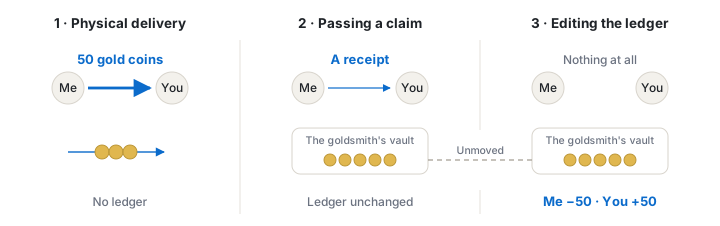
The same act — I pay you 50 — involves three completely different things actually moving:
| Stage | What actually happens when you pay | Where the cost comes from |
|---|---|---|
| Physical delivery | Coins travel from my hands to yours | Weight, guards, distance, time |
| Transferable receipt | A piece of paper moves from me to you; the coins stay put | One thing only: trusting the goldsmith |
| Direct bookkeeping | The goldsmith crosses out 50 under my name and writes 50 under yours; not even paper moves | Trusting the goldsmith + the ledger being correct |
The third step is the decisive one. The moment the goldsmith starts editing the ledger directly, payment leaves the physical world for good. Every transfer you make on your phone today still works exactly this way.
The goldsmith analogy will come back in later chapters, so let's mark where it breaks down now:
- In reality there is more than one goldsmith. The story works because everyone keeps their coins with the same man, so one ledger settles everything. The first thing the next chapter does is remove that assumption.
- Receipts eventually outnumbered the coins. Goldsmiths discovered that as long as everyone didn't show up for their coins at once, they could issue more receipts than the vault held. From that point on, receipts and coins stopped mapping one-to-one, and "what exactly can this receipt redeem" became a real question — one the course answers in full when it reaches the hierarchy of money.
2. The Core Definition
A payment is: reduce the number next to the payer's name by X, and increase the number next to the payee's name by X.
Every chapter that follows is built on this one sentence.
The simplest case: Dean and Alice use the same bank, and Dean sends Alice 100. The bank's ledger (the table recording how much money each person has) changes like this:
| Ledger entry | Before | After |
|---|---|---|
| Dean's deposits | 1,000 | 900 |
| Alice's deposits | 500 | 600 |
| Total owed to customers | 1,500 | 1,500 |
Look at the third row. The total the bank owes its customers hasn't changed. To the bank, this transfer merely swapped creditors: it now owes Dean 100 less and Alice 100 more. The bank paid out nothing of its own, and nothing physical moved at any point.
Note the phrase "the bank owes its customers," by the way. The balance you see in your banking app was never "your money sitting somewhere inside the bank" — it is the line in the bank's ledger that says how much the bank owes you. This way of seeing things gets used more and more as the course goes on.
This is a book transfer (two accounts on the same ledger; banks also call it an on-us transfer). Among all payments that need a third party to keep the books, it is the fastest and cheapest there is: instant arrival, near-zero marginal cost, and no half-finished state in between. When you pay someone who uses the same bank you do, this is what runs.
3. One Rule That Can't Be Broken
Dean's deposits go down by 100 and Alice's go up by 100 — these two line changes must succeed together.
Here is what happens if only one goes through. Dean is debited 100 but Alice is never credited: the 100 vanishes into thin air. The other way around: 100 appears out of nowhere. The first is a customer complaint; the second is an accounting incident.
This property is called atomicity: both lines change, or neither does — no state in between. On a single ledger it isn't hard to achieve, because there is only one bookkeeper and its word is final. Exactly what techniques guarantee it, the course unpacks when it reaches ledgers and reconciliation.
For now, just hold on to this measuring stick. Every time a new rail appears in this course, hold it up and ask:
How does this rail make sure both sides change together?
You will find that the more complex the rail, the more it compromises on exactly this question — and every one of those compromises eventually surfaces as a risk, a fee, or a constraint on some product design.
4. Why Cash Is the Exception
Everything so far has been ledger payment: money moves because some third party edits a ledger. Cash is not that.
I hand you a $100 bill and the transaction is done — no third party, no ledger, and therefore no atomicity problem. And once the bill is in your hand, the thing can never be undone; that property is called finality.
| Dimension | Cash | Ledger payment |
|---|---|---|
| Needs a third party? | No | Yes — someone has to keep the books |
| Is arrival final? | Yes — in your hand means yours | Depends on the rail; usually not |
| Distance limit | Face to face only | None |
| Amount limit | Bounded by weight and volume | No physical bound |
| Traceable? | Barely | A full trail, end to end |
What makes cash so hard to replicate is that it delivers both of these at once: instant finality, and no third party to trust.
What the digital payments industry has been doing for the past seventy years is, at bottom, chasing that one property — building ever more elaborate machinery to approach cash's "given is given" certainty. The next chapter takes finality apart in detail; instant clearing and on-chain settlement, both covered later, are further attempts along the same chase.
5. The Question This Chapter Leaves Open
A book transfer is simple because there is one ledger and one bookkeeper.
But suppose Dean is at Bank A and Alice is at Bank B. Bank A has taken 100 off Dean's balance — why should Bank B add 100 to Alice's? And the 100 that Bank A now owes Bank B: what does it actually get paid with, in the end?
The next chapter answers these two questions with two words: clearing and settlement.
6. Self-check questions
- After a book transfer completes, how much did the bank's own assets and liabilities change?
- Why can "the money arrived" and "the payment is final" be two different things?
- A fire destroys the goldsmith's ledger; the vault is untouched. What do the depositors have left?
7. Answers
Answer for yourself before reading on.
- Assets: unchanged. Total liabilities: unchanged. The only thing that moved is who the liabilities are owed to — 100 less to Dean, 100 more to Alice; the size of the balance sheet didn't move at all. This is also why a book transfer costs the bank almost nothing.
- "Arrived" means the number on the payee's side of the ledger went up. "Final" means that increase can never be reversed. In a book transfer the two happen in the same instant. But an ACH payment (the US system for batch transfers between bank accounts — unpacked later) can still be returned up to 60 days after arriving, and in a card payment, at the moment authorization succeeds no money has moved at all (unpacked when the course reaches the card transaction lifecycle). The gap between these two events is the root of a large share of the product design and risk machinery in the rest of this course.
- Whoever is still holding a paper receipt is fine — it reads "the bearer of this note may collect 100 gold coins"; it belongs to whoever holds it, and the goldsmith will honor the paper. Whoever moved on to stage three, existing only as a line in the ledger, has nothing left: not one coin is missing from the vault, but nobody can prove which coins are whose. In ledger payment, the ledger is not a record of the money. The ledger is the money. The course meets a real-world version of this when it reaches neobanks.
Previous: (none — this is the starting point) Next: Chapter 2 · Two Jobs Between Banks: Clearing and Settlement