Banking Circle: The Heaviest Licence in Every Jurisdiction
Part II · Products (Chapters 2–9) Builds on: Chapter 0 (what each of the six columns covers, the marking conventions); question three in the EU section of the previous chapter — why an EMI must have a bank standing behind it — is the key to the business described here New concepts in this chapter: rail wholesaler, vIBAN, Agency Banking, the safeguarding resting place, reserve banking, scheme settlement and sponsorship
1. What It Does
Banking Circle (BC from here on) is a fully licensed Luxembourg bank, controlled by the private equity firm EQT, and it does none of the things an ordinary bank does: no individuals, no ordinary companies, only regulated institutions — payment firms, acquirers (the firms that take card money on a merchant's behalf: the money from the card reaches them first and is settled on to the merchant afterwards), card issuers, other banks, digital asset firms (licensed firms trading, custodying or running venues for crypto-assets), plus one category that makes no payments at all: investment funds (fund vehicles and fund administrators, buying bankruptcy-remote accounts and institutional FX rather than renting a clearing seat, so they are left aside from here on). Its own numbers: the bank entity serves 850+ regulated institutions and moves more than €1.5 trillion of payments a year (from the website, 2026-05, with no statistical cut-off date given).
The business model in one line: BC is a rail wholesaler — it has taken seats on the clearing rails of many countries, and it rents those seats out along with the other parts of a bank licence, never touching an end user. Question three in the previous chapter made the point that behind every EMI (e-money institution — the tier ② payment licence that may issue a balance) there has to be a bank: a resting place for the money, a seat in clearing, and the execution of card settlement. BC is the bank that does nothing but stand behind. The parts are sorted by what the customer is missing:
| What the customer is missing | The part BC rents out |
|---|---|
| Where the money rests | Multi-currency accounts across 24 currencies; safeguarding for payment firms' client funds — the regulator-recognised segregated resting place |
| Whose name the money moves in | vIBANs (virtual account numbers: one real account underneath, a dedicated number issued to each customer, all the money pooled in the same account, and the number alone tells you whose the funds are); Agency Banking (the customer enters clearing in its own name while BC puts its own clearing membership behind it as guarantor and settles on its behalf — this is clearing sponsorship) |
| How the money reaches the other side | Local pay-ins and pay-outs on the rails BC participates in directly (seconds, full amount); SWIFT for cross-border; instant on-ledger transfers between BC's own customers |
| How to turn it into another currency | FX; fiat↔stablecoin conversion and settlement; EURI, its own euro stablecoin |
There is a timing gap in that fourth row worth noting. Two-way fiat↔stablecoin conversion is what BC has claimed publicly since the CASP came through (2026-04), but the developer documentation has only one direction live, fiat converted into stablecoin; converting stablecoin back into fiat is still marked Coming Soon [?]. So read that row as "the permission is in place, the delivery is half done".
The group also runs two other businesses, YouLend (lending against transaction flow) and B4B Payments. Neither runs on the banking licence, and neither is in scope here. B4B is often shortened to "corporate cards", but what it actually holds is Mastercard principal membership in the UK and the EU plus Visa partner status in the US, and what it sells is BIN sponsorship: lending its own scheme membership to firms that have none, so they can issue cards under their own brand. That draws a line inside the group: the bank itself does not issue cards and does not sponsor BINs — card issuing is B4B's business. The Issuers page on the website offers funding accounts and top-up reconciliation to card issuers; it does not say "we can issue cards for you". The two should not be read as the same thing.
2. BC's Licence Map
Start with where it holds the licences:
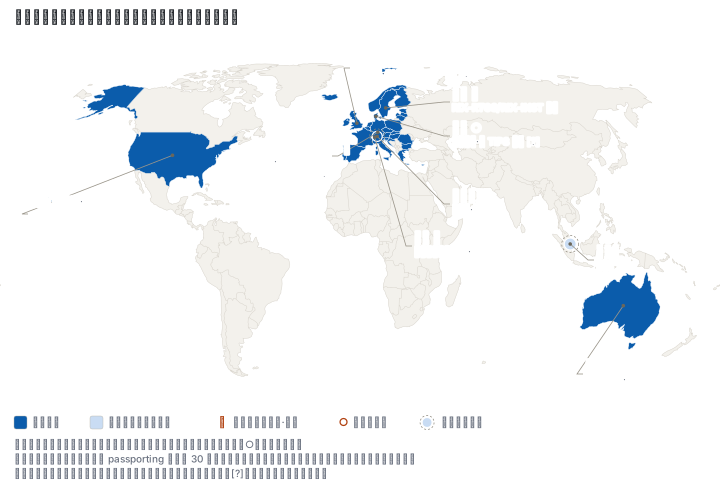
What the map claims, in one line: BC's route is to take the heaviest licence available in each jurisdiction — dark shading in one block, light shading on Singapore alone. A banking licence is a superset of a payment licence, so in the three jurisdictions where BC holds one (the EU, the UK, the US) the payment cell reads covered rather than missing. Singapore is the single exception: a tier ② payment licence, the major payment institution (MPI) licence, and nothing heavier.
Now how those licences turn into a business — who rents, and what:
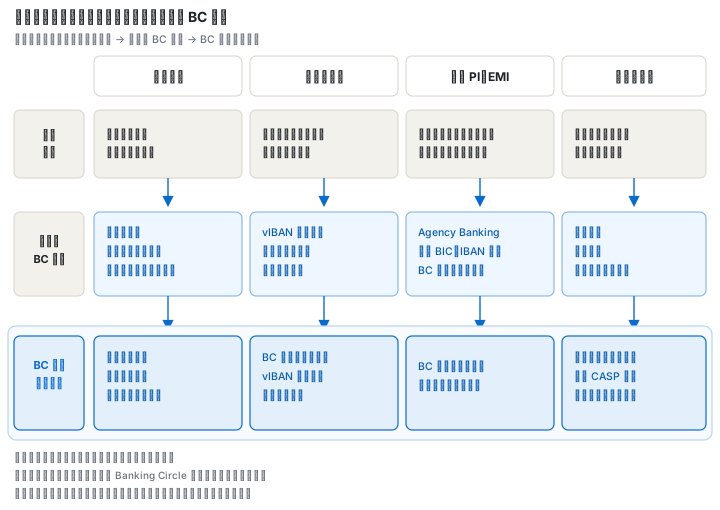
Each of the three blanks reads a particular way. Tier ③, the light banking licence (take deposits or hold in custody, but do not lend): pointless for BC, because the tier ④ banking licence is a superset of it. The two crypto columns: empty everywhere outside the EU — CASP (crypto-asset service provider) and EMT (e-money token) are both EU licences, and outside the EU a stablecoin business has no regulatory ground to stand on. That also draws a timeline: before the CASP came through in April 2026, BC could issue its own stablecoin on the EMT permission but could not convert fiat↔stablecoin for customers. The lending and securities column: the bank itself stays out, and lending is filled in by a separate group company, YouLend, outside the licensing perimeter.
How Each Licence Gets Used
Luxembourg credit institution licence (CSSF, Luxembourg's financial regulator; announced 2020) — the parent licence, and the source of every other part. Deposit-taking eligibility lets it be the safeguarding resting place for payment institutions, which is a product in its own right. Bank status buys it membership of the clearing systems. Passporting makes the one licence cover about 30 countries, and the five branches are sales and operations posts only — every permission comes from the Luxembourg parent.
Direct participation in euro clearing — all three SEPA schemes: SCT ordinary credit transfers (2020), SCT Inst instant credit transfers (2021), SDD direct debits (2022); the website describes it as a direct connection to the ECB. Danish krone instant payments run through the ECB's TIPS platform, again as a direct participant. This is where the licence's value gets cashed in: a customer signs one contract with BC and has rented every one of those seats.
"Direct participation in all three SEPA schemes" comes with one qualification: T2 and TIPS participation is confirmed on the ECB's own lists, but Banking Circle is not findable on the three public lists for STEP2 and RT1, which is where SCT and SDD actually clear. This chapter records direct participation as BC states it; anyone quoting the claim externally should carry the qualification, and the verification work is set out in section 7 [?].
UK third-country branch authorisation (PRA and FCA, the UK prudential and conduct regulators; from 2023-11) — the regulatory standing that lets BC keep trading onshore in Britain after Brexit, and the hook the sterling rails hang on: direct participation in FPS (Faster Payments, UK) went live 2023-04-28 and is on Pay.UK's participant list, and direct participation in CHAPS is confirmed by the Bank of England's own list of direct participants, where the registered name reads "Banking Circle, S.A. (London branch)". Rails hang off the locally licensed entity — a rule that holds everywhere across BC, and all three have now been checked one by one against the official registers of the clearing systems concerned: GBP on the UK branch, CHF on the Liechtenstein subsidiary, AUD on the Australian ADI.
Two under MiCA, the EU crypto-asset regulation: EMT issuance (EURI live from 2024-08) plus the CASP authorisation (CSSF, 2026-04-15) — the official footnote is that this makes BC the first in Luxembourg to hold banking licence, EMT and CASP at once. The EMT permission runs down the status-threshold route the previous chapter set out in its EU section: BC is already a credit institution, so issuing a stablecoin needs no new entity. The CASP is what lets it convert fiat↔stablecoin in both directions inside a regulatory framework, and the stablecoin settlement service announced 2026-04-27 (USDC, USDG and EURI) stands on it. What is in place here is the licence permission; how far it has actually shipped is a separate question — the reverse direction, stablecoin converted back to fiat, is still marked as not live in the developer documentation. See section 5.1.
Connecticut state-chartered uninsured wholesale bank (BC US, Final Certificate 2023-07) — the onshore vehicle for dollars: regulated USD accounts and clearing access for non-US institutions. No FDIC deposit insurance, institutions only, and the level of Federal Reserve access has not been made public [?]. Ownership is now confirmed: the entity hangs at group level and is not a subsidiary of the bank. The group's own wording in 2026-05 lists "Banking Circle S.A., Banking Circle US, B4B Payments, YouLend and ASL" side by side as affiliated companies across different regulatory jurisdictions. That is exactly why the subsidiary list on the bank's regulatory page does not include the US entity — mapping BC's licences off that one page alone will mislead you.
Singapore MPI (MAS, Singapore's financial regulator; granted 2025-11) — the one place on BC's map where it holds a payment licence and nothing more: it entered the Asian hub on a tier ② licence, and whether it upgrades to something heavier remains to be seen. The MAS financial institutions directory shows four activities ticked on this licence — account issuance, domestic money transfer, cross-border money transfer and e-money issuance — and the digital payment token (DPT) module is not among them. Which is to say BC's stablecoin business still stands on one piece of regulatory ground only, the EU's; the Singapore licence cannot carry it.
3. User Stories
All four scenarios are payment only; lending is out of scope for this chapter. Each one ends with the parts it rents.
1. Remittance firm: every currency opened in one due diligence pass. As a remittance firm sending small sums home for migrant workers, I want segregated accounts in every payout currency at a single bank, so that one due diligence pass (the counterparty compliance review: checking the other side's licences, AML programme, audited accounts, ownership and governance) settles both country-by-country account opening and safeguarding compliance for client funds. — Rents: the banking licence (deposit-taking eligibility plus a regulator-recognised segregated resting place), 24-currency accounts, and local clearing in each currency — the payout end has to land on local rails too, or the money never reaches the recipient.
2. Card issuing processor: accounts and rails rented to fit the gap. As a card programme provider that owns its processing platform and has bought an EMI issuing licence (Marqeta's actual shape: the processing platform is its own, the issuing licence is the acquired TransactPay), all I am missing is accounts and money movement across 30 European countries. I want to rent BC's accounts, vIBANs, FPS and SEPA rails as I need them, so that every piece of the puzzle comes from whoever owns it: processing from me, issuing permission from TransactPay, accounts and clearing from BC. — Rents: vIBANs and the directly participated rails. This is the commercial version of exactly the three things question three in the previous chapter listed — the resting place for the money, the seat in clearing, and the funding execution behind card settlement.
3. Licensed EMI: entering clearing in its own name. As a neobank or e-money institution that already holds a licence (an EMI, tier ② payment licence), I want to reach SEPA and UK FPS under my own BIC and with IBANs I issue myself, so that my customers get an account number with my name on it while I never have to build clearing membership of my own. — Rents: Agency Banking (BC's direct participation membership plus its standing as a bank to sponsor).
4. Stablecoin firm: the whole fiat leg in one place. As a global platform holding stablecoin balances (a Bridge, an Orbital, a FalconX), I want euro and sterling local pay-ins and pay-outs, dollar send and receive worldwide, and fiat↔stablecoin conversion all at one bank, so that the fiat leg does not have to be stitched together bank by bank and country by country. — Rents: the directly participated rails and SWIFT, plus the stablecoin settlement built on the CASP. Mind where the division of labour falls: serving Bridge, BC handles the fiat layer only and never touches the coin (conversion happens inside Bridge); the business where BC touches coin itself, stablecoin settlement, only exists because the CASP came through in April 2026.
4. Summary of Advantages
- The licence advantage: the banking licence broken into API-shaped parts and rented out — accounts, vIBANs, clearing and FX each available on their own, so a mature customer orders against its own gaps instead of handing the whole stack over.
- The access advantage: mainstream banks de-risk crypto and high-risk payment sectors, dropping whole categories of customer to keep clear of compliance exposure. BC went the other way and made that population its core business — a licensed bank that will actually take you is itself a scarce thing, and it usually decides the deal before price does.
- The payments advantage: direct participation in local clearing across the euro area, the UK, Sweden, Switzerland, Australia and Denmark, plus the direct ECB connection, with SWIFT filling the rest — no intermediary banks, money in seconds, and a density of direct participation deeper than anything comparable. Be precise about what has been verified: the UK, Sweden, Switzerland and Australia, plus T2 and TIPS in the euro area, can all be found entry by entry on the official participant registers. Two cannot — Denmark, because the Danish central bank publishes no participant register, and SCT/SDD in the euro area, because Banking Circle does not appear on EBA CLEARING's STEP2 or RT1 registers. For those two, BC's own word is the only source [?].
- The stablecoin regulatory stack: banking licence, EMT and CASP held together, so fiat↔stablecoin conversion rests on complete regulatory ground, and issuing EURI itself drives the conversion cost on the euro leg towards zero. The limit: all three are EU licences and stop dead at the EU border (on the licence map the crypto columns are filled in one jurisdiction only).
- A structural price advantage: direct participation strips out intermediary bank fees; when both sides sit inside BC the transfer is an entry on its own ledger; FX is hedged internally against two-way customer flow [?]. That is structurally low cost, not publicly low prices.
One caution against over-attribution: point 4 only dates from April 2026 — the customers already on the books chose BC on points 1, 2, 3 and 5. And the "issuing EURI itself" half of point 4 needs discounting further, as section 5.1 explains: BC's centre of gravity in stablecoins is no longer its own coin.
5. Four Shifts in What It Claims to Be (2023 to Now)
The section above is a snapshot; this one reads the direction of travel. BC has changed its external claim four times in three years, and each time the line being redrawn is the same one: do I go into this business myself, or do I only be the bank behind whoever does? Read the four together and one bearing emerges: wherever a step faces an end user or an end merchant, BC is stepping back; wherever someone else's step needs a bank behind it, BC is stepping forward.
5.1 Stablecoins: from issuing a coin to banking the issuers
Two roles first, kept apart. A stablecoin issuer is the party that mints a token and holds the reserve assets behind it — Circle for USDC, Paxos for USDG. Reserve banking is what the bank does that holds those reserves for the issuer: every coin issued has to have real money sitting somewhere, that money goes into a regulated bank, and the bank has to keep up with a redemption cycle that never closes.
BC has occupied both roles, but the weight has moved. In 2024-08 it issued EURI on the strength of its EMT e-money token issuance under MiCA, billed as the first compliant stablecoin issued and backed by a bank in the EU — that step was going in as the issuer. By 2026-04, with the CASP in hand, the stablecoin settlement service it announced supported USDC, USDG and EURI alike, which is to say it had taken other people's coins on board. Further along, the digital assets customer page updated in 2026-06 lists "stablecoin issuers" outright as a customer category, offering them reserve banking and a compliant issuance process; nowhere on that page does EURI appear again, and the customers on display are Paxos, Circle, Ripple, Coinbase and Kraken. EURI's own product site has not been updated since 2024-09.
The claim moved from "use my coin" to "keep the money behind your coin with me." What this means for a reader: to judge BC's stablecoin capability, do not look at how much EURI is in circulation. Look at how many issuers' reserve accounts it has won.
One thing inside that claim is still unconfirmed. What BC says publicly is fiat↔stablecoin conversion in both directions, but the developer documentation has only one direction live — fiat converted into stablecoin and sent to a chain address, which the industry calls an on-ramp. The reverse, taking stablecoin off-chain and converting back to fiat (off-ramp), is still marked Coming Soon, and the technical documentation for this product line as a whole sits behind a password [?]. The signal you can read: this capability is in controlled release, and should not be planned around as if it were mature.
5.2 Australia: it bought an acquiring licence, then cut acquiring out
Acquiring is the business of taking card money on a merchant's behalf — the money from the card goes to the acquirer first and is settled on to the merchant after clearing, and the acquirer faces the merchant directly and issues it a merchant ID. That is a different thing from scheme settlement, which only moves money between institutions inside the card scheme's clearing cycle and never touches a merchant. A third thing again is scheme sponsorship: lending your own card scheme membership to an institution that has none, so it can join the network under its own name. Note that this is not the same as the clearing sponsorship in section 1 — same word, different thing being lent: clearing sponsorship lends membership of a clearing system, scheme sponsorship lends membership of Visa or Mastercard.
In 2025-08 BC completed its acquisition of ASL in Australia, which became a wholly owned subsidiary of Banking Circle S.A. ASL is an APRA-licensed ADI that settles directly with the Australian central bank, and it had historically held principal membership of Visa and eftpos plus a product line called Merchant Acquiring — the acquiring capability came in with the licence.
Then BC took it out. The official Australian capability list from 2025-10 no longer carries Merchant Acquiring or Card Schemes, and by 2026 the Australian site keeps only scheme settlement plus sponsorship into domestic and international card schemes.
This move is worth remembering on its own, because it rewrites BC's boundary from "cannot" to "chose not to": the capability was bought and paid for and still got cut, which says that staying out of acquiring is a line BC drew itself, not a wall it ran into. It also squares with the positioning in section 1 — acquirers are BC's customers, not its competitors.
5.3 Direct debit: from half a product back to plain plumbing
Direct debit is the SDD named in section 2, and the direction of payment is the reverse of a transfer: rather than the payer pushing money out, the payee pulls it from the payer's account against an authorisation obtained beforehand. Subscriptions, utility bills and loan instalments all run on it. That authorisation is the mandate — the payer signs once, and every later collection references it. Who collects, stores and updates that mandate is the heaviest operational burden in the business.
BC used to carry part of it: the old collections product line came with hosted mandate pages, dynamic mandate management, collection-frequency risk rules, the whole apparatus. All of that is now marked deprecated, and the new interface does exactly one thing — reference a mandate ID you already hold on your own side when you initiate a collection. The documentation is blunt about it: BC does not create, capture or store mandates and takes no responsibility for managing them; the payee must hold its own SEPA Creditor Identifier, build its own authorisation capture and storage, and carry the compliance exposure under the scheme rulebook itself.
This claim retreated from half a product to plain plumbing. What this means for a reader: treating BC's direct debit as a collections solution you can switch on will not work — it raises the bar on the customer's own operational capability, and suits only institutions that already run a direct debit business.
5.4 FX: a new institutional-grade quoting channel
There are two ways to get an FX quote. Request for quote (RFQ) is one question and one answer: you send a request, you get back a dealable price, it lives for a few tens of seconds and then expires. Streaming is a continuous push: you hold a long-lived connection, every price change is pushed to you, and you deal at the moment you judge right. The first is simple and suits FX incidental to a payment; the second is complex and is how a trading desk works.
BC used to offer RFQ and automatic conversion embedded in a payment, and nothing else. It has now added a streaming channel — covering the major euro and dollar pairs, enabled separately — and moved the quoting endpoint to a third version.
The direction is towards institutional customers. But one boundary does not move with it, and a reader should hold onto it alongside: BC's FX is spot only, out to T+2 at the furthest — no forwards, no swaps, no options. A customer that needs to fix a rate three months out has to find another supplier no matter how sophisticated the quoting channel gets.
6. Licence Reference Table: 10 Jurisdictions × 6 Categories
For looking things up. The skeleton is the 10 jurisdictions × 6 categories table in Appendix A of the licence overview, and the marking conventions are in its Appendix B: ✅ held, ❌ no licence record found in public sources (which is not proof there is none), 🟡 applied for or in transition, covered = covered by a heavier licence in the same jurisdiction. Anything unknown is written [?] and goes into the list at the end of the chapter; it never takes a 🟡.
The legend for the world map above is settled here too: dark = banking licence, light = payment licence (including e-money), striped = applied for or in transition, ◉ = direct participation in central bank clearing, hollow circle = access unconfirmed.
| Jurisdiction | Banking licence | Central bank clearing access | Payment licence (including e-money) | Crypto-asset services | Crypto issuance | Lending and securities |
|---|---|---|---|---|---|---|
| EU | ✅ Luxembourg credit institution licence, passportable across about 30 countries | ✅ Direct T2 participation confirmed on the ECB list; direct participation in all three SEPA schemes is BC's own wording, and it is not on the STEP2 lists [?] | covered (by the banking licence) | ✅ CASP crypto-asset service provider authorisation (CSSF, 2026-04) | ✅ EMT e-money token issuance, issuing EURI itself | ❌ The bank itself stays out |
| UK | ✅ Third-country branch authorisation (PRA, the prudential regulator, plus the FCA, the conduct regulator) | ✅ Direct participation in FPS (Faster Payments) 2023-04; direct participation in CHAPS for large value — both confirmed on official lists | covered (by the banking licence) | ❌ No FCA crypto registration found | ❌ | ❌ |
| Switzerland | ❌ No local banking licence; the Swiss franc is carried by the Liechtenstein entity, see below the table | ✅ Direct participation in SIC and SIC-IP; the carrying entity is the Liechtenstein subsidiary, confirmed on the SIX bank master data register | ❌ Switzerland has no payment licence to hold, and BC holds no heavier Swiss licence either — neither condition for "covered" is met, so this is a gap | ❌ | ❌ | ❌ |
| US | ✅ Connecticut state-chartered uninsured wholesale bank, hanging at group level | ❌ No record of a Federal Reserve master account; the level of access has not been made public [?] | covered (a banking licence removes the need for state-by-state MTLs) | ❌ | ❌ No application seen for a GENIUS federal issuer licence | ❌ |
| Singapore | ❌ No local banking licence applied for | ❌ No direct FAST connection found | ✅ MPI major payment institution licence (MAS, Singapore's financial regulator, 2025-11), with account issuance, domestic transfer, cross-border transfer and e-money issuance ticked | ❌ The MAS directory confirms the DPT digital payment token module is not ticked | ❌ | ❌ |
| Hong Kong | ❌ | ❌ | ❌ | ❌ | ❌ | ❌ |
| Mainland China | ❌ | ❌ | ❌ | ❌ | ❌ | ❌ |
| Brazil | ❌ | ❌ | ❌ | ❌ | ❌ | ❌ |
| Argentina | ❌ | ❌ | ❌ | ❌ | ❌ | ❌ |
| Philippines | ❌ | ❌ | ❌ | ❌ | ❌ | ❌ |
Carrying entities outside the table (outside the ten jurisdictions, but holding up capabilities inside it): the Liechtenstein subsidiary holds a credit institution licence (FMA, Liechtenstein's financial regulator) and carries the Swiss franc business; in Australia the acquisition of ASL brought an ADI, an authorised deposit-taking institution (APRA, the prudential regulator; completed 2025-08), which became a wholly owned subsidiary of Banking Circle S.A., with direct connections into the Australian payment system including NPP instant payments, and BC Payments Australia holds an AFSL alongside it. The branch network is the UK, Denmark, Germany, Sweden and Norway — branches are sales and operations posts only, and every permission comes from the Luxembourg parent.
7. Open Questions
Three of the original five have been verified; those conclusions are now in the body of the chapter, and only the note survives here.
Verified (no longer open)
Which entity carries the SIC direct participation— confirmed as the Liechtenstein subsidiary: in SIX's Swiss bank master data register, the entry numbered 83049 with BIC BCIRLI22XXX is registered as Banking Circle (Liechtenstein) AG and carries a SIC participation flag of Y. Banking Circle S.A. has no entry in that register at all.Whether the Singapore MPI includes the DPT module— the MAS financial institutions directory shows it unticked; the licence covers account issuance, domestic transfer, cross-border transfer and e-money issuance only.The multi-rail direct participation claim needs checking against each participant register— now checked one by one: CHAPS on the Bank of England's list of direct participants, RIX-RTGS and RIX-INST in the Riksbank's Participants in RIX (participant code 9600), NPP on AP+'s list of direct clearing and settlement institutions and the AusPayNet member list, T2 on the ECB participant list. That exercise turned up one new inconsistency, item 2 below.
Still open
- BC US's level of Federal Reserve access (direct or through an agent). Where the entity sits in the group is settled and no longer in doubt.
- Direct participation in SEPA SCT and SDD Core. What is confirmed: BC appears on the ECB's T2 participant list (BIC BCIRLULLXXX, participation type 1), and seven BC BICs appear on the TIPS list. What is not findable: SCT and SDD Core clear over EBA CLEARING's STEP2 platform, and Banking Circle appears on none of the three public lists — STEP2 SCT, STEP2 SDD Core, RT1. That is "not findable in a public register", not disproof — BC may reach the same result by stacking other clearing arrangements on top of its T2/TIPS participation, or the lists may simply be behind.
- Direct participation in Danish krone clearing. The Danish central bank publishes no participant register, so there is no way to verify it independently and BC's own word has to stand.
- When the reverse direction (stablecoin converted back to fiat) goes live. The developer documentation marks it Coming Soon, and the technical documentation for that product line sits behind a password.
- How FX is hedged internally and how net positions are handled, which decides who earns the spread.
8. Sources
- BC regulatory information page (full record of entities, licences and branches), About (customer numbers, payment volume, milestones)
- The rails it names as direct participation (insights, 2026-06-18), UK FPS direct participation goes live (2023-04-28)
- CASP authorisation and stablecoin settlement announcement (2026-04-27), EURI launch announcement (2024-08)
- Singapore MPI licence announcement, Bridge partnership announcement (2026-06), Marqeta partnership announcement
- Connecticut Department of Banking, new banks in Connecticut (BC US), BC US deposits-not-insured statement
- Clearing participant registers (used for the verification in section 7): Bank of England, CHAPS direct participants, Riksbank, Participants in RIX, SIX Swiss bank master data, AusPayNet institution search, ECB T2 participant list
- BC developer documentation (where each claim stands in practice; used in section 5), B4B Payments partner solutions page (BIN sponsorship and scheme membership), MAS financial institutions directory (BC Payments Pte. Ltd.)
- Group CEO appointment release (where the group entities are listed side by side, 2026-05-18), ASL acquisition completion announcement (2025-08)
Previous: Chapter 1 · Ten Jurisdictions in Detail: What Each Licence Lets You Do Next: Chapter 3 · Wise: Eighty Light Licences Stitched into One Network