Overview: What Payment Licences Exist
Part I · The Map (Chapters 0–1) Builds on: nothing — this course is self-contained, and every concept is explained on the spot the first time it appears (licence names inside the reference grid are the exception: they are pointers, unpacked one by one in the next chapter) New concepts in this chapter: the six columns, passporting, the four-tier yardstick, the clearing door is sinking
1. What This Course Answers
In one line: a payment licence is a statement of what you are allowed to do with your customers' money.
This course sets out what the core licences are, and what business capability each of them gives a financial company.
First, a step up: whose balance sheet does the money land on
All six licence categories answer the same question — what is your customers' money, once it is with you. That question rests on one accounting idea, so it is worth a paragraph here; every chapter after this uses it.
You put £100 into a bank. That single sum gets recorded in two places on the bank's books. One entry is a liability: the bank owes you £100 and you can ask for it back at any time. The other is an asset: the £100 in cash is now the bank's to deploy, and it can lend it out, buy government bonds, or park it at the central bank. Put the two together and you have the institution's balance sheet — the liability side says who it owes, the asset side says what it did with the money.
Which makes "does the money land on your balance sheet" a real dividing line. If it does, the money is now something you owe, and you may put it to work as long as you can pay it back when asked. If it does not, the money is merely parked in a segregated account in your name, not one penny of it is yours, and you cannot touch it. The difference between the six licence categories comes down to where that line falls: who is allowed to take client money onto their own balance sheet, and what they may then do with it.
2. The Licence Categories at a Glance
Regulators do not sort licences by whether you call yourself a bank or a fintech. They sort them by what you do with client money. This course groups licences into five categories on that logic, plus one more column for central bank clearing access — the point at which a licence's value gets cashed in. Six columns in all, and every licence map in the chapters ahead is laid out on the same six.
Banking Licence
In one line: client money lands on the licence holder's own balance sheet, and the holder decides what to do with it.
It can take deposits from the public. The moment money arrives it becomes the bank's liability, and the bank decides for itself how to hold the matching assets: lend it out and earn a net interest margin, buy government bonds, or simply leave it sitting in its settlement account at the central bank. All three are legal, and which one it picks is what makes it one kind of bank rather than another — Banking Circle barely lends at all. It parks most of what it takes in on clearing accounts, and its actual business is holding other people's client money for them.
Lending is the heaviest of the three, and it is why this category draws the heaviest supervision: deposits are callable on demand, loans come back over years, and the two sit mismatched on the same balance sheet. A failure hurts depositors and infects other banks — hence capital adequacy ratios, deposit insurance and central bank supervision, the full set.
Central Bank Clearing Access
In one line: this column is not a licence but an eligibility — it decides how many hands a payment has to pass through to get where it is going.
Three words to pin down first; they recur in every chapter ahead:
- Clearing is the reckoning: the participating institutions pool the payment instructions they have sent one another and work out the net position — who owes whom, and how much. No money has moved yet.
- Settlement is the payment: funds are actually transferred according to what clearing worked out, and once they are, the debt is extinguished and the transfer is irrevocable. So a payment is always cleared first and settled second — plenty of systems compress the two into a single second, but they remain two distinct acts.
- Direct participation is a status: the institution holds its own settlement account at the central bank and connects to the clearing system in its own name, with nobody acting for it. The alternative is indirect participation, routing through an institution that does participate directly.
This course reserves the word "rail" for the pipe itself — a jurisdiction's clearing system is one rail; the status that lets you sit on it is direct participation. So this column asks one thing only: can you open an account at the central bank and sit directly inside that jurisdiction's clearing system.
Without it, a cross-border payment has to be relayed through a chain of banks that hold accounts with one another — this is correspondent banking. Every extra hop adds a fee, adds latency, and adds one more place where you cannot see where the money got to. With it, the same payment splits in two: one local clearing run in the sending country, one in the receiving country, with a single netting entry on your own ledger in between. That is the foundation under Wise and its "local in, local out, netted in the middle" model — the two ends are the two countries the payment crosses.
So this is where a licence's value gets cashed in: the closer you sit to the clearing layer, the faster money arrives, the less it costs, and the more visible its movement is. Position decides control.
The bar for getting into a clearing system is not set at one height. Banks are over it in every jurisdiction; licences lighter than a bank's were under it everywhere, and are now over it in six — the UK first in 2018, the EU most recently in 2025 (see Rule 3).
Payment Licence (Including E-money)
In one line: you may hold client money, but that money has to sit untouched at a bank, and not a cent of it can be used.
What this licence lets you do is roughly everything a payment app does today:
- Open accounts for customers and issue an account number that can receive money (an IBAN — an international bank account number — or a virtual account number)
- Collect money for customers, and pay money out for them
- Convert currency
- Issue cards — debit or prepaid — so customers can spend their own balance directly
- Take card payments for merchants, which is to say acquiring
- Settle transfers between customers with one entry on your own ledger, without touching a bank
There is exactly one thing you cannot do, and that one thing decides the entire business model: the money cannot be lent out, and you cannot pay interest on it — it has to sit untouched in a segregated account at a bank. So a company on this licence earns from fees and the FX spread, and never from a bank's net interest margin.
Crypto-asset Services
In one line: you touch crypto on someone else's behalf — custody, exchange, brokerage, running a trading venue — but you do not issue it yourself.
Terminology first. EU law (MiCA, the EU crypto-asset regulation) says "crypto-assets"; Hong Kong, Brazil, the Philippines and Argentina say "virtual assets"; Singapore, working inside its payments act, says "digital payment tokens" (DPT). Same thing.
Crypto Issuance
In one line: you mint the coin yourself — and every licensing framework in the world today covers only stablecoins with something real behind the peg.
Where the frameworks stop: almost everything already in force covers fiat-pegged stablecoins and nothing else. The exception is the ART under the EU's MiCA (asset-referenced token, where the peg can be a basket of currencies or commodities — applicants have been scarce). Native coins, meaning Bitcoin, Ether and anything else with no issuer, and algorithmic coins, which hold their price through code rather than reserves, fall outside every licensing framework. Either nobody regulates them, or they are banned outright.
Lending and Securities
In one line: you lend your own money (which is why the licence is light), or you handle customers' investment products (a different regulatory logic altogether).
A lending licence takes no deposits, so if the lender fails only its shareholders are hurt and supervision stays light. A securities licence governs investment products rather than payment money, and this course does no more than name it.
Other Financial Licences
Financial licences go far beyond these six columns. Insurance, funds and asset management, futures and derivatives, credit reporting, clearing organisations (this is the category Mainland China's NetsUnion and UnionPay sit in), mortgages, pensions — each is its own licensing regime, and none of them appear in this course.
Only one thing decides whether a licence gets written in: does it govern what you can do with client money.
By that test, lending and securities should have been cut. Lending uses your own money, securities touch customers' investment products, and neither is payment money. They stay because licensed companies keep bolting both onto the same app — Revolut's stock trading, Bridge's lending — and without a column for them, the licence maps of the seven companies ahead would each have a hole in them. So the course names them and leaves it there.
3. Start with a picture: which layer the money stops at
Now that each of the six categories has a definition, put them on one picture and the structure appears. Client money always ends up somewhere — an account at some bank, and below that the central bank. On this picture, licences differ in exactly one way: how many layers a product sits away from that resting place — two layers for the ones that only pass instructions, one for the ones that may pool money but must park it at a bank, and zero for the ones that are the resting place. (The separate dimension is how many countries the licence is valid in — see Rule 2.)
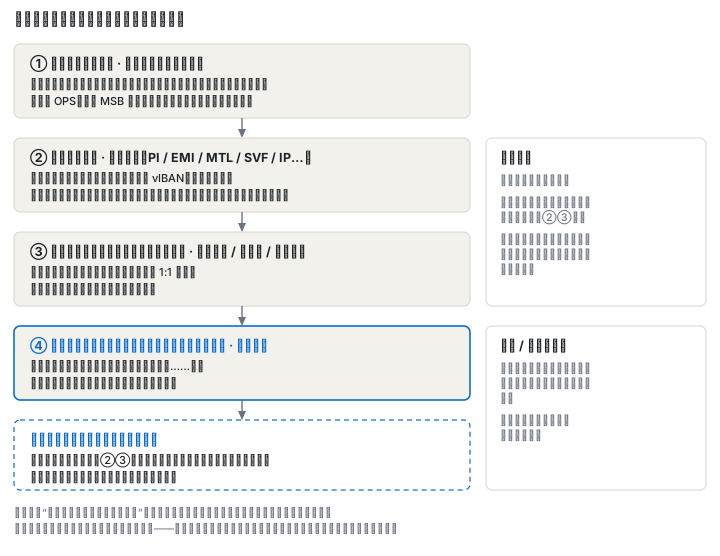
The ①②③④ on the picture are the four tiers of the yardstick in Rule 1 below. Fix their relative positions in your head now: you will use them to read the three rules, and every product chapter after that. The dashed box at the bottom is not a fifth tier — clearing access hands out no licences, it only recognises them. Come back to this picture while reading the product chapters. Once you see which tiers a company occupies, the difference between licence portfolios is obvious at a glance.
This is also where the course's coordinate vocabulary gets fixed for good, and every licence map ahead uses the same one: a jurisdiction is a row, a licence category is a column, the intersection of the two is a cell, and ①②③④ are tiers — a tier is a height on this picture and has nothing to do with rows or columns. The full 10 jurisdictions × 6 categories grid, every cell filled in, sits in Appendix A at the end of this chapter: for looking things up, not for reading through.
4. Three Rules for Reading the Map
The three rules are the whole map, compressed, and they are what this chapter actually wants you to leave with. Their evidence is scattered across the ten jurisdiction sections of the next chapter; they stand here first so that you read the detail with a yardstick already in hand.
Rule 1: a licence's weight = what you may do with client money
Put every licence from all ten jurisdictions side by side and one four-tier yardstick surfaces — the same four layers as the picture above, with the regulatory form and the real examples filled in here:
| Tier | What you may do with client money | Regulatory form | Examples from the ten jurisdictions |
|---|---|---|---|
| ① Pass instructions only, never touch the money | The money never passes through your hands | Registration or filing is enough | Philippine OPS (operator of payment system registration), US MSB registration (a FinCEN AML filing — federally there is registration but no licence), EU payment initiation and account information services (PIS/AIS) |
| ② Hold client funds | Money passes through and rests with you: client funds are pooled into a segregated account the platform opens at a bank in its own name, and transfers between users settle with an entry on the platform's own ledger without ever touching bank rails. The money itself may not be diverted or lent out | Payment licence | EU/UK PI/EMI, Singapore MPI/SPI, Brazil IP, Philippines EMI, Hong Kong SVF, Mainland China payment business licence, US MTL, plus Argentine PSP and Swiss SRO registration (tier ② in registration form: no capital review, but the money genuinely passes through) |
| ③ Take deposits or hold in custody, but do not lend | The money comes onto my balance sheet (or into my custody), but is never put at risk | Light banking licence / special-purpose licence | Swiss FinTech licence, US national trust bank charter, GENIUS stablecoin licence, Hong Kong stablecoin licence, UK qualifying stablecoin issuance |
| ④ Take deposits and lend | Lend depositors' money out and earn the net interest margin | Full banking licence | The banking licence in all ten jurisdictions |
There is only one logic behind this yardstick: supervisory intensity tracks who gets hurt when the money goes wrong, and how far the damage spreads. At ① no money can be hurt. At ② the firm can fail and the money is still sitting in the segregated account. At ③ the money is on my balance sheet, but a 1:1 reserve stands behind it (in custody form it never reaches my balance sheet at all). At ④ there is a maturity mismatch — deposits are callable on demand, loans come back over years — so if depositors all come for their money at once (a bank run), the bank cannot sell its long-dated assets fast enough and goes under, taking the banks that lent to it down with it. Which is why tier ④ carries capital adequacy ratios, deposit insurance and central bank supervision, the full set.
What you can do with client money is that logic's workable proxy: the act sets how far the damage can spread, so asking about the act is enough to place a licence on the ladder.
The two crypto columns are not a fifth tier. They are the same yardstick moved from fiat to crypto. Crypto-asset services are a variant of ② and ③, holding and moving assets for other people. Crypto issuance is issuing a balance: the user hands money in, and the institution writes an entry on its own ledger that the user can hold indefinitely and spend with any third party at any time. In the fiat world that act is called issuing e-money; on-chain it is called issuing a stablecoin. The regulator is looking at the same thing either way. Jurisdictions put stablecoin issuance on different rungs — the EU pushes it into the tier ② EMI framework (or demands bank status), Switzerland treats it as deposit-taking under ③/④ logic, and the US, the UK and Hong Kong have built a purpose-made ③ — but all of them sit on this yardstick.
The yardstick works just as well on licences that are not in the grid: meet an unfamiliar one, ask what it lets you do with client money, and whichever tier that answer lands in is the tier. The UAE's stored value facility licence = tier ②. A trust charter in any country = tier ③.
The yardstick's exceptions land, as it happens, by that same logic. A lending licence never touches client money, only its own, and if it fails only its shareholders are hurt — on the who-gets-hurt test it ranks alongside ①. But it handles something different from ①: tier ① handles other people's instructions, a lender handles its own capital. So this course gives it a column of its own rather than folding it into ①. The securities licence steps outside the yardstick altogether — it governs investment products rather than payment money, on a different regulatory logic, and this course does no more than name it.
Rule 2: a licence's geographic reach = how integrated the regulation is
One EU licence works across about 30 countries, which is passporting. The other nine jurisdictions run one licence per country. In the US a bank charter is valid nationally, while the payment licence shatters into one per state. The crypto columns obey the same rule: CASP passporting across 30 countries is the only arrangement of its kind in the world, and it stops dead at the EU border — Banking Circle's CASP authorisation has no force in the UK, the US, Singapore or Hong Kong, each of which has to be applied for separately.
The corollary is where you domicile. Picking a jurisdiction is a leverage game: Banking Circle set up in Luxembourg and Revolut started on a Lithuanian licence, both spending one country's supervisory cost to pry open a 30-country market. In the other direction, national coverage in the US comes down to two ready-made routes: assemble MTLs state by state (the route Wise and Bridge took), or trade on a licensed bank's status — issue cards on the bank's BIN (the card number range, the BIN sponsor model) and run pay-ins and pay-outs through a partner bank (the route most card-issuing fintechs take). A third route exists in theory: get or buy a banking licence of your own. It has the highest bar, and none of the seven companies in this course use it to cover the US.
Rule 3: the clearing door is sinking
Central bank clearing access hands out no licences, it only recognises them — what a product holds decides how many layers it sits from the central bank. The global storyline of the past decade has been doors opening: direct participation, once reserved for tier ④ banks, handed down to the light licences at ② and ③.
| Year | Jurisdiction | Door opened | Opened to |
|---|---|---|---|
| 2018 | UK | FPS, instant retail clearing | Non-bank PIs and EMIs — the world's first, and Wise was first through it |
| 2018 | Hong Kong | FPS (Faster Payment System), instant retail clearing | Holders of the SVF licence |
| 2019 | Switzerland | SIC — not a retail side rail, but the central bank clearing system itself | Holders of the FinTech licence (tier ③) |
| 2020 | Brazil | PIX instant payments | Licensed IPs, with a central bank settlement account to match |
| 2021 | Singapore | FAST / PayNow retail instant clearing | Major payment institutions (MPIs) |
| 2025 | EU | T2 large value / TIPS instant | PIs and EMIs |
Two exceptions make a neat control group. The US does not open the door: a Federal Reserve master account is still restricted to depository institutions, and neither an OCC national trust bank charter nor the coming GENIUS stablecoin licence gets you one — which is why US payment innovation grew on top of the borrow-a-bank model. Mainland China went the other way and shut a door that was already open: the 2018 severing of direct connections pushed payment institutions that had wired themselves straight into banks back behind a single clearing intermediary, NetsUnion or UnionPay. The goal was not efficiency, it was control.
The corollary: opening the door raises what a light licence is worth. The ladder itself has not changed, but the distance between tiers ②/③ and tier ④ is closing. The Swiss FinTech licence (tier ③, with Fiat24 participating directly in SIC) and the Hong Kong SVF (tier ②, participating directly in FPS) prove that light-licence direct participation runs stably. Nobody climbed up into the clearing layer; the clearing layer's threshold came down to where the players already stood.
5. Wrapping Up
The body of this chapter gave you three things: plain-language definitions of the six columns, one picture of how money is layered, and three rules for reading the map. The rules are for remembering; the 10×6 grid in Appendix A is for looking things up — and the next chapter takes that grid apart row by row — ten jurisdictions, and for every licence the regulator, what it lets you do, where it stops, and who holds it. Every ✅ and ❌ in the product chapters is grounded there.
Appendix A: The Reference Grid, 10 Jurisdictions × 6 Categories
For looking things up, not for reading through: to find out what licence a given line of business needs in a given place, take the jurisdiction row and the category column and read the one cell. Each cell gives the licence name and a one-line placement, and acronyms are spelled out where they first appear. The full treatment of every licence is in the next chapter. Every cell in the clearing column answers the same question: who is allowed through the door.
| Jurisdiction | Banking licence | Central bank clearing access | Payment licence (including e-money) | Crypto-asset services | Crypto issuance | Lending and securities |
|---|---|---|---|---|---|---|
| EU | Credit institution licence (one licence, passportable across about 30 countries) | Banks participate directly in euro clearing (T2 for large value, TIPS for instant); since 2025 the threshold has sunk to the PI/EMI payment licences | Payment institution (PI) licence / e-money institution (EMI) licence, two of them (merging around 2028) | Crypto-asset service provider (CASP) authorisation (under MiCA, the EU crypto-asset regulation; also passportable across about 30 countries) | E-money token (EMT) issuance (you must already be a bank or an EMI) | MiFID investment firm licence (the EU securities-markets law); consumer credit is left to each member state |
| UK | Banking licence (granted by the PRA, the prudential regulator; new banks start in mobilisation, a restricted opening period) | Banks participate directly; in 2018 the threshold sank to the PI/EMI payment licences — the world's first non-bank direct participation in an instant clearing system, FPS (Faster Payments) | PI / EMI (inherited from the old EU regime) | Authorisation by the FCA, the conduct regulator (transition running 2026–2027) | Qualifying stablecoin issuance sits with the FCA; anything designated systemic is co-supervised with the Bank of England | FCA consumer credit authorisation; investment business also sits with the FCA |
| Switzerland | Full licence (Banking Act Art. 1a) / light FinTech licence (Art. 1b) | Banks participate directly in SIC, the Swiss interbank clearing system; in 2019 the threshold sank to the light FinTech banking licence | No dedicated licence — the most you get is registration with an SRO (a self-regulatory AML body); the reform proposes creating one | SRO registration plus a DLT (distributed ledger) trading facility licence | No dedicated licence — issuing a stablecoin is treated as deposit-taking, which lands you back on the banking or FinTech licence | Securities firm licence (FinIA, the Financial Institutions Act); consumer credit licence |
| US | Dual track of national and state bank charters; national trust bank charters as well | Only depository institutions can open a Federal Reserve account (Fedwire for large value, FedNow for instant); the door has not sunk, and non-banks all route through a bank | No federal licence — a money transmitter licence (MTL) is filed state by state across nearly all 50 states; federally there is only FinCEN's MSB registration for AML | State MTLs / New York's BitLicense (the heaviest crypto licence at state level) | Issuer licence under GENIUS, the 2025 federal stablecoin act (still being stood up) | Broker-dealer licence; lending is licensed state by state |
| Singapore | Full bank / wholesale bank / digital bank (retail DFB, wholesale DWB) | Banks participate directly in MEPS+, the central bank's large-value system; in 2021 retail instant clearing (FAST/PayNow) sank to the MPI payment licence | Major payment institution (MPI) / standard payment institution (SPI) licence, one licence covering seven activities | Digital payment token (DPT) services (ticked inside the payment licence) plus the DTSP licence, which covers firms serving overseas customers only | SCS single-currency stablecoin framework (legislation not yet in force [?]) | Capital markets services (CMS) licence; moneylender's licence |
| Hong Kong | Three-tier banking licence (a digital bank is a licensed bank in fully digital form) | Banks participate directly in the central bank's RTGS (real-time gross settlement); in 2018 instant clearing through FPS (Faster Payment System) sank to the SVF licence | Stored value facility (SVF) licence plus money service operator (MSO) licence, for currency exchange | Virtual asset trading platform (VATP) licence, granted by the SFC, the securities regulator | Stablecoin issuer licence (first two granted in April 2026) | Money lenders licence; SFC regulated activities Types 1–13 |
| Mainland China | Banking licence (granted by the NFRA, the national financial regulator); includes the private-bank track | Banks participate directly in CNAPS, the central bank's payment system; the door swung shut instead — payment institutions must route through NetsUnion or UnionPay | Payment business licence (two categories: stored-value account operation, and payment transaction processing) | Banned outright (since 2021) | Banned; the digital yuan is run by the central bank itself | Microlending and consumer finance licences; securities sit with the CSRC |
| Brazil | Multiple-service bank / commercial bank licence | Banks participate directly; in 2020 instant clearing through PIX sank to the IP payment licence, with a central bank settlement account to match | Payment institution (IP) licence, one licence with four authorisations | Virtual asset service provider (PSAV) licence (application window open in 2026) | No issuance licence; cross-border use of crypto has been folded into FX controls | SCD direct credit companies / SEP peer-to-peer lending platforms; securities sit with the CVM, the securities regulator |
| Argentina | Banking licence (granted by the BCRA, the central bank) | Direct participation is limited to licensed financial institutions; the door has not sunk, and CVU (a uniform virtual account address) is used instead to hang PSP accounts off the national transfer network | Payment service provider (PSP) registration (a filing only, with no capital review) | PSAV registration (with the CNV, the securities regulator; since 2024) | No framework | Non-financial credit provider registration; securities sit with the CNV |
| Philippines | Universal / commercial bank plus digital bank licence (capped at 10 in total) | Banks participate directly in PhilPaSS, the central bank's system; retail clearing — InstaPay (small-value instant) and PESONet (batched, next day) — is open to EMIs | E-money issuer (EMI) licence plus operator of payment system (OPS) registration | Virtual asset service provider (VASP) licence from the BSP, the central bank (currently frozen), plus the SEC, the securities regulator, for investment-type tokens | No dedicated licence | Financing and lending company licences; trust licence (BSP) |
Appendix B: Reading and Marking Conventions
The conventions in this section hold across the whole course, Chapter 10 included.
The course works with the same ten jurisdictions throughout: the EU, the UK, Switzerland, the US, Singapore, Hong Kong, Mainland China, Brazil, Argentina and the Philippines. Chapters 2–3 and 5–9 are the product chapters, and each follows the same skeleton: what the product does → its licence map → a user story, walking one specific customer through one complete flow → a summary of the advantages. Banking Circle, Wise and Revolut each add a section on shifts in product positioning after that skeleton, and Fiat24 closes with a wrap-up of the whole course. Chapter 4 compares four companies side by side and Chapter 10 is an appendix indexed by customer scenario; neither follows the product-chapter skeleton.
The licence map in a product chapter uses the same 10 jurisdictions × 6 categories skeleton as the grid in this chapter, with a mark in every cell:
| Mark | Meaning |
|---|---|
| ✅ | Held, and the prose says how the business uses it |
| ❌ | No licence record found in public sources (which is not proof there is none) |
| 🟡 | Applied for / under review / in transition |
| covered | The capability in this cell is already covered by a heavier licence in the same jurisdiction, so no separate licence is needed — coverage, not a gap. Two forms: the jurisdiction does issue the lighter licence but a heavier holder need not apply for it (a banking licence is a superset of a payment licence); or the jurisdiction never created the licence at all and the capability sits inside the heavier one (Switzerland has no payment licence, and moving money is covered by the banking or FinTech licence). Both forms share one precondition — the holder really does hold that heavier licence in that jurisdiction. If it does not, the cell is ❌ |
Facts are marked at four levels of reliability:
| Mark | Meaning |
|---|---|
| No mark | Traceable to an official source — a regulator's website, the text of the law, or a supervisory register |
| [reported] | Reported by the press, with no official statement from the regulator or the company involved |
| [inferred] | Assembled from facts that have been verified individually; the conclusion itself has no direct source |
| [?] | Awaiting confirmation — not found in public sources, or in doubt; the Open questions list at the end of each chapter says which |
Acronyms used throughout the course, not re-glossed in each chapter's tables:
| Acronym | Full name, in one line |
|---|---|
| PI | Payment institution licence (EU/UK): collect and pay out for customers; money may pass through briefly, but no balances may be issued |
| EMI | E-money institution licence (EU/UK/Philippines): everything a PI can do, plus issuing balances and cards; client money must be segregated 1:1 and never lent |
| MTL | Money transmitter licence (US): receive and move money for customers, licensed one state at a time |
| MPI / SPI | Major / standard payment institution licence (Singapore): one licence, seven activities ticked as needed, two size bands |
| SVF | Stored value facility licence (Hong Kong): issue wallet balances and stored value cards |
| IP | Payment institution licence (Brazil): four authorisations combined as needed, including issuing e-money balances |
| CASP | Crypto-asset service provider authorisation (EU MiCA): custody, trading and exchange of crypto-assets |
| EMT | E-money token issuance (EU MiCA): issue a stablecoin pegged to a single fiat currency; the threshold is being a bank or an EMI first |
| VASP / PSAV | Virtual asset service provider licence (Philippines / Brazil and Argentina): the local counterpart to a CASP |
| SCD | Direct credit company licence (Brazil): a light licence for lending own capital, with e-money issuance attached |
| ADI | Authorised deposit-taking institution (Australia): Australia's banking licence |
| BIC / IBAN | Bank identifier code / international bank account number: how an institution and an account are identified in cross-border messaging |
Written as of 2026-08-03. Licensing regimes are live things, and the text separately flags the status of the reforms in flight (the EU's PSD3, the Swiss FinIA amendment, the GENIUS rulemaking in the US, the UK crypto authorisation regime). The facts in this chapter — licence names, regulators, statutory limits on what each licence can do, clearing access rules — come from the regulators' own websites and the text of the law. Sources are given line by line in the ten jurisdiction sections of the next chapter, and are not repeated here.
Previous: (none — this is the starting point) Next: Chapter 1 · Ten Jurisdictions in Detail: What Each Licence Lets You Do