Wise: Eighty Light Licences Stitched into One Network
Part II · Products (Chapters 2–9) Builds on: Chapter 0 (what each of the six columns covers, the marking conventions, Rule 3 — the clearing door is sinking); question two in the EU section of ten jurisdictions in detail — the line between a PI and an EMI New concepts in this chapter: the central bank gateway, the program bank, correspondent services
1. What It Does
Wise (founded 2011 as TransferWise) started in consumer cross-border remittance, and the mechanism fits in a line: local in at one end, local out at the other, netted in the middle. A UK customer pays pounds over UK local clearing into Wise's UK account; the family in Brazil is paid reais out of Wise's Brazilian account over Brazilian local clearing. Two local payments cancel out one cross-border remittance — no money crosses the border, only an entry on Wise's own ledger does. What that mechanism is worth depends entirely on how deep the local end goes at each end, which makes Wise's story, at bottom, a history of collecting licences and getting into clearing systems.
Five product lines: consumer remittance; the multi-currency account (balances in 40 currencies plus local receiving details in a dozen or so countries); the Wise debit card; Wise Business (business accounts and batch payouts); and Wise Platform, which wholesales all of the above to banks and corporates — Monzo's international transfers are rented from Wise. Two further features, Interest and Stocks, belong in the lending and securities column; this chapter marks them on the map and goes no further. Its own numbers: 80+ licences and registrations worldwide, and direct connections into 9 clearing systems.
One exclusion matters: Wise does not touch crypto. Its published policy bans using a Wise account to buy or sell cryptocurrency, and it is the only one of the seven companies in this course with both crypto columns empty (it has been advertising for a stablecoin product lead since 2025-10, so the position may be softening [reported]; section 5 opens that crack up).
2. Wise's Licence Map
Start with where it holds the licences — not one patch of dark shading anywhere, and nine clearing marks:
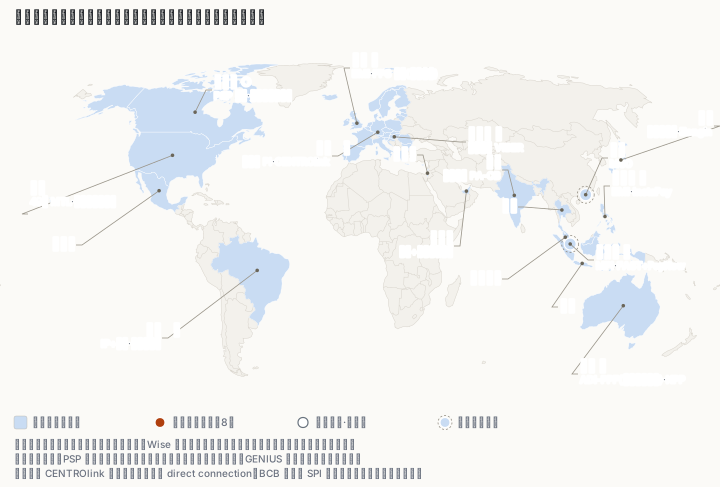
The marking conventions carry over from Appendix B of the licence overview: ✅ held, ❌ no licence record found in public sources, 🟡 applied for or in transition, covered = covered by a heavier licence. Anything unknown is written [?] and goes into the list at the end of the chapter. The world map legend: dark = banking licence, light = payment licence (including e-money), striped = applied for or in transition, ◉ = direct participation in central bank clearing.
| Jurisdiction | Banking licence | Central bank clearing access | Payment licence (including e-money) | Crypto-asset services | Crypto issuance | Lending and securities |
|---|---|---|---|---|---|---|
| EU | ❌ | ✅ SEPA through CENTROlink, the Bank of Lithuania's gateway; direct participation in Hungary's VIBER/GIROInstant (2020) | ✅ Belgian payment institution (PI) licence (Wise Europe SA) | ❌ | ❌ | ✅ Estonian investment firm licence (Wise Assets Europe) |
| UK | ❌ | ✅ Direct FPS participation plus a Bank of England settlement account (2018-04, the first non-bank anywhere) | ✅ E-money institution (EMI) licence (Wise Payments Ltd, FCA 900507) | ❌ | ❌ | ✅ Wise Assets Ltd (FCA) |
| Switzerland | ❌ | ❌ | ❌ (customers are most likely served by the UK entity [?]) | ❌ | ❌ | ❌ |
| US | ❌ (the OCC refused its trust charter on 2026-07-23; a refiling under the GENIUS framework is planned 🟡) | ❌ (no Fed access; in states where it is unlicensed it rides its partner bank, CFSB) | ✅ MTLs across 48 states and 4 territories; FinCEN MSB registration | ❌ | ❌ | ❌ (Interest runs on program bank deposits: client money is swept into a partner bank to earn interest, which is not a security) |
| Singapore | ❌ | ✅ Direct FAST connection (2022-02); PayNow (2025) | ✅ MPI (Wise Asia-Pacific) | ❌ | ❌ | ✅ Capital markets services (CMS) licence |
| Hong Kong | ❌ | ❌ | ✅ MSO (Customs and Excise) | ❌ | ❌ | ❌ |
| Mainland China | ❌ | ❌ | ❌ (inbound transfers run through a licensed partner's channel [reported]) | ❌ | ❌ | ❌ |
| Brazil | ❌ | ✅ Direct Pix connection (its own claim; its standing on the SPI register is [?]) | ✅ Payment institution (IP) licence including e-money issuance, plus an FX broker licence | ❌ | ❌ | ❌ |
| Argentina | ❌ | ❌ | ❌ | ❌ | ❌ | ❌ |
| Philippines | ❌ | ✅ Direct InstaPay participation plus a BSP settlement account (2024-11) | ✅ EMI + RTC (remittance and transfer company) + OPS (Wise Pilipinas) | ❌ | ❌ | ❌ |
Outside the table, what matters beyond the ten jurisdictions: Australia, an ADI-PPF (a purpose-restricted class of deposit-taking institution) plus direct NPP participation (2021, the first fintech); Japan, Type I and Type II funds transfer service registrations plus Zengin access (approved 2024, live 2025-11, the first non-bank, with a Bank of Japan settlement account to match); Canada, RPAA registration with the central bank plus membership of Payments Canada in its first PSP intake (2026-01); Thailand, five licences (2026-03, the first non-bank [reported]); the UAE, stored value plus retail payment licences (2025-10); India, a PA-CB cross-border payment aggregator authorisation; and Malaysia, Mexico, Indonesia and Israel among others.
The map reads three ways.
First, the empty banking column is a choice, not a gap. Wise deliberately does not become a bank — no deposits, no lending, and the whole business model sits on fees and the FX spread. What it did take is the thing that traditionally only banks had: direct participation in clearing. Its own "9 clearing systems" figure covers three arrangements that are not equally heavy, and unpacks as seven plus one plus one. Seven are seats it took itself — UK FPS, Hungary's VIBER, Australia's NPP, Singapore's FAST, the Philippines' InstaPay, Japan's Zengin and Brazil's Pix. The eighth is the euro area, reached through CENTROlink, the Bank of Lithuania's gateway, rather than a seat of its own inside T2. The ninth is membership of Payments Canada in its first non-bank intake, and membership is a standing rather than a clearing system — so it is a ticket in hand rather than a connection already running. Where the text below says "nine points of access", it means all three arrangements together. Four of them made Wise the first non-bank in the world or in the country: UK FPS (the world's first), Australia's NPP, the Philippines' InstaPay and Japan's Zengin. It is the biggest beneficiary of Rule 3, the clearing door sinking, and one of the forces pushing it: whenever a door opens, the first through it is usually Wise.
Second, the payment column comes in every shape there is, which makes it a live specimen of how far the ten jurisdictions diverge. One and the same multi-currency account: the UK entity runs it as an EMI (a stored-value balance), the EU entity as a Belgian PI (an account-shaped payment account, with no top-up mental model allowed), the US as a 48-state MTL jigsaw, Singapore as an MPI with the boxes ticked, Hong Kong on nothing but an MSO exchange registration, Brazil on an IP plus an FX broker licence, and the Philippines on a heavy EMI position. Question two called the PI/EMI line thin enough for one company to stand on both sides of it — the company standing on both sides is Wise.
Third, the US row needs reading on its own. Forty-eight state MTLs, one per state, examined every year: this is what Rule 2 — a licence's geographic reach tracks how integrated the regulation is — looks like in America, a jigsaw assembled state by state. A six-state consent order in 2025-07 (AML deficiencies, a USD 4.2 million penalty) exposed what the jigsaw route costs in compliance. On 2026-07-23 the OCC refused Wise's national trust bank charter application, again citing AML deficiencies, and Wise stated it would refile under the GENIUS framework. The application was widely read as a run at Fed clearing access [reported] — but note the conclusion of the US section in ten jurisdictions in detail: a trust charter does not get you through the Federal Reserve's door. All it buys is the standing to argue for a settlement account as a federally chartered institution, not the access itself. Circle was granted the same national trust bank charter on 2026-07-10 — for the contrast, see Circle.
How Each Licence Gets Used
UK EMI plus direct FPS participation (2018) — the flagship pairing: the EMI issues balances and cards, while direct FPS participation and a Bank of England settlement account make every sterling payment in or out a local transfer in seconds, with UK account details (sort code and account number) available on demand.
CENTROlink (the euro area) — the payment gateway run by the Bank of Lithuania: a non-bank PSP reaches every SEPA scheme through it, instant credit transfers (SCT Inst) included, and settles through the Lithuanian central bank. It is a third shape sitting between direct participation and routing through a bank — you neither take a seat in T2 yourself nor hang off a commercial bank, you rent the central bank's gateway. New ECB rules in 2025 require indirect participants to convert to direct participation within a set period; whether Wise Europe has moved to direct TIPS participation has not been announced [?].
Direct participation with the Hungarian central bank (2020) — the first direct participation case inside the EU: an MNB settlement account plus GIROInstant and VIBER, the foundation under local forint account details. Which shows that the EU row is no solid block either: the euro area goes in through CENTROlink, and the non-euro currencies are entered country by country.
US 48-state MTLs plus CFSB — coverage as a service: in states where it holds no licence of its own, Wise trades on the charter of Community Federal Savings Bank (CFSB), a New York bank. Clearing runs through the partner bank end to end, which is the other reason the trust charter application was widely read as a run at Fed access [reported].
Brazil's two licences plus Pix — the payment institution licence (which carries the e-money issuance authorisation) lets it issue local accounts in Brazil, the FX broker licence keeps real conversion compliant, and the direct Pix connection (fully live in 2025) turns the Brazilian leg into an instant local transfer.
A heavy licence position in the Philippines — EMI plus the RTC remittance and transfer company licence plus OPS registration plus direct InstaPay participation plus a BSP settlement account; in 2024-11 it became the first global fintech fully connected to the Philippine payment system. This is what going deep on licences in a remittance destination country looks like.
3. User Stories
1. Consumer remittance: local at both ends, no messages in the middle. As a Brazilian working in London, I want to send my family in São Paulo the real equivalent of £500 every month, so that they have it the same day and I do not lose a slice to every intermediary bank on the way. The money's path: I pay pounds over FPS into Wise's UK account (EMI plus direct FPS participation) → Wise nets it on its own ledger → Wise's Brazilian entity pays reais to my family over Pix (IP licence plus the direct Pix connection). Both ends are instant local transfers, with no SWIFT message and no correspondent bank.
2. Freelancer: local account details that collect money worldwide. As a designer taking work from US and European clients, I want a US ACH account number, a UK sort code, a euro IBAN and an Australian BSB (bank-state-branch, the Australian routing number), so that clients pay me the way they pay a domestic supplier and I convert and withdraw in one go afterwards. Outside the US, behind each set of local details sits one local payment licence plus one clearing connection — local account details are direct participation turned into a product. The US set is the exception: Wise has no clearing access there, and the ACH number is the partner bank's.
3. A bank renting the network: Wise Platform. As a neobank with no intention of building cross-border capability of its own (a Monzo), I want to embed Wise's remittance engine in my app, so that my users send money at Wise's prices and speeds inside my interface while I never have to get licensed in 40 countries. — Wholesaling 80 licences and 9 direct connections to institutional customers is how a retail company grew an infrastructure business. The difference from Banking Circle: BC wholesales the parts of a banking licence, Wise wholesales one complete capability, remittance.
4. Summary of Advantages
- Depth of access: the deepest set of clearing connections any non-bank holds anywhere — seven direct participations, one central bank gateway and one membership, four of them firsts. Every direct participation is a structural cost advantage: no intermediary banks, money in seconds, liquidity you can see.
- Breadth of light licences: the 80+ licences sit almost entirely at tiers ① and ② (registrations and payment licences), the heaviest of them being Australia's purpose-restricted deposit-taking authority (ADI-PPF), and not one is a banking licence that could lend — 40+ currencies covered at the lowest regulatory capital cost available. The compliance jigsaw across forty-odd regulators is itself the barrier to entry for whoever comes next.
- A self-consistent model: take no deposits and you carry no prudential supervision; revenue comes entirely from fees and the spread, and transparent pricing becomes the brand. The price is that there is no net interest margin to earn — and the US Interest feature routes around that through an arrangement built on program banks (the term is literal: partner banks that provide the receiving accounts for a particular money programme): Wise sweeps client money into a partner bank (JPMorgan) where it earns interest, with deposit insurance passing through to each end user by name. A textbook case of product design inside a licence constraint.
- The limit is the US: no banking licence and no trust charter, with the trust application refused in 2026-07 — so the ticket that would let it argue for a Federal Reserve settlement account is still missing, and the cost of maintaining a jigsaw examined annually across nearly 50 states runs on indefinitely. This is the bill side of Rule 2, geographic reach tracking regulatory integration.
- No crypto: both crypto columns empty. This network is the proof that instant multi-currency payment works without stablecoins — which also makes it the strongest control group against the stablecoin story of cheap, fast cross-border.
5. Three Shifts in What It Claims to Be (2023 to Now)
The four sections above are a snapshot; this one reads the direction of travel. Wise has changed its external claim three times in three years, and the three map onto three older postures: towards correspondent banking, replace it; towards the Federal Reserve's door, wait for it; towards crypto, ban it. Since 2023 each posture has given ground: from replacing correspondent banking to carrying it, from waiting for the Fed's door to open to knocking on it, and from an outright crypto ban to planning the next licence under a stablecoin statute.
5.1 Correspondent banking: from the old plumbing it routed around to a source of customers
Start with the old business itself. When a bank has to pay out a currency it holds no clearing access for, it sends the payment instruction as a SWIFT message to a bank that does have that access and with which it keeps an account, and that bank puts the money down locally. The bank running that errand for another bank is the correspondent bank. Chains of them, each forwarding and each taking a cut, are where slow and expensive cross-border payments come from. Wise's founding mechanism — split one cross-border remittance into two payments that each land locally, and net them off on its own ledger — exists precisely to route around that chain: the line in user story 1 above, "no SWIFT message and no correspondent bank", describes the road it built for consumers.
The shift came in 2023-09, when Wise Platform and SWIFT announced a partnership at Sibos, SWIFT's annual conference, with a product called Correspondent Services. A bank changes no systems and no message standards, only one routing configuration: the SWIFT payment message goes out as before, but lands on Wise, and the final delivery runs through Wise's own network — seven directly participated rails plus the euro gateway, with partner banks covering the rest. Wise writes back the SWIFT gpi payment status, so the sending bank keeps end-to-end visibility. Its own figures: 57% of payments delivered instantly, 94% within 24 hours.
The claim widened from "I route consumers around correspondent banking" to "I will be your correspondent bank" — the messaging layer stays with SWIFT, the money layer becomes Wise's own network. Set that against Wise Platform in section 3: the wholesale customer widened from the neobank that never wanted to build cross-border capability to the incumbent bank that never intended to leave SWIFT, and the new customers named in the last two annual results — Morgan Stanley, Standard Chartered, Itaú, Raiffeisen — are the footnote to that widening. The website's own positioning today, "the network for the world's money", points the same way. What this means for a reader: to judge the ceiling on this infrastructure business, do not count the fintechs it has signed. Count the incumbent banks that have handed it the final delivery leg of their SWIFT traffic. The first substitutes the existing stock; the second grows on top of it.
5.2 The US: from borrowing a partner bank forever to knocking on the Fed's door
Section 2, reading three, gave the facts; this one reads the direction. Wise's set of direct connections makes it the largest beneficiary of Rule 3, the clearing door sinking: in the UK, Australia, the Philippines and Japan it waited for — and pushed — each system to open to non-banks, then walked in first. The US is the one place that route fails. The Federal Reserve's door shows no sign of sinking towards non-banks, and Wise has borrowed a partner bank for dollar clearing for over a decade.
In 2025-06 it changed stance and filed with the OCC for a national trust bank charter, to be called Wise National Trust, N.A. A trust charter takes no deposits and makes no loans; it is the lightest thing that still counts as a bank. Read the choice this way: Wise was willing to put on a bank's coat to reach clearing, but cut the coat as thin as it would go — the business model of taking no deposits and earning fees and spread was not conceded by an inch. The outcome is in section 2: refused on 2026-07-23. In the meantime the Federal Reserve had proposed, in 2026-05, pausing master account applications from uninsured trust banks, which leaves the far end of this road suspended as well [reported]. What matters is the move after the refusal: not a retreat back to waiting, but a statement that it will refile under the GENIUS framework (no filing date given; it goes in the Open questions list).
The claim moved from "wait for the door to sink" to "reshape yourself far enough to reach the door, and not one inch further". Two things follow for a reader. First, Rule 3 gains a boundary condition: where the clearing door does not sink, a non-bank has only two options, keep routing through someone else or reshape itself, and Wise is now running both at once — the refusal does not touch the existing business on 48 state MTLs, as its own statement makes plain. Second, the framework it chose to refile under is a stablecoin statute, and that detail pulls the third shift into view.
5.3 Crypto: from an outright ban to planning the next licence under a stablecoin statute
What this shift moves is not a product but one of this chapter's arguments. "No crypto" is not merely a risk policy at Wise: advantage 5 in section 4 says this network proves instant multi-currency payment works without stablecoins, which makes it the strongest control group against the stablecoin story — and that argument holds only if Wise really touches none. So weigh the two facts below by whether the control-group status survives.
There are only two, and they point the same way. The light one: in 2025-10 Wise advertised for a digital assets product lead, with the role scoped to include letting customers hold digital assets in their Wise account [reported] — a statement of intent, not a product. The heavy one: in 2026-07, after the trust charter was refused, Wise said it would refile under GENIUS. GENIUS — the federal stablecoin statute covered in the US section of ten jurisdictions in detail — regulates exactly one kind of firm: the issuer of a payment stablecoin, on issuance, 1:1 reserves and redemption at par. Filing under that statute means filing for the status of stablecoin issuer. The statement named no product, but whatever Wise eventually does with that status, it cannot get there without issuing and holding stablecoins itself.
In one line: the ban is still posted (the help page is unedited), while the licence route is already being laid on the assumption of touching coin — which makes "no crypto" a state with an expiry date rather than a principle that will not change. What this means for a reader: when citing Wise as evidence that cross-border works without stablecoins, timestamp the claim. Two signals mark the expiry — when that help page gets rewritten, and when the GENIUS filing actually goes in. Set it against Revolut: in the same window it has already put a sterling stablecoin of its own into a UK regulator's controlled trial. Two companies that both started in retail — one has just cracked its ban open, the other is standing at the issuer's door.
6. Open Questions
- How Wise participates in Brazil's Pix: whether the BCB register shows it as a direct participant or as one going through a settlement representative [?].
- Whether Wise Europe has converted to direct TIPS/T2 participation under the new ECB rules [?].
- Which entity serves Swiss customers — inferred to be the UK one, with nothing official saying so [?].
- When the refiling with the OCC goes in, and what form of licence it takes under the GENIUS framework.
- The US MTL state count moves; at the time of writing the official page said 48 states plus 4 territories.
7. Sources
- Wise's own regulatory list (entities and licence numbers by jurisdiction), its US state licence page
- UK FPS direct participation and the euro connection (company blog), the Hungarian central bank direct access announcement
- Singapore FAST access announcement (2022), Philippine InstaPay direct participation announcement, Japan Zengin approval announcement, Australia NPP (AP+)
- Brazilian payment institution licence (company blog), full Pix functionality goes live (company blog)
- The OCC refusal, decision CD#1381, the six-state consent order (Texas 2025-013), the refiling statement (SEC Form 6-K)
- Wise's position on cryptocurrency, the Assets licence page, how the program banks behind US Interest work
- For section 5: the SWIFT partnership announcement, Wise side (2023-09), SWIFT's own release, the trust charter application as published by the OCC (Wise National Trust, N.A.), FY2025 results (the Platform bank customers by name), FY2026 results, the digital assets product lead posting (Cointelegraph, 2025-10) [reported], the master account proposal and the background to the refusal (Banking Dive) [reported]
Previous: Chapter 2 · Banking Circle: The Heaviest Licence in Every Jurisdiction Next: Chapter 4 · Customer Distribution: All Licensed, Yet Serving Entirely Different People