Buy Now, Pay Later: Why Merchants Accept Double the Card Fee
Part III · The Same Rails, Wearing Other Form Factors (Chapters 8–10) Builds on: Chapter 7 (the cheaper the rail, the less it can offer), Chapter 9 (flat per-transaction fee and ad valorem fee) New concepts in this chapter: buy now, pay later (BNPL), soft credit, conversion rate and basket size, adverse selection
1. The Question the Previous Chapter Left Open
Every local method so far has been accepted by merchants for the same reason: it is cheaper. iDEAL costs twenty or thirty euro cents a payment. Pix runs an order of magnitude under cards. UPI is simply zero.
Now look at something that runs the other way.
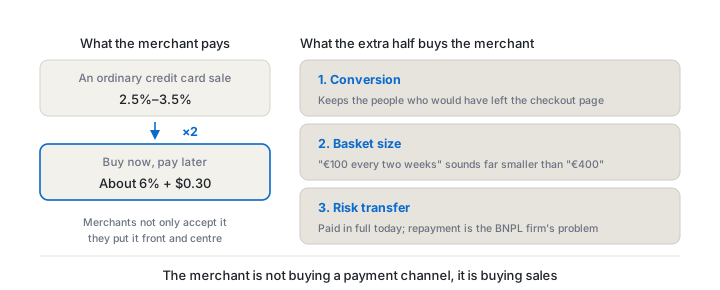
Buy now, pay later (BNPL) charges merchants roughly twice what a card does.
| Method | Merchant cost |
|---|---|
| A standard credit card transaction (interchange, network fees, acquirer markup) | 2.5%–3.5% |
| Klarna | 5.99% + $0.30 for most merchants; above $50 million in annual revenue, negotiable down to 3.29% + $0.30 |
| Afterpay | 4.99% + $0.30 |
| Affirm | around 6% + $0.30 |
Merchants not only accept this. They put the button in the most prominent spot on the checkout page.
Why would a rational merchant pay double the fee on the same transaction?
This chapter answers that one question.
2. First, What It Actually Is
The typical shape: you choose it at checkout, pay a quarter on the spot, and the rest comes out in three instalments, one every two weeks. No interest charged to you.
For the consumer: no interest. For the merchant: a very high fee. For the BNPL company: the money comes from the merchant.
That structure matters, because it settles what kind of business this is.
This is not a lending product. It is a marketing product sold to merchants. The consumer pays nothing, so the consumer is not the customer. The merchant pays, so the merchant is the customer. Whatever the BNPL company is selling the merchant has to be worth that 6%.
So what is it selling?
3. What the Merchant Buys First: Conversion
The checkout page is the steepest stretch of the e-commerce funnel. The shopper has already picked the item, already clicked through to pay — and then walks away.
One reason for walking away is very concrete: that price is not available right now, or the shopper does not want to part with it right now.
A €400 coat, to someone on a fixed monthly salary, is a decision worth hesitating over. The same coat at "€100 now, the rest in three payments" clears a much lower bar.
The 6% the merchant pays buys the people who would otherwise have walked.
Run the arithmetic and the trade becomes obvious. Take 100 people arriving at the checkout page:
| Without BNPL | With BNPL | |
|---|---|---|
| Orders completed | 60 people | 66 people (6 more) |
| At €400 an order | €24,000 | €26,400 |
| Fees | 3% = €720 | 6% = €1,584 |
| Net revenue | €23,280 | €24,816 |
€864 more in fees, €1,536 more in revenue. As long as the lift in conversion is large enough, double the fee pays for itself.
That arithmetic rests on one condition: the extra orders have to be genuinely extra — not people who were going to buy anyway and simply switched payment method. This is the hardest thing to establish in any assessment of BNPL, and it is where merchants and BNPL companies fight hardest in negotiation. The conversion lifts quoted across the industry should be read with that doubt attached.
4. What the Merchant Buys Second: Basket Size
The second effect is worth more than the first, and it is more reliable.
Instalments change more than whether you buy. They change how much you buy.
€400 is one number. "€100 every two weeks" is a different number. The second sounds much smaller, even though they are the same thing.
So the same shopper who came in for the €400 coat starts looking at the €600 one — because "€150 every two weeks" still sounds acceptable.
What the merchant is buying is a shift upward in basket size. And this half measures better than conversion does: same catalogue, same customers, and the average BNPL order comes in visibly higher.
Put the two together and you have the consideration for that 6%. The merchant is not buying a payment channel. It is buying sales. A payment channel is negotiated at 2%; a sales tool is negotiated on results — two completely different pricing logics, and the reason BNPL dares to charge what it charges.
5. The Third: Risk Transfer
There is one more layer, easy to overlook.
In a typical BNPL arrangement the merchant is paid in full on the spot, less the fee, and whether the consumer ever repays is the BNPL company's problem.
That hands the entire consumer credit risk out the door. The merchant runs no underwriting, no collections, and carries no bad debt.
Compare it with running instalments yourself: assess the customer, build collections, sit on receivables. The overwhelming majority of retailers cannot do this and do not want to.
So part of that 6% is an insurance premium. What the merchant buys is "I get paid today, and the rest is not my problem."
6. Is the Business Itself Any Good
That covers the merchant side. Now look at the provider.
Klarna listed on the New York Stock Exchange on 10 September 2025, priced at $40, a valuation of $15.1 billion — above the planned $35 to $37 range. It opened at $52 on day one and closed at $45.82.
Two numbers belong next to that:
- Klarna's peak private-market valuation, in 2021, was $45.6 billion.
- As of 18 June 2026, the share price was around $17.66, about 56% below the IPO price.
It listed at a third of its peak, and then lost more than half again.
Why? Take the business apart.
On the revenue side sits the merchant fee. It is high, but it is competitive — Klarna, Afterpay, Affirm and PayPal are all chasing the same merchants, and a merchant can plug in several of them at once.
On the cost side sits bad debt, and here there is a structural problem: adverse selection. People who choose to pay in instalments are, on average, shorter of cash than people who pay in full. By design, this product attracts a larger share of the weaker repayers.
Add funding costs on top. A BNPL company fronts the money to the merchant, and the money it fronts is borrowed. When rates rise, that cost widens directly.
Revenue held down by competition, bad debt and funding costs pushed up by rates and adverse selection — the gap between them is the whole of the profit. It is far thinner than it looks.
That explains the valuation, and it explains the interesting thing in the next section.
7. They All Ended Up Issuing Cards
Klarna and Affirm both now issue physical and virtual cards.
This deserves a pause.
The entire BNPL story was "the alternative to the card" — young people don't use credit cards, they use buy now, pay later. A few years in, the BNPL companies are issuing cards themselves.
The reason is not hard to see. BNPL shows up at one moment, on the checkout page, and the relationship ends when the transaction does. A card is resident: it sits in your wallet and in your phone, and every purchase you make is a chance for it to take part. A card is a continuing relationship. BNPL is a one-off contact.
If you want to turn a one-off contact into a continuing relationship, the readiest form available is a card.
Which produces a convergence worth remembering:
BNPL said it would replace the card, and made itself into one.
Payment Systems, on interchange, made the point that the shape of the card system was forced on it by economic structure. What you are looking at here is the same thing running the other direction: a challenger arrives from outside, runs for a while, and grows into the shape of the thing it came to challenge.
This pattern turns up again in the chapter on the financials do not show it, on a much larger scale.
8. Regulation
Country by country, BNPL is being pulled into consumer credit regulation. The reasoning is direct: functionally it is lending, but because it charges no interest it has sat outside the consumer credit rules — no full affordability assessment, no credit bureau reporting, no clear remedy when something goes wrong.
Effective dates differ by jurisdiction and I have not verified them one by one, so no dates here. The direction is settled: regulate it as credit.
What that does to the business follows straight from the cost analysis above: a full affordability assessment lowers approval rates, a lower approval rate lowers the conversion lift the merchant sees, and the conversion lift is the entire basis for that 6%.
9. Three Conclusions
One: the merchant paying double is not buying a payment channel, it is buying sales. Conversion and basket size together are the consideration. So BNPL is priced on results, not on channel cost — which is why it can charge twice what a card does.
Two: revenue held down by competition, bad debt pushed up by adverse selection, and a narrow gap in between. Klarna listed at a third of its 2021 peak and lost more than half again afterwards. A high fee is not a high margin.
Three: BNPL said it would replace the card, and ended up issuing cards. Because a card is a continuing relationship and BNPL is a one-off contact. The challenger grew into the shape of the challenged.
10. The Question This Chapter Leaves Open
That is more or less the full landscape of local payment methods: the ones you scan, the ones that redirect you to a bank, the ones you type a code into, the ones that hand you a slip for the convenience store, and the ones that let you pay later.
A merchant selling globally faces a very long list, and a different list in every country.
Stripe and Adyen have integrated more than a hundred payment methods. Why?
The industry gives three reasons: coverage, cost, conversion. The next chapter costs the three of them out separately, and points out which one is systematically overstated.
11. Self-check questions
- BNPL charges the consumer no interest and the merchant 6%. Starting from "whoever pays is the customer," what kind of product is this?
- What are the two main things a merchant gets for the extra fee it pays on BNPL? Which one is easier to measure?
- The arithmetic in section 3 rests on one condition that must hold. What is it, and why is it so hard to verify in practice?
- Why is there adverse selection on the cost side of BNPL? What does that mean for the profitability of the business?
- Klarna and Affirm have both started issuing cards. Explain the turn using "one-off contact vs continuing relationship."
12. Answers
Answer for yourself before reading on.
- It is a marketing product sold to merchants, not a lending product. The consumer pays nothing, so the consumer is not the customer; the merchant pays, so the merchant is the customer. Whatever the BNPL company sells the merchant has to be worth that 6% — and a payment channel by itself is not.
- Conversion (keeping the people who would have abandoned the checkout page) and basket size (instalments make the same person willing to buy the more expensive thing). Basket size is easier to measure — same catalogue, same customers, and you can compare the average BNPL order directly. A conversion lift is very hard to strip clean of the people who were going to buy anyway and merely switched payment method.
- The condition is that the extra orders have to be genuinely extra, not orders that would have closed anyway under a different payment method. It is hard to verify because you cannot observe the counterfactual — what this person would have done had BNPL not been offered. This is also where merchants and BNPL companies fight hardest in negotiation, and why the conversion lifts quoted across the industry should be read with that doubt attached.
- Because people who choose instalments are on average shorter of cash than people who pay in full, so by design the product attracts a larger share of the weaker repayers. Bad debt is therefore structurally higher than for a random population. Put that alongside revenue held down by competing providers and funding costs that widen with interest rates, and the profit is whatever narrow gap survives the squeeze from both ends — a high fee is not a high margin, and Klarna's valuation is the evidence.
- BNPL appears only at the moment of checkout and the relationship ends with the transaction: a one-off contact. A card sits in your wallet and your phone and gets a chance at every purchase you make: a continuing relationship. If you want to convert one-off contact into a continuing relationship, the readiest form available is to issue a card. So the challenger grew into the shape of the thing it came to challenge.
Previous: Chapter 9 · Local Methods Without a QR Code: The Netherlands, Poland, and the Convenience Store Next: Chapter 11 · Why Stripe and Adyen Integrate a Hundred Payment Methods