Local Methods Without a QR Code: The Netherlands, Poland, and the Convenience Store
Part III · The Same Rails, Wearing Other Form Factors (Chapters 8–10) Builds on: Chapter 7 (who funds a rail), Chapter 8 (card wrappers and genuine alternatives) New concepts in this chapter: bank redirect, flat per-transaction fee versus ad valorem fee, cash vouchers, the channel split
1. The Question the Previous Chapter Left Open
Among the genuine alternatives, QR codes are only one branch. There is a whole other category that never scans anything.
This chapter covers three of them, and they represent three completely different ideas:
- The Netherlands' iDEAL: jump into your own bank app to confirm.
- Poland's Blik: type six digits on the checkout page.
- Brazil's Boleto and Japan's convenience store payment: get a slip first, then go pay cash in person.
The third sounds like something from the last century. It is still everywhere, and the reason is clear.
2. iDEAL: Throw Authentication Back to the Bank
Buying something in the Netherlands, you pick iDEAL, the page asks which bank you hold an account with, you jump into your online banking or bank app, confirm a payment inside it, and jump back to the merchant page.
This is called a bank redirect. Its design idea is one sentence:
The merchant does not need to know who you are — let your bank know who you are.
That solves the ugliest part of online payment. In the card world, taking a payment online means the merchant has to handle card numbers, make fraud decisions, and carry card-not-present chargeback risk — Payment Systems has a whole chapter on that thirty-year arms race.
iDEAL routes around the entire block: authentication happens on the bank side, and what the merchant receives is a confirmation that your bank says the money has been sent.
The effect: iDEAL takes about 70% of Dutch online transactions and processed over 1.5 billion payments in 2025. In its own country it is far bigger than cards.
3. A Piece of Primary-School Arithmetic That Decides Everything
iDEAL prices differently from every rail so far.
It charges a flat amount per payment, typically €0.20 to €0.35, depending on volume and provider.
Not a percentage. An amount per payment.
How big a difference is that? Do the arithmetic. Take €0.25 per payment against a 2% card rate:
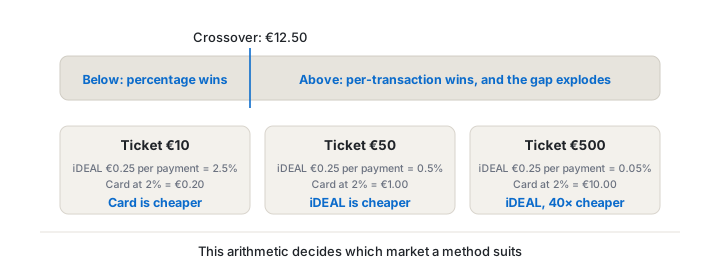
| Basket size | iDEAL (€0.25 per payment) | Card (at 2%) | Cheaper |
|---|---|---|---|
| €10 | €0.25 = 2.5% | €0.20 | Card |
| €12.50 | €0.25 = 2% | €0.25 = 2% | Tie |
| €50 | €0.25 = 0.5% | €1.00 | iDEAL |
| €500 | €0.25 = 0.05% | €10.00 | iDEAL, by 40× |
A flat per-transaction fee and an ad valorem fee cross at one basket size. Below that point the percentage is cheaper; above it the flat fee is cheaper, and the gap gets absurd as you go up.
That arithmetic explains a pile of things:
First, why iDEAL is so strong in Dutch e-commerce. E-commerce baskets are usually tens of euros and up — right on the side where the flat fee wins.
Second, why methods like this do badly on small, frequent payments. Buying a coffee, €0.25 per payment is a disaster.
Third, why India and Indonesia had to do something else. A huge share of Indian transactions are small (recall that UPI is 85.5% of payment count but only 9.5% of value), so a flat per-transaction fee simply does not work there — which is why India chose zero and Indonesia chose tiers by ticket size. Micro merchants pay zero on small tickets precisely because a percentage collects almost nothing on small amounts while a flat fee would crush the merchant.
One problem, three answers — the Netherlands, India, Indonesia — and all three fall out of this arithmetic.
4. iDEAL Is Being Folded into Wero
iDEAL's current situation deserves its own section, because it is the doorway to the most important thing happening in European payments right now.
EPI (the European Payments Initiative) is a project by a group of European banks, and its product is called Wero. Its goal is blunt: reduce Europe's dependence on two American card networks.
Wero has offered person-to-person transfers in Belgium, France, and Germany since 2024, with 56 million users today. E-commerce functionality is already live in Germany and will roll out in Belgium, France, Luxembourg, and the Netherlands in 2026.
And iDEAL is being folded in:
- From 8 January 2026, a nationwide campaign in the Netherlands
- From 29 January to 31 March 2026, a joint iDEAL | Wero mark on web pages
- In October 2026, every Dutch issuing bank connects to Wero
Note one item in particular: Wero's Purchase Protection rolls out in phases, targeting full coverage on 1 January 2028.
That item matters far more than it looks.
An A2A scheme with the explicit goal of displacing cards is spending years building itself a buyer protection regime — which is to say, rebuilding what the card networks' chargeback mechanism already does.
That is exactly what the last row of the table in the five rails compared was about: a push payment is gone the moment it is pushed, and there is no equivalent dispute mechanism. Wero has now acknowledged the gap and is filling it.
This is not a failure of Wero; it is a rule: to take cards' high-ticket business, you first have to build cards' dispute protection. The chapter on the financials do not show it works this rule through in full.
5. Poland's Blik: Six Digits
Poland's approach is simpler, and smarter.
You click Blik at checkout, open your bank app, the app gives you six digits, you type them into the checkout page, and press confirm in the bank app.
No step to pick your bank, no redirect, no waiting for a bounce-back. One code, two actions, done.
The effect: Blik takes over 65% of Polish e-commerce, with more than 2.4 billion payments in 2024, 64 per person, three times the payment count of cards.
Blik deserves its own mention because it is a counterexample, and counterexamples are more useful than examples.
Recall the success conditions the earlier chapters distilled: a central bank mandate, a statutory zero, super app distribution.
Poland has none of them. Card acceptance in Poland is very good, contactless penetration is high, there is no zero-fee rule, and there is no central-bank-run scheme.
Blik won on experience, plus coordinated action by local banks.
Which means the "institutions and incentives" explanatory frame from earlier is not universal. The conditions for displacement uses Blik as the touchstone for testing the model — a model that cannot explain Blik is not usable.
6. Cash Vouchers: Built for People Without a Bank Account
Brazil's Boleto Bancário works like this: you order online, the merchant generates a slip with a barcode, you print it or save the barcode, and take it to a bank, a convenience store, or a lottery agent to pay cash. Once paid, the merchant is notified and ships.
Mexico's OXXO is the same thing (OXXO is a convenience store chain), and so is Japan's convenience store payment.
The flow is far slower and far more awkward than tapping a card. Why does it exist?
Because of the second pillar in cards assume three things: to have a card, you first need a bank account.
Cash vouchers serve people who have cash, have a phone, can shop online, and have no card. For them, the alternative is not "pay with a card," it is "cannot buy."
So the test for this kind of method is not "is it backward" but "who does it reach." In a market with low banking penetration, not supporting cash vouchers means giving up a slice of your customers.
It is also why the category is shrinking: as schemes like Pix let people without cards pay online, the reason for cash vouchers to exist is being drained away piece by piece. Pix ate a large chunk of Boleto's share — something instant that also requires no trip out of the house is obviously better than printing a slip and queuing at a convenience store.
Boleto was not beaten by better technology. It was beaten by something that reaches the same people with a much better experience.
7. The Channel Split: The Most Valuable Thing the Netherlands Teaches
One last thing, and it is the most valuable observation in this chapter.
iDEAL took Dutch online but did not take Dutch offline. When Dutch people pay in a shop, they still use debit cards running on international card network rails.
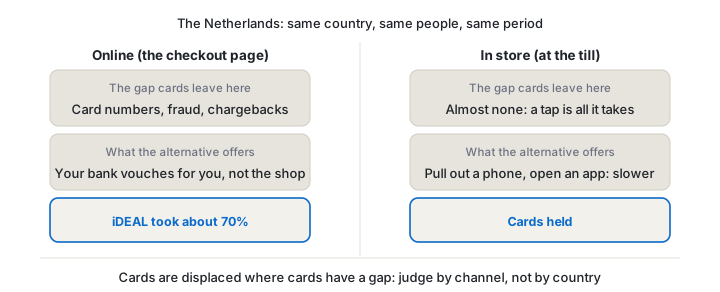
Same country, same people, same period, and online switched while offline did not.
Why? Because online and offline are not the same problem.
| Online | Offline | |
|---|---|---|
| Where cards hurt | Card number has to be entered, fraud risk, high chargeback risk | Almost nowhere — insert or tap and you're done |
| The alternative's advantage | Authentication thrown to the bank, routing around the whole block | Pull out a phone, open an app — slower than tapping a card |
| Result | iDEAL took about 70% | Cards held |
Cards get displaced where cards leave a gap. Cards have a gap online, so iDEAL got in; cards have no gap offline, so iDEAL cannot get in.
In the conditions for displacement this observation becomes part of the model: judge by channel, not by country. What makes the Dutch case precious is that it produced both a successful displacement and a failed one inside the same country, holding every other national-level variable constant.
8. Three Conclusions
One, a flat per-transaction fee and an ad valorem fee cross at some basket size, and that arithmetic decides which market a method fits. The Netherlands charges per payment, India set zero, Indonesia tiered by size — all three choices fall out of this arithmetic.
Two, a European scheme built explicitly to displace cards is spending years building itself buyer protection. Wero's Purchase Protection targets full coverage in 2028. To want cards' high-ticket business is to have to build cards' dispute protection first.
Three, judge displacement by channel, not by country. iDEAL took Dutch online and cannot get into offline, because cards have a gap online and none offline.
9. The Question This Chapter Leaves Open
The methods in this chapter share one trait: they are cheaper than cards. iDEAL costs a couple of dimes a payment, Blik is cheap, Boleto is not expensive either. Cheap is the main reason merchants accept them.
Now look at the exact opposite.
There is a class of payment method that charges merchants roughly double the card rate, and merchants queue up for it.
It is called buy now, pay later. Merchants pay double the money — for what?
10. Self-check questions
- Which block of trouble does iDEAL's bank redirect solve for a merchant taking payment online?
- iDEAL charges €0.25 per payment and the card charges 2%. At a €10 basket and a €500 basket, which is cheaper, and by how much?
- Why can't India use iDEAL's flat per-transaction model? Answer with this chapter's arithmetic and the numbers from the India chapter.
- Wero plans full purchase protection coverage by 2028. What structural gap in A2A schemes does that reveal?
- iDEAL took about 70% of Dutch online transactions but could not take offline. Why? What does that tell you methodologically about judging whether cards will be displaced in a given country?
11. Answers
Answer for yourself before reading on.
- It solves the entire card-not-present block: the merchant does not handle card numbers, does not make its own fraud decisions, and does not carry the high card-not-present chargeback risk. Authentication happens on the bank side, and all the merchant receives is the result — your bank confirms the money has been sent. The merchant does not need to know who you are; let your bank know who you are.
- At €10: iDEAL charges €0.25, which is 2.5%, while the card charges €0.20 — the card is cheaper. At €500: iDEAL still charges €0.25, which is 0.05%, while the card charges €10.00 — iDEAL is cheaper, by 40×. The crossover is at €12.50.
- Because a huge share of Indian transactions are small — UPI is 85.5% of payment count but only 9.5% of value, which means tiny tickets. A flat amount per payment translates into an enormous effective rate on small tickets and would crush small merchants outright. So India chose zero and Indonesia chose tiers by ticket size and merchant size. A flat per-transaction fee only works in a market with high enough basket sizes.
- It reveals that A2A push payments have no equivalent dispute and buyer protection mechanism: once the money is pushed it has arrived, and when something goes wrong there is no cross-institution remedy process. Cards have the chargeback right, institutionalised. For Wero to take cards' business it has to build that regime itself, and that takes years — because it is rules and arbitration, not technology.
- Because cards have a gap online and none offline. Online you have to enter a card number and there is fraud and chargeback risk; iDEAL routes around all of it, so it won. Offline you insert or tap and it is done, and pulling out a phone to open an app is slower, so iDEAL has no advantage and cannot get in. The methodological point: judge whether displacement will happen by channel, not by country. The Netherlands produced both a success and a failure inside one country, which holds every other national-level variable constant.
Previous: Chapter 8 · The Word "Wallet" Has Been Misleading You Next: Chapter 10 · Buy Now, Pay Later: Why Merchants Accept Double the Card Fee