Why Stripe and Adyen Integrate a Hundred Payment Methods
Part IV · The Aggregator's Side (Chapter 11) Builds on: Chapter 7 (who funds the rail), Chapter 9 (flat per-transaction fee and ad valorem fee), Chapter 10 (pricing on results) New concepts in this chapter: one integration for many methods, the attribution problem in conversion, channel cost versus the aggregator's own margin
1. The Question the Previous Chapter Left Open
By this point, a merchant selling globally is looking at a list like this: the Netherlands wants iDEAL, Poland wants Blik, Brazil wants Pix and Boleto, India wants UPI, Indonesia wants QRIS, China wants Alipay and WeChat Pay, Germany wants PayPal and direct debit, Japan wants convenience store payment, everywhere wants cards, and on top of all of it, buy now, pay later.
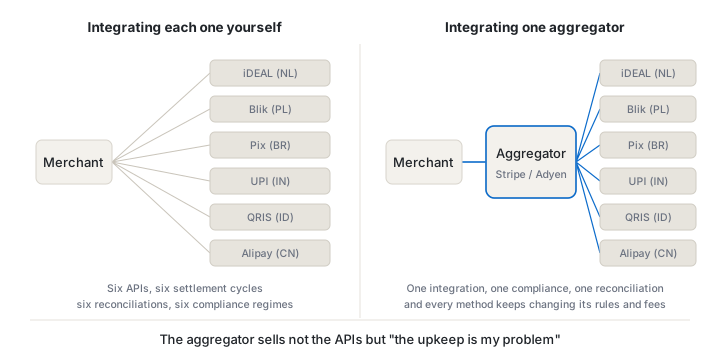
Each one has its own interface, its own settlement cycle, its own reconciliation format, its own refund flow, its own compliance requirements.
Stripe and Adyen have integrated all of it, and say to the merchant: integrate me once.
The industry gives three reasons for this: coverage, cost, conversion.
This chapter costs the three out separately. Two of them are extremely solid. The third is systematically overstated.
2. The First: Coverage
This one is the simplest, and the hardest to argue with.
In many markets, not supporting the local method means having no business. Not less business. None.
Look at the numbers:
| Market | Dominant local method | Share |
|---|---|---|
| China | Alipay + WeChat Pay | 89% of e-commerce value |
| India | UPI-led wallet category | 68% online |
| Netherlands | iDEAL | about 70% online |
| Poland | Blik | over 65% of e-commerce |
A card-only merchant entering the Netherlands can reach the remaining thirty percent. Entering Poland, under thirty-five.
The line from Payment Systems holds here: in many markets, not supporting the local payment methods means giving up most of that market's users.
Coverage needs no argument. It is arithmetic.
3. The Second: Cost
The second reason is also hard, and it can be costed precisely.
Go back to the arithmetic in local methods without a QR code: a flat per-transaction fee and an ad valorem fee cross over at some basket size.
For a merchant whose basket size is above fifty euros, iDEAL's €0.20–0.35 a payment against a card's percentage rate is a difference of several times over. In Brazil, Pix's 0.22%–0.33% against a credit card's 2.2%–2.34% is a difference of nearly ten times.
For a retailer whose margin is thin to begin with, taking payment costs from 2% to 0.3% adds more than a point straight to net margin. In retail, that is enormous.
So when an aggregator sells cost, it is selling something real.
But there is a very common confusion to clear away here, because it will make you misjudge the aggregator's own business:
A lower channel cost for the merchant does not mean a lower margin for the aggregator.
The aggregator's revenue is what it charges the merchant minus what it pays out. A large part of a card's cost is interchange — money passing through the aggregator on its way to the issuer. It only handles it. Local methods cost less, so the aggregator charges less, but the spread in the middle is not necessarily thinner.
So when you see Stripe's or Adyen's "average take rate" fall, hold off on the conclusion. It may only be a mix shift as local methods grow, not a price war. This is one of the most common mistakes in reading these companies' financials.
4. The Third: Conversion, and Where It Is Overstated
The third reason is the one most often reached for, and the one that deserves the biggest discount.
The argument runs like this: if the checkout page does not carry the method the consumer is used to, the consumer abandons the purchase. There is no shortage of research putting a specific abandonment percentage on it.
The direction is right. The Dutch example in local methods without a QR code is the evidence: iDEAL took seventy percent of online transactions, so the Dutch really do prefer it.
The problem is the magnitude, and the reason is methodological.
First, the people producing this research are the people selling the thing. Worldpay, Adyen and Stripe all publish industry reports and all make money when merchants add methods. That is not an accusation of fabricated data. It is a statement that the design and framing of such research lean naturally in a favourable direction.
Second, survey answers and actual behaviour are different things. Ask someone "would you abandon a purchase if your preferred payment method wasn't there," and they will say yes. At an actual checkout page, plenty of them pay with something else. Stated preference is always stronger than revealed preference.
Third, and most fundamental: attribution is hard. A merchant switches on iDEAL and conversion goes up. You cannot establish how much of that came from iDEAL and how much from everything else that changed in the same period. This is the same counterfactual problem the previous chapter ran into.
So use this reason as follows: local methods do affect conversion, but any specific percentage should be treated as a ceiling, not an estimate.
None of which says the aggregators are lying. Coverage and cost alone carry the whole business. Conversion is a bonus that has been sold as the main reason.
5. What the Aggregator Is Really Selling
The three reasons above are what gets said to the merchant. From the aggregator's own side, the core asset of this business is something else.
Integrate once, comply once, reconcile once.
Think through what a merchant has to do to connect ten local methods itself: negotiate ten commercial agreements, build ten technical integrations, handle ten settlement cycles, reconcile ten sets of books, satisfy ten compliance regimes, operate ten refund flows. And every one of them changes.
The expensive part is not the integration. It is that the work never ends. Every method is revising its rules, its interface, its pricing. Every market is issuing new regulatory requirements. Finishing the integration is not the end for a merchant; it is the start of feeding a permanent maintenance burden.
What the aggregator sells is "that burden is mine."
Which is why the moat here is deeper than it looks. A hundred integrations can be copied. A hundred relationships under continuous maintenance cannot.
And the business has one very attractive property: the aggregator does not need a view on which method wins. Pix wins, it connects Pix. Cards win, it connects cards. Wero takes off, it connects Wero.
In an industry where everyone is betting on a winner, the aggregator is the one role that does not have to bet. It charges a toll, not a stake.
6. Why Southeast Asia Needs This Business Most
Go back to the observation in Southeast Asia's fragmentation: Southeast Asia is the only place where closed-loop wallets and bank rails have coexisted for the long run.
An Indonesian merchant may have to handle QRIS, several wallets and cards all at once. A merchant trading across Southeast Asia multiplies that by six countries.
The more fragmented the market, the more aggregation is worth. That is why the region has grown a crop of local aggregators, and why every global aggregator is investing there.
Look at Brazil the other way round: Pix alone accounts for the overwhelming majority of payments, so a merchant that connects Pix has covered most of its transactions. In a concentrated market, aggregation is worth less.
The more unified a market's payment landscape, the less an aggregator matters. The more fractured, the less replaceable it is.
7. Three Conclusions
One: coverage and cost are hard, conversion is soft. Coverage is arithmetic — skip iDEAL in the Netherlands and you have thirty percent of users. Cost is arithmetic — 2.3% to 0.3% in Brazil. Conversion points the right way, but the numbers come from an interested party and attribution is hard, so treat them as a ceiling.
Two: a lower channel cost for the merchant does not mean a lower margin for the aggregator. When the average take rate falls, do not conclude anything yet; it may only be a mix shift as local methods grow.
Three: the aggregator's real asset is maintaining a hundred relationships, not having built a hundred integrations. Which is also why it never has to bet on a winner — it collects a toll.
8. The Question This Chapter Leaves Open
Merchants are switching, aggregators are integrating, local methods are growing.
Which leaves the last question: are Visa and Mastercard actually in trouble?
Start with the bad news. The bad news is genuinely bad — India's debit card volume fell by two thirds in four years, and Brazil's Pix passed the combined volume of both card types in three.
9. Self-check questions
- Of the three reasons an aggregator gives a merchant, which two are arithmetic and which one deserves a discount? Why?
- Research of the form "X% of consumers abandon a purchase when the local method isn't offered" — give three reasons not to take it at face value.
- Why does "Stripe's average take rate is falling" not imply "Stripe's margin is falling"?
- What is the aggregator's least copyable asset? Why is it not the hundred integrations?
- Why is aggregation worth more in Southeast Asia than in Brazil?
10. Answers
Answer for yourself before reading on.
- Coverage and cost are arithmetic: skip iDEAL in the Netherlands and you reach only about thirty percent of users, skip Blik in Poland and under thirty-five; Brazil's Pix at 0.22%–0.33% against credit cards at 2.2%–2.34% is nearly ten times. Conversion deserves a discount, because it depends on estimating a counterfactual, and the counterfactual cannot be observed.
- (a) The people doing the research are the people who make money when merchants add methods, so the framing leans naturally in a favourable direction; (b) preferences stated on a survey are stronger than actual behaviour, and plenty of people at a real checkout page pay with something else; (c) attribution is hard — conversion rose after launch, but you cannot establish how much came from the method itself. So treat any specific percentage as a ceiling, not an estimate.
- Because a large part of the fee is money passing through the aggregator on its way to someone else — card interchange going to the issuer, for instance. The aggregator only handles it. Local methods cost less, so it charges less, but the spread in the middle is not necessarily thinner. A falling average take rate is usually just a mix shift as local methods grow, not a price war.
- It is maintaining a hundred relationships. An integration is a one-time, copyable piece of work. But every method keeps revising its rules, its interface and its pricing, and every market keeps issuing new compliance requirements, so the maintenance burden never ends. What the aggregator sells is precisely "that burden is mine."
- Because Southeast Asia is highly fragmented: closed-loop wallets and bank rails have coexisted for the long run, one merchant may have to handle QRIS, several wallets and cards at once, and trading across borders multiplies that by the number of countries. Brazil is the opposite — Pix alone carries the overwhelming majority of payments, so one integration covers most transactions. The more unified the market, the less aggregation is worth.
Previous: Chapter 10 · Buy Now, Pay Later: Why Merchants Accept Double the Card Fee Next: Chapter 12 · Are the Card Networks in Danger? Part One: Where Cards Genuinely Lost