Are the Card Networks in Danger? Part One: Where Cards Genuinely Lost
Part V · Are the Card Networks Actually in Danger (Chapters 12–14) Builds on: Chapter 4 (India's debit card numbers), Chapter 5 (the scale of Pix), Chapter 8 (a card wrapper versus a genuine alternative) New concepts in this chapter: absolute decline, payments sovereignty, the squeeze on interchange
1. The Question the Previous Chapter Left Open
The first eleven chapters were about how other things grew. This one starts asking a different question: what have those things done to Visa and Mastercard?
This chapter carries only the bad news, and it does not discount any of it. The next chapter gives the other side. You have not read the argument until you have read both. Read one and you will reach the opposite conclusion.
One methodological rule first: only genuine alternatives count, not card wrappers. Apple Pay has a card inside it, so it does not count. Every item listed in this chapter is a transaction on which the card networks earn nothing at all.
2. India: A Payment Instrument in Absolute Decline
Start with the hardest one.
| 2021 | 2025 | |
|---|---|---|
| Indian debit card volume | 4.087 billion payments | 1.336 billion payments |
| Indian debit card value | 7.4 lakh crore rupees | 4.5 lakh crore rupees |
(A lakh crore is one trillion.)
Four years, and volume fell 67%.
Read that slowly. This is not slower growth. This is not a lower market share. This is two thirds fewer transactions in absolute terms.
And it happened in a country whose economy was growing and whose digital payments were exploding. Over the same period UPI went from 38.73 billion payments to 228.28 billion.
In the history of payments, a mainstream instrument shrinking in absolute terms inside a large economy is a rare thing. India's debit card is exactly that case, and the cause is plain: UPI does what a debit card does — push money out of your own account to someone else — and does it free, faster, and more conveniently.
This is the strongest single piece of evidence for the proposition that a local scheme can genuinely replace cards, not merely slow them down.
3. Brazil: Past Them in Three Years
Brazil has a different shape, and moved faster.
- Pix launched in November 2020.
- 2024: about 64 billion payments, +53% year on year, 80% more than credit and debit cards combined.
- 2025: 79.8 billion payments, R$35.36 trillion in value, about 219 million payments a day.
From launch to passing the combined volume of both card types took three calendar years.
India was squeezed out slowly. Brazil was simply overtaken. The reason is in Brazil's central bank answer: mandatory participation bypassed the cold start problem.
4. Two More Pieces: China and Europe
China: Alipay and WeChat Pay account for 89% of e-commerce value and 87% of in-store POS.
But state this one precisely. Visa and Mastercard never had much domestic business in China to begin with. Domestic cards there are UnionPay's territory. So China's story is "wallets replaced the act of paying by card" — not "Visa lost this much revenue".
Treating China as evidence of Visa bleeding overstates the bad news. It is the most common hole in the case for the prosecution, and worth plugging yourself before someone else does.
Europe is the reverse. Europe is where the card networks genuinely make money, and an organised opponent is now emerging.
- iDEAL holds about 70% of Dutch online payments, and passed 1.5 billion payments in 2025.
- Blik holds over 65% of Polish e-commerce, passed 2.4 billion payments in 2024, and runs at three times card volume.
- Wero already has 56 million users, launched e-commerce functionality in Germany, and rolls out to Belgium, France, Luxembourg and the Netherlands in 2026; in October 2026 every Dutch issuing bank connects.
EPI, the group behind Wero, states its objective plainly: reduce Europe's dependence on two American card networks.
This is not commercial competition. It is a political project. The distinction matters, because a political project's tolerance for losses and patience with time both run far beyond a commercial one's.
5. The Structural One: Interchange Is Being Squeezed from Three Sides
Everything above is what happened in the market. There is one more thing, more fundamental, and it attacks the economic engine of the whole card arrangement.
The chapter on cards assume three things made the point: interchange is the reason the card issuing business exists. Weaken it and the entire structure loosens.
It is now being squeezed from three directions at once:
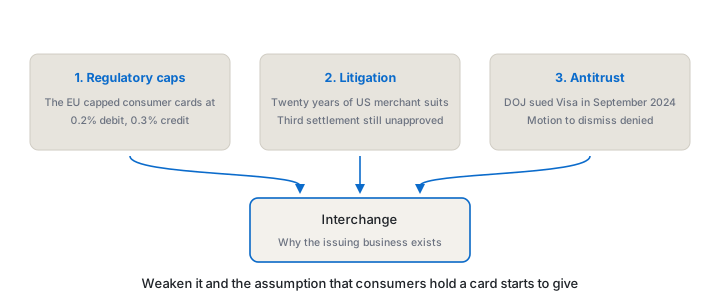
One: regulatory price caps. The EU capped consumer card interchange at 0.2% for debit and 0.3% for credit.
Two: litigation. In the US merchant class action that has run for nearly twenty years, the settlement Visa and Mastercard reached in March 2024 was rejected by Judge Brodie in June 2024, on grounds including unfairness between large and small merchants and relief that was "meagre" against what merchants might win at trial. A third version was filed on 10 November 2025, and merchant groups still oppose it. As of mid-2026 it has not been approved.
Three: antitrust. The US Department of Justice sued Visa on 24 September 2024, alleging monopolisation of debit network services, including a claim that Visa reached agreements with potential competitors not to compete. Judge Koeltl denied Visa's motion to dismiss, and the case continues. Fact discovery closed on 17 March 2026; expert discovery runs to 7 August 2026.
There is one detail inside the third that deserves its own section.
6. The Defendant's Own Judgment
In January 2020, Visa announced it would acquire Plaid, a company that connects bank account data. In November of the same year, the DOJ sued to block the deal. In January 2021, Visa abandoned it.
The DOJ's complaint quoted Visa's internal documents, which described Plaid as a threat to Visa's debit business.
Why does this matter more than every number above?
Because what is said in public is said to the market, and what is written internally is written for yourself. Visa has consistently said in public that account-to-account payments are a complement, not a substitute. But internally, in documents nobody intended outsiders to read, it treated that path as a threat — and was willing to spend more than $5 billion to buy it.
In this argument, this is the only piece of evidence that comes from the defendant and was not produced to persuade you. The prosecution's strongest item is not India's numbers. It is this.
Note in passing that Visa later acquired Tink, and Mastercard acquired Finicity and Aiia — all open banking data companies of the same type. If you cannot buy the biggest one, buy the others. The behaviour itself tells you how they see this.
7. The Case for the Prosecution, in Full
Compress the chapter into one paragraph:
Across a set of important markets, local schemes have already pushed cards to the margin, and in at least one case the result is absolute decline, not a transfer of share. At the same time, the economic engine of the card system — interchange — is being squeezed from three sides by price caps, litigation and antitrust. Europe has produced a political project whose stated objective is reducing dependence on the card networks. And the card networks themselves, in internal documents, concede this is a threat and answer it by making acquisitions.
That is a strong case. Every item in it is on the record.
8. But
If everything in this chapter is true, you would expect to see something in Visa's and Mastercard's financials.
You cannot.
Visa's fiscal 2026 third quarter (ended 30 June) net revenue was $11.63 billion, +14% year on year. Mastercard's second quarter of 2026 net revenue was $9.3 billion, +14.1%.
Not slower growth. Double-digit growth. Across the years in which Pix, UPI, iDEAL and Blik all rolled out in full, neither company has posted a single quarter of declining revenue.
Any explanation that works has to hold this chapter and that fact at the same time. "Cards are being displaced" and "the card networks are earning more" are not a contradiction. They are a phenomenon that has not yet been explained.
The next chapter explains it. The answer has four parts, and two of them have nothing to do with technology.
9. Self-check questions
- Why is India's debit card data "absolute decline" rather than "falling share"? Why does the distinction matter?
- "Alipay and WeChat hold 89% of Chinese e-commerce, so Visa has lost heavily in China" — where does that reasoning go wrong?
- Which three directions are squeezing interchange? Why is squeezing it more fundamental than taking away some transactions?
- Why are the Visa internal documents quoted in the DOJ complaint more persuasive than India's and Brazil's numbers?
- All the evidence in this chapter holds, yet Visa's and Mastercard's revenue is still growing in double digits. Does that mean the evidence is wrong?
10. Answers
Answer for yourself before reading on.
- Because the absolute number of payments fell — from 4.087 billion to 1.336 billion — not "grew more slowly than others and so lost share." The distinction matters because falling share can coexist with absolute growth in a fast-growing market (the pie gets bigger, your slice is a smaller fraction but still larger). Absolute decline means the instrument is genuinely being abandoned, and no amount of growth can paper over it.
- It goes wrong at Visa and Mastercard never having much domestic business in China — domestic cards are UnionPay's territory. China's story is "wallets replaced the act of paying by card," not "Visa lost this much revenue." Counting it as evidence of Visa bleeding overstates the bad news.
- Regulatory price caps (the EU at 0.2% debit, 0.3% credit), litigation (the US merchant class action, the settlement rejected in June 2024, a third version filed in November 2025 and still unapproved), and antitrust (the DOJ's September 2024 suit against Visa, with the motion to dismiss denied). It is more fundamental than losing transactions because interchange is the reason the card issuing business exists: it pays for the issuer's risk controls, its bad debt and its cashback. Weaken it and banks have less reason to issue, and the premise that "the consumer has a card in hand" starts to loosen.
- Because public statements are made to the market and internal documents are written for yourself. Visa says publicly that A2A is a complement rather than a substitute, while internally treating it as a threat and being willing to spend more than $5 billion to buy it. This is the only evidence from the defendant that was not produced to persuade you. The later acquisitions of Tink, Finicity and Aiia confirm the reading.
- It does not mean the evidence is wrong. It means the explanation is incomplete. Every item is on the record, but plainly none of it has converted into lost revenue. So other mechanisms must be operating at the same time — either what was displaced never earned much, or cards earn it back elsewhere, or the displacement is narrower than it looks. A working explanation has to hold both sets of facts at once.
Previous: Chapter 11 · Why Stripe and Adyen Integrate a Hundred Payment Methods Next: Chapter 13 · Are the Card Networks in Danger? Part Two: Why the Financials Don't Show It