Are the Card Networks in Danger? Part Two: Why the Financials Don't Show It
Part V · Are the Card Networks Actually in Danger (Chapters 12–14) Builds on: Chapter 12 (where cards genuinely lost), Chapter 4 (volume and value come apart), Chapter 5 (functions added only after launch) New concepts in this chapter: authorization hold, the chargeback right, cross-border yield, value-added services, ownership of the standard (EMVCo), the networks' own QR schemes
1. The Question the Previous Chapter Left Open
Everything the previous chapter presented holds. And yet Visa's fiscal 2026 third quarter net revenue was $11.63 billion, +14% year on year, and Mastercard's second quarter of 2026 was $9.3 billion, +14.1%.
The displacement is real, and the revenue is accelerating.
This chapter gives four explanations. The first two say the part that was taken was never worth much. The last two are moats — and they have nothing to do with technical merit, and are very hard to get around.
2. The First: Most of What Was Taken Was Never Earning the Networks Anything
Walk the previous chapter's battlefields again and ask one question: how much could Visa have earned there in the first place?
| Market | Who won | Where Visa / Mastercard stood to begin with |
|---|---|---|
| China | Alipay, WeChat Pay | Almost no domestic business; domestic cards are UnionPay's territory |
| India | UPI | What lost was the debit card, and Indian interchange was already extremely low |
| Brazil | Pix | What it mostly replaced was cash, Boleto and debit cards |
| Netherlands | iDEAL | Lost online only. In-store, not lost |
In four battlefields, not one of them is "the high-margin credit card business was taken away."
This is not a coincidence, and the next chapter will show that it is structural. For now, hold the conclusion: the places local schemes win most easily are exactly the places the card networks earn least.
3. The Second: What Won Was Volume, Not Value
The pair of numbers left behind by India's zero fee earns its keep here.
In the second half of 2025, UPI carried 85.5% of India's payment volume and 9.5% of its value.
The card networks earn on value, essentially, not on volume.
So "UPI took 85.5% of the volume," translated into revenue impact, reads: it took the transactions that are small enough individually that they were never contributing much fee anyway.
Groceries, a taxi, sending a friend ten rupees — that is volume. A flight, a refrigerator, a renovation — that is value.
UPI took the first. It did not take the second.
Look only at volume and you will think cards have been comprehensively displaced. Look only at value and you will think nothing has happened. The truth is in between, and revenue follows value.
4. The Third, and a Real Moat: Credit
Now the two moats that matter. The first one already showed its face in India's zero fee.
An A2A rail moves money you already have. Credit is somebody fronting you money you don't. These are two different things, and the second needs something a rail cannot supply.
Lending requires capital, the capacity to absorb bad debt, underwriting models, collections. None of these are functions of a clearing rail. They need a balance sheet and a license.
A rail can carry credit; it cannot create it.
The evidence is not in theory. It is in what the markets themselves did:
- India let RuPay credit cards ride on UPI. And from 1 June 2026, the portion of any payment above ₹2,000 started carrying MDR — the moment credit came onto the rail, the zero fee broke.
- Brazil produced products that hang instalments off Pix, funded by payment institutions or by the merchant.
- And the thing described in buy now, pay later: Klarna and Affirm said they would replace the card, and ended up issuing cards.
Three markets, three different paths, all converging on the same result: credit was not replaced. It moved onto the new rail and carried on.
Note where the returns land, though. The interest and the interchange that credit generates go mainly to the issuer, not to the network. So strictly speaking, "credit is a moat" is truer for JPMorgan than for Visa. For the networks the benefit is indirect: credit transactions carry higher ticket sizes, and the networks charge on value.
5. The Fourth Moat: Who You Go To When Something Goes Wrong
This is the most overlooked one, and the hardest to get around.
You buy a $10,000 appliance online. The merchant takes the money, ships nothing, and disappears.
On a card: you go to your issuer and file a chargeback. This is an institutionalised right, with a procedure, an evidentiary standard, deadlines and arbitration. There is a very good chance the money comes back. The UK's Consumer Credit Act 1974, section 75, goes further and makes the credit provider jointly liable for the supplier's breach, covering transactions in the £100 to £30,000 range.
On an A2A push payment: you pressed confirm and the money went out. A push payment is irrevocable by design. You can go to the police, you can sue, but there is no cross-institutional, fast remedy provided by the payment system itself.
This difference is not technical. It is institutional.
And it has a very clean corollary — this corollary is the most useful thing in this chapter:
The dispute protection on a card is, in substance, an insurance policy packaged into the fee. The value of that policy rises with the ticket size, and it rises with the gap between paying and receiving.
From which you can read off directly which categories stay on cards and which flow away:
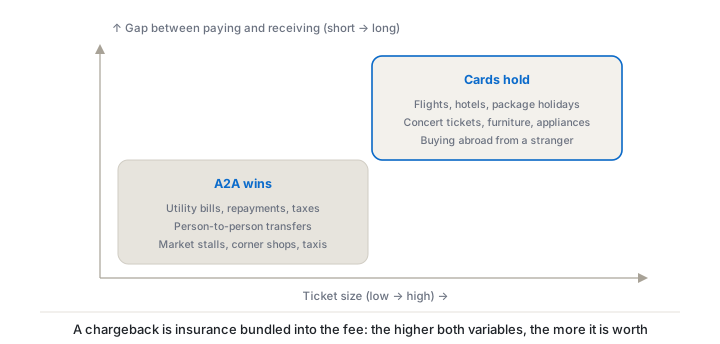
| Cards will hold | A2A will win |
|---|---|
| Flights, hotels, package holidays | Utility bills, loan repayments |
| Event tickets | Person-to-person transfers |
| Furniture, made-to-order goods, renovation | Government fees |
| Large appliances, expensive electronics | Market stalls and small convenience store baskets |
| Buying cross-border from a merchant you don't know | Food delivery, ride-hailing |
| Any transaction where you pay first and receive much later | Any transaction where money and goods change hands at once |
Hold this table against the previous chapter's battlefields and it hits every one. What Pix and UPI won was bill payment, transfers and small-value retail. What cards held was travel and high-value e-commerce.
Now the strongest corroborating fact.
Wero — the European project whose stated objective is reducing dependence on the card networks — is building itself Purchase Protection, targeting full coverage on 1 January 2028.
A scheme designed to replace cards is spending years rebuilding the card dispute mechanism. That is a concession: if you want to take the card networks' high-ticket business, you must first pay what cards pay for that protection.
6. And a Pile of Things Cards Have Long Done That A2A Is Still Building
Beyond credit and disputes, there are several functional gaps, and each one locks up whole industries:
Recurring debits. Pix got Pix Automático five years after launch, in 2025; UPI added it later too. Subscriptions, monthly fees and instalment billing were impossible before that.
Authorization holds. This one gets discussed least and does the most damage. A hotel freezes an amount at check-in and charges a different one at check-out. A petrol station pre-authorises and then charges by the litre. A restaurant authorises, then settles once the tip is added.
That whole capability — authorise one amount, capture another — has no native equivalent in a push payment. And it is the operating premise of the hotel, car rental, fuel and restaurant industries.
Refunds, especially partial refunds. A card refund is a reversal bound to the original transaction. An A2A refund is a brand new payment: the merchant has to store the payer's account details and do its own reconciliation.
Guest checkout. A card number can be read off a piece of plastic by anyone and typed in. A2A generally requires the payer to have a particular bank's app installed and open. Telephone orders and agent-assisted orders have no clean equivalent.
No cashback and no points. This is the deadliest one: in a market where interchange is not capped, the consumer gets a direct benefit from using a card. They have no reason to give up their own cashback in order to save the merchant money.
7. What the Card Networks Themselves Have Done
They have not stood still. And the first place they reached into is the very code this course has spent half a book on.
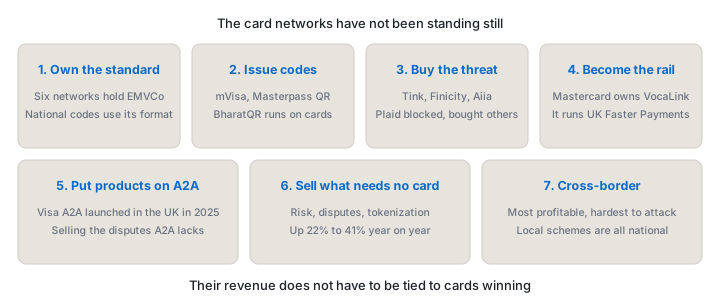
Own the standard: the QR format was not set by a neutral body. EMVCo is owned in equal shares by Visa, Mastercard, American Express, Discover, JCB and UnionPay — and the merchant codes of Brazil's Pix, Thailand's PromptPay, Malaysia's DuitNow, Singapore's PayNow, Hong Kong's HKQR, Indonesia's QRIS and Vietnam's VietQR all use EMVCo's merchant-presented format. The national codes produced as proof that "A2A is displacing cards" speak a language the card networks wrote. The specifications are published free, so the networks collect nothing at this layer; what they hold is the seat at the table — where the format goes next, what fields the next version adds, whose specification cross-border linkage aligns to.
Run their own codes: they did not stop at the standard, they built QR schemes themselves. Visa's mVisa went live in India in September 2015 and spread to Kenya, Rwanda, Egypt, Nigeria and a dozen other markets; Mastercard's Masterpass QR launched in Nigeria in August 2016, reached 33 African countries in one go through Ecobank, and entered India that November. In February 2017 NPCI built BharatQR together with Visa, Mastercard and American Express — one code accepting RuPay, Visa and Mastercard, running on the card rails, not UPI. An Indian shopfront may carry two codes: one with UPI underneath and one with a card.
On scale the clearest case is UnionPay: its QR is accepted by over 30 million merchants in mainland China, and by more than 1.5 million merchants across 44 countries and regions outside it. UnionPay is both one of EMVCo's six owners and one of the world's largest card networks — and a card is what runs under its code.
So the act of scanning was never on the opposite side from cards. It is a form factor. Whose rail sits under the form factor is what decides where the bill lands.
Buy the threat: Visa acquired Tink; Mastercard acquired Finicity and Aiia — all open banking data companies. After the DOJ blocked Plaid, they went and bought others.
Become the rail: Mastercard owns VocaLink, and VocaLink operates the UK's Faster Payments and Bacs. The British instant payment rail so often cited to prove that A2A will replace cards is operated by Mastercard.
The more recent move is to build the product directly onto A2A: Visa announced Visa A2A in September 2024 and launched it in the UK in 2025, aimed at bank-transfer use cases like bills and subscriptions, and sold on giving A2A a dispute and refund mechanism — precisely the fourth moat in this chapter. It did not go and fight Faster Payments for the rail. It went and sold the thing that rail lacks.
Put the card on the new rails: push products like Visa Direct and Mastercard Move send money out to cards, accounts and wallets.
Sell things that do not depend on cards: this one is already conspicuous in the financials. Visa's fiscal 2026 third quarter value-added services revenue was $3.8 billion, +34% year on year; in the second quarter value-added services were +41%. Mastercard's first quarter of 2026 value-added services and solutions were $3.5 billion, +22%.
Value-added services means risk controls, dispute handling, consulting, tokenization, identity. The key point: most of these services have nothing to do with the rail. If cards lose share and the card networks sell risk controls and dispute handling to the winner, the revenue is still there.
This matters more than every other defence above: it means the networks' revenue does not have to be tied to cards winning.
Cross-border is their most profitable business and the hardest to attack. Visa's fiscal 2026 third quarter cross-border volume was +12%, Mastercard's first quarter of 2026 +13% — both faster than the total. And every local scheme is a national scheme: UPI does not leave India, Pix does not leave Brazil, iDEAL does not leave the Netherlands. To displace cards cross-border you have to solve foreign exchange, sanctions, anti-money-laundering, cross-jurisdictional dispute rules and a cross-border directory — which is precisely the set of things the card networks sell.
8. Four Conclusions
One: most of what was taken was a market the networks were never earning in. They had no domestic share in China, what lost in India was the debit card, which carried almost no interchange, what Pix replaced in Brazil was mainly cash and Boleto, and the Netherlands lost only online.
Two: what won was volume, not value, and revenue is charged on value. UPI holds 85.5% of India's volume and 9.5% of its value — the space between those two numbers is why the financials show nothing.
Three: credit and dispute protection are two genuine moats, and neither is technical. A rail cannot create credit; a push payment has no chargeback. The evidence is what the markets did: MDR came back the moment RuPay credit cards rode UPI, and Wero is rebuilding purchase protection.
Four: the networks are selling things that do not depend on cards, and selling them fast. Value-added services growing 22% to 41% year on year. If cards lose and they sell risk controls and dispute handling to the winner, the revenue does not lose with them.
9. The Question This Chapter Leaves Open
Two chapters in, both sets of facts are on the table.
What is needed now is not another piece of evidence. It is something you can judge with:
Give me a country. Can you predict whether the local scheme there will displace cards?
The model has to explain two counterexamples or it is useless: the UK has had an instant transfer rail since 2008, and the US has had ACH for far longer — fast, cheap, and decades old, and at checkout people still reach for a card.
A model that cannot explain the UK and the US is not worth using.
10. Self-check questions
- Do the card networks charge on value or on volume? How does that explain "UPI holds 85.5% of volume and the financials show nothing"?
- Once RuPay credit cards rode UPI, the portion above ₹2,000 started carrying MDR. What structural fact does that prove?
- What is the card chargeback right, in substance? Describe it as insurance, and name the two variables its value rises with.
- Use your answer to question 3 to predict: a flight, or a utility bill — which one stays on cards? Why?
- Why does growth in value-added services revenue say more about the networks not fearing a loss than cross-border growth does?
- What is Mastercard's relationship to the UK's Faster Payments? Why is that ironic?
- Who owns EMVCo? Why say "the national codes built to go around cards speak a language the card networks wrote"? If the specifications are free, what are the networks getting at this layer?
11. Answers
Answer for yourself before reading on.
- Essentially on value. So the 85.5% of volume UPI took corresponds to only 9.5% of value — what it took were the transactions small enough individually that they were never contributing much fee. Groceries and taxis contribute volume; flights and renovations contribute value. Look only at volume and you will think cards were comprehensively displaced, but revenue follows value.
- It proves that a rail can carry credit; it cannot create it. Moving your own money has a marginal cost near zero, so it can be priced at zero. Lending requires capital, the capacity to absorb bad debt, underwriting and collections — those are real costs, and a law saying you may not charge does not conjure the money from anywhere. So the moment credit comes onto a rail, a fee necessarily comes back with it.
- In substance it is an insurance policy packaged into the fee: when something goes wrong — no delivery, goods not as described — you have an institutionalised remedy with a procedure and an arbitrator. Its value rises with the ticket size, and it rises with the gap between paying and receiving the goods.
- The flight stays on cards. A flight is a high ticket, and a long time passes between paying and flying, during which the airline can fail or the trip can be cancelled — both variables at their maximum, so the insurance is worth the most. A utility bill is small and the service was delivered in the same period, so there is almost no non-delivery risk, the insurance is worth nothing, and it flows to A2A.
- Because cross-border is still card business — it proves cards remain strong in one area, but if cards lose overall, cross-border takes the hit with them. Value-added services (risk controls, dispute handling, tokenization, consulting) are mostly independent of the rail and can be sold to whoever operates any rail. So even if cards lose share, the networks sell those capabilities to the winner and the revenue is still there. It decouples the company's fate from cards winning.
- Mastercard owns VocaLink, and VocaLink operates the UK's Faster Payments and Bacs. The irony: the British instant payment rail most often produced as proof that A2A will replace cards is operated by the very card network it supposedly threatens.
- EMVCo is owned in equal shares by Visa, Mastercard, American Express, Discover, JCB and UnionPay — a card network consortium, not a neutral standards body. And the merchant codes of Pix, PromptPay, DuitNow, PayNow, HKQR, QRIS and VietQR all use EMVCo's merchant-presented format — the very codes most often produced as proof that cards are being displaced, in a format written by the displaced. The specifications are free, so there is no fee to earn at this layer; what the networks get is the seat: where the format goes, what the next version adds, whose specification cross-border linkage aligns to. Free is the method, not the concession — the same play Denso Wave ran by charging nothing for QR patents: no toll gate spreads fastest, and what spreads is yours.
Previous: Chapter 12 · Are the Card Networks in Danger? Part One: Where Cards Genuinely Lost Next: Chapter 14 · A Model That Predicts: What It Takes to Displace Cards