A Model That Predicts: What It Takes to Displace Cards
Part V · Are the Card Networks Actually in Danger (Chapters 12–14) Builds on: Chapters 3–7 (four patterns), Chapter 9 (the channel split), Chapters 12–13 (both sides) New concepts in this chapter: forced ubiquity, a reason on the consumer side, a functional gap, payments sovereignty
1. The Question the Previous Chapter Left Open
Both sets of facts are on the table. What is needed now is not a third set of facts. It is a ruler:
Give me a country. Can you judge whether the local scheme there will displace cards?
First, be clear about the exam this ruler has to pass.
The UK has had Faster Payments since 2008 — instant, cheap, nationwide. The US has had ACH for far longer, decades, at a few cents a payment.
Both countries have a fast, cheap transfer rail. In both countries, people still pay with a card at checkout.
A model that says "A2A is fast and cheap, so it will win" cannot explain those two cases. A model that cannot explain the counterexamples is not usable.
2. Three Conditions
Compress the material of the previous thirteen chapters and three conditions are what is left.
Condition one: forced ubiquity.
A payment method is worth nothing until it works everywhere, and working everywhere requires every large institution to go live at the same time. There are only two roads to that:
- Administrative force: the central bank orders it (Brazil).
- Distribution monopoly: one company is large enough that it is itself "everywhere" (China).
Those two are the roads that get there in one step. A third is "one law plus one national institution" (India), which sits between them: the law removed the obstacle of fees, the national clearing institution supplied the coordination point, but it still took several years to spread.
A voluntary bank consortium basically does not work. Europe has tried many times, and EPI itself originally set out to build a European card network, turning to A2A only when that stalled.
Condition two: a reason on the consumer side.
This is the one most often left out, and it is the core of the British and American counterexamples.
Saving the merchant money does not change consumer behaviour. The person paying is the consumer; the person handing over the fee is the merchant. Their interests were separate from the start.
So either A2A is genuinely better for the consumer (faster, simpler, money arrives), or cards are not good enough for the consumer (no cashback, no points, poor experience).
Condition three: cards left a functional gap.
For displacement to happen, cards have to be bad at something first: small merchants cannot accept cards at all (the acceptance gap), or paying online is a miserable experience (typing a card number, fraud risk).
Where cards are entirely good enough, nobody switches.
3. Running the Model Against Seven Markets
| Market | Forced ubiquity | A reason on the consumer side | A gap in cards | Outcome |
|---|---|---|---|---|
| Brazil | Yes (central bank mandate) | Yes (free, seconds, keys are easy) | Yes (cash and Boleto everywhere) | Displaced (credit excepted) |
| India | Yes (law + NPCI) | Yes (free, and debit cards carry no cashback) | Large (an enormous acceptance gap) | Debit cards in absolute decline |
| China | Yes (distribution monopoly) | Yes (subsidies, red packets, experience) | Large (small merchants cannot afford a POS terminal) | Displaced |
| Netherlands (online) | Bank consortium, barely | Yes (no card number to type) | Yes (card-not-present experience is poor) | Displaced, about 70% |
| Netherlands (in-store) | As above | No (tapping a card is fastest) | No | Not displaced |
| Poland (online) | No | Yes (six digits, superb experience) | Yes | Displaced, over 65% |
| UK (checkout) | No | No (cashback, and section 75 protection) | No (contactless works very well) | Not displaced |
| US (checkout) | No | No (rich cashback) | No | Not displaced |
The model fits. And it fits in a convincing way: it explains the successes and the failures at once, including a split inside a single country.
The two Dutch rows are the best evidence. Same country, same people, same period — displaced online, not displaced in store. Every variable at national level (culture, regulation, banking system, smartphone penetration) is identical. The only difference is whether cards leave a gap in that channel.
So judge by channel, not by country.
4. The UK and the US: What the Counterexamples Say
These two deserve their own section, because what they overturn is the single most popular intuition.
The UK has Faster Payments (2008). The US has ACH, RTP (2017) and FedNow (July 2023). The rails are all there, all fast, all cheap. At checkout, nobody uses them.
Not one of the three conditions is met:
No force. Nobody required the banks to turn these rails into a checkout method, so they have remained transfer tools rather than payment methods.
No consumer reason. British and American credit cards carry cashback, points and institutionalised protection (the UK adds section 75 joint liability). Why would someone who earns cashback on a card switch to something with no cashback in order to save the merchant money?
No gap in cards. A contactless card is a tap in a shop, faster than pulling out a phone and opening a bank app. Online there is one-click payment and a stored card.
Then the most interesting layer, and the most counterintuitive thing in this whole analysis:
The EU capped interchange at 0.2% for debit and 0.3% for credit.
The cap was meant to protect merchants. But it did something else in passing:
The merchant now saves less, so the merchant has no reason to push an alternative.
In the US, a credit card can cost a merchant 2.5%–3.5%, so merchants have a powerful motive to push something else. In Europe, cards already cost a fraction of a percent — spending effort to talk consumers out of something they find perfectly pleasant, in order to save twenty basis points, is not worth it.
Regulators, capping interchange in order to discipline the card networks, drained the fuel out of the challengers at the same time.
Which explains an apparent paradox: the US is the market where merchants have the most to save, and the market where A2A has made the least progress. Because condition two is not met — consumers there hold the richest cashback in the world, and that cashback is exactly what high interchange pays for.
5. Poland, the Case That Won't Behave
A model does not get to pick only the cases that flatter it. Poland is the one that refuses to fall in line.
Poland has no central bank mandate, no zero-fee rule, excellent card acceptance and very high contactless penetration. Condition one fails, condition three is met only barely.
Blik won anyway, taking over 65% of Polish e-commerce at three times card volume.
It won on condition two: experience. Six digits, two actions — faster than typing a card number, and cleaner than picking a bank and being redirected the way iDEAL does it. Add coordinated action by the local banks, and "works everywhere" got done without anyone being forced.
Poland shows that condition one can be substituted for by a good enough product plus strong enough local coordination. That makes the model slightly weaker and considerably more honest: the three conditions are not three gates. They are three forces that can compensate for one another. One of them strong enough can carry another's shortfall.
6. One More Rule, Cutting Across
The three conditions judge whether displacement happens. There is one more rule that judges how far it goes, and it comes from the previous chapter:
Any transaction that needs credit, an authorization hold or dispute protection stays on cards. The rest flows away.
This rule is orthogonal to the three conditions. A country can satisfy all three conditions and A2A still will not take flights or instalments. Brazil is the example: Pix passed the combined volume of both card types in three years, and the credit card block barely moved.
So the complete judgment is two steps:
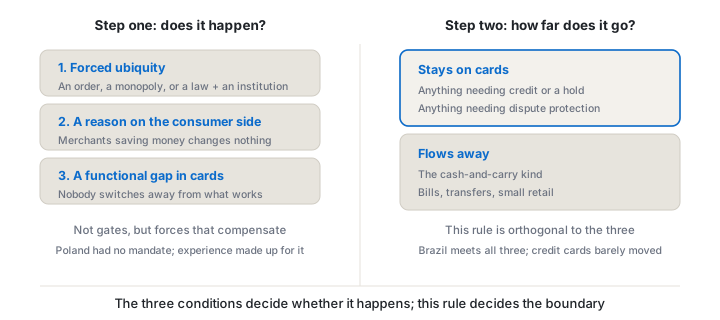
- The three conditions decide whether displacement happens in that country.
- The credit, hold and dispute rule decides where the boundary of the displacement lies.
7. The Last Layer: The Real Opponent May Not Be Called A2A
At this point there is a more fundamental question to ask.
Look back at every market where cards lost. Who actually won?
| Market | Winner | What it is |
|---|---|---|
| India | UPI | NPCI — a national clearing institution jointly owned by the banks |
| Brazil | Pix | Brazil's central bank |
| China | Alipay, WeChat Pay | Two Chinese companies, later brought under NetsUnion |
| Europe | Wero | EPI — a group of European banks, with the stated objective of reducing dependence on the American card networks |
Not one of the winners is a technology. Every winner is a domestic institution.
A2A is the tool they used. It is not the thing itself.
Put another way: the main threat facing Visa and Mastercard is not account-to-account payment as a technology. It is the will of individual countries to hold retail payments in their own hands. A2A simply happened to arrive with a scheme that was technically feasible, cheap, and politically defensible.
This has a name: payments sovereignty.
The term needs one qualifier, though, or it gets overused: what gets taken back is the rail, not necessarily the standard. These countries' merchant codes are still generated in EMVCo's format — and EMVCo is owned in equal shares by Visa, Mastercard, American Express, Discover, JCB and UnionPay. As the financials do not show it put it: the specifications are free, so the networks earn nothing at this layer, but they are sitting at the table. A country can build its own rail, set its own pricing and run its own dispute rules while its codes are still generated to somebody else's format. Sovereignty is layered — do not mistake a win at one layer for the whole thing.
Once you see it that way, what you should be watching changes.
Stop tracking A2A transaction volumes. Start tracking:
- whether new countries announce that they are building their own scheme;
- whether central banks start requiring domestic transactions to run on domestic rails;
- whether Wero's rollout across Europe stays on schedule — and above all whether its purchase protection is built by 2028, because that determines whether it can touch the high-ticket business at all.
Europe is the only large high-income market where all three conditions are being assembled at once: interchange is already capped very low (so cards' advantage on the consumer side is weak), the banks are pushing Wero in an organised way, and there is explicit political will behind it.
Brazil and India proved this can be done. Europe decides what it is worth.
8. Four Conclusions
One: three conditions — forced ubiquity, a reason on the consumer side, a functional gap in cards. They are not gates but forces that can compensate for one another — Poland covered its missing mandate with an outstanding experience.
Two: judge by channel, not by country. The Netherlands was displaced online and not in store inside one country, holding every national-level variable constant.
Three: capping interchange drains the fuel out of the challengers at the same time. That explains why the US, with the most merchant savings available anywhere, has seen the least A2A progress, and why the British rail that has existed since 2008 never made it onto the checkout page.
Four: the winner was never a technology. It was a domestic institution. The real story is not "A2A versus cards." It is payments sovereignty — and A2A is simply the handiest tool it has right now.
9. An Exercise for You
Take a market this course has not covered — Japan, Nigeria, Saudi Arabia, Vietnam, Mexico.
Ask four questions in order:
- Is there anyone who can force ubiquity? (A central bank? A national clearing institution? A company with overwhelming distribution?)
- Does the consumer have a reason to switch? (Do cards carry cashback? Is the experience good enough?)
- Do cards leave a functional gap? (Can small merchants accept cards? Is the online experience bad?) — remember to ask this per channel.
- How much of this market's transaction mix needs credit, holds or dispute protection?
The first three decide whether it happens. The fourth decides where the ceiling is.
If you can answer those four questions with confidence, this course has done its job.
10. Self-check questions
- What are the three conditions? Why call them "forces that compensate for one another" rather than "three gates"?
- The UK has had an instant transfer rail since 2008. Why do people still pay by card at checkout? Which of the three conditions does it lack?
- "The US is the market with the most merchant savings available and the least A2A progress" — explain the paradox with the model.
- Why did the EU's cap on interchange end up helping the card networks?
- The Dutch online and in-store outcomes are opposite. Why is that case methodologically so valuable?
- Brazil satisfies all three conditions. Why did the credit card block stay essentially untouched?
- "The real threat is not A2A, it is payments sovereignty" — how does that change what you should be watching?
11. Answers
Answer for yourself before reading on.
- Forced ubiquity, a reason on the consumer side, and a functional gap in cards. They are compensating forces rather than gates because of Poland: no central bank mandate, no zero-fee rule, and good card acceptance, and Blik still won on an outstanding experience plus coordinated action by the local banks. One condition strong enough can carry another's shortfall.
- It lacks conditions one and two, and condition three fails as well. Nobody required the banks to turn Faster Payments into a checkout method, so it stayed a transfer tool. British credit cards carry cashback, points and section 75 joint liability, so consumers have no reason to switch. And a contactless card is a tap in a shop, so cards leave no gap. None of the three is met, so nothing happened.
- Because the party that saves is the merchant and the party that has to switch is the consumer, and their interests were separate from the start. America's high interchange paid for the richest cashback in the world, so consumers get a direct benefit from using a card, and condition two is sealed shut. A merchant wanting to save 3% still cannot move a consumer who is earning cashback.
- Because the cap squeezed out what the merchant had to save. In the US a card costs a merchant 2.5%–3.5%, a powerful motive to push an alternative; in Europe cards already cost a fraction of a percent, and spending effort to talk consumers out of something they find pleasant, in order to save twenty basis points, is not worth it. Regulators, disciplining the card networks, drained the challengers' fuel in passing.
- Because it holds every national-level variable constant: same country, same people, same period, identical culture, regulation, banking system and smartphone penetration. The only difference is whether cards leave a gap in that channel — online you type a card number and carry fraud risk (a gap, and iDEAL took about seventy percent), in store you tap (no gap, and cards held). So you must judge by channel, not by country.
- Because the three conditions judge whether it happens, not how far it goes. The boundary is set by the other rule, the one that cuts across: transactions needing credit, an authorization hold or dispute protection stay on cards. Pix moves money you already have and cannot create credit — credit needs capital, the capacity to absorb bad debt and underwriting. So Pix took the ground held by cash, Boleto and debit cards, and the credit card block barely moved.
- Because in every market where cards lost, the winner was a domestic institution (NPCI, Brazil's central bank, EPI), not a technology. A2A is only the tool they used. So what to watch is not A2A transaction volumes but whether new countries announce their own schemes, whether central banks require domestic transactions on domestic rails, and whether Wero's purchase protection gets built by 2028 (which determines whether it can touch the high-ticket business). Europe is the only large high-income market where all three conditions are being assembled at once.
Previous: Chapter 13 · Are the Card Networks in Danger? Part Two: Why the Financials Don't Show It Next: Appendix A · A Map of the World's Local Rails — What Sits Under the Form Factor