Appendix A: A Map of the World's Local Rails — What Sits Under the Form Factor
Purpose: take every local method this course has covered, split it into four layers, and give you one comparison table you can apply to any market. Builds on: the cost structure of a QR code, the five rails compared, the word wallet. This is an appendix: outside the main line. It introduces no new judgment, it only tightens the measuring stick the main line already used by one turn. New concepts here: the four-layer model (form factor / scheme / rail / settlement), overlay services, the alias directory, one rail with several form factors
1. The Sentence This Course Has Not Said Out Loud
The previous fourteen chapters talked a great deal about QR codes. One sentence was never pulled out and stated on its own, and it is the foundation the whole course rests on:
A QR code is a form factor, not a rail.
The code does not move money. It is a piece of encoded collection information — who is being paid, how much, and which specification to parse it by. What actually moves money from one account to another is the rail underneath the code.
The direct consequence: "QR payments" is not a category of payment method at all. It is a category of initiation. Asking how a market's QR payments are doing is asking nothing. The question is three sentences long: which rail sits under that code, whose rail is it, and who funds it?
This is also why the Chinese duopoly and Southeast Asia's fragmentation look like the same thing and have opposite economics — the codes look identical, and what is underneath them is not the same species.
This appendix turns that sentence into a model you can apply to any market.
2. The Four Layers
Any local payment method splits into four layers. From the top down:
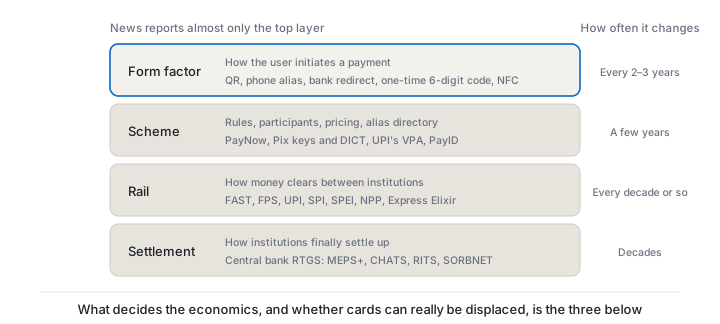
| Layer | What it determines | What it usually looks like |
|---|---|---|
| Form factor | How the user initiates a payment | QR code, phone-number alias, bank redirect, one-time six-digit code, NFC tap, request to pay |
| Scheme | Rules, participants, pricing, the alias directory | PayNow, Pix keys and DICT, UPI's VPAs, PayID and Osko, DiMo |
| Rail | How money clears between institutions | FAST, FPS, UPI, SPI, SPEI, NPP, Express Elixir |
| Settlement | How institutions finally square up | The central bank's large-value system: MEPS+, CHATS, RITS, SORBNET, dedicated instant settlement accounts |
The four layers turn over at wildly different speeds: settlement barely moves in decades, rails get replaced every fifteen years or so, schemes get added every few years, and the form factor throws up something new every two or three.
And the news reports almost nothing but the top layer. "Country launches cross-border QR linkage," "country launches phone-number transfers" — all form factor. What determines the rail's economics, and whether it can genuinely displace cards, sits in the three layers below.
This is what the course's "ask which layer" habit looks like here: when you meet the name of a local payment method, place it in these four layers before you decide what it means.
One thing to note in passing, because it changes how the top layer looks: the form-factor layer's standard is not neutral. The QR format comes from EMVCo, and EMVCo is owned in equal shares by Visa, Mastercard, American Express, Discover, JCB and UnionPay. The layer that looks most neutral is the least neutral one.
3. The Model Across Eleven Markets
| Market | Form factor | Scheme | Rail | Settlement |
|---|---|---|---|---|
| Singapore | QR (SGQR), phone number, UEN | PayNow | FAST | MEPS+, deferred net, two cycles a day |
| Hong Kong | QR (HKQR), phone number, email | FPS addressing service | FPS | CHATS, real-time gross |
| India | QR, VPA, intent links | UPI's VPA system | UPI (NPCI) | Central bank accounts |
| Brazil | QR, Pix keys | DICT (the alias directory) | SPI | The central bank's PI accounts, no overdraft allowed |
| Indonesia | QR (QRIS) | The QRIS standard | The four switching institutions designated under GPN, with BI-FAST taking over | Central bank |
| Thailand | QR, phone number, ID number | PromptPay | ITMX | Central bank |
| Mexico | CoDi is a QR, DiMo is a phone number | CoDi (2019), DiMo (2023) | The same one: SPEI | Banxico |
| Australia | No QR at all, aliases instead | PayID, Osko, PayTo | NPP | RITS Fast Settlement Service |
| Poland | One-time six-digit code | BLIK (run by PSP) | Express Elixir (instant) / Elixir (batch) | SORBNET |
| Netherlands | Bank redirect | iDEAL (being folded into Wero) | SEPA, including SCT Inst | T2 |
| China | QR | The wallets' own rules | Closed loop: the wallet's own ledger; the interbank leg runs through NetsUnion | Central bank |
Read this table by column, not by row.
Look down the form-factor column: QR codes, phone-number aliases, six-digit codes, bank redirects — four form factors sitting on the same species of thing underneath. Australia's entire NPP has essentially no QR and is a mature local instant rail regardless; Poland's BLIK uses a string of six digits and reached penetration in its own market that cards never did. There is no stable relationship between form factor and success.
Look down the settlement column: Singapore's FAST and Hong Kong's FPS are the same thing to a user — send to a phone number, arrives in seconds. But FAST settles on MEPS+ by deferred net settlement, twice a day, while Hong Kong's FPS sits inside CHATS and settles real-time gross. Identical user experience, completely different intraday risk carried by the institutions. The user never sees this layer, and it is the layer regulators care about most.
Now look at the China row. It is the only one whose rail cell reads "closed loop." That is not a formatting quirk — what sits under China's codes is not a public rail, it is two companies' ledgers. the word wallet spends a whole chapter on that one difference, and here it occupies a single cell.
4. One Rail, Two Form Factors: Mexico Proves It Cleanly
If you keep only one case for "the form factor is not what matters," keep Mexico.
Banxico built SPEI in 2004 — a national instant transfer rail, 24/7. The rail was never the missing piece. What was missing was how ordinary people would reach it.
So the central bank built two form factors on top of it:
First CoDi, in 2019: QR plus NFC. Everything you would want was there — central bank sponsorship, free to use, a nationwide rail underneath. It did not take off.
Then DiMo, in 2023: a phone-number alias. The same SPEI, nothing else changed, only the initiation swapped from "scan a code" to "type a phone number." By the end of 2023 it had 5.28 million registered users, and passed 7 million by May 2024 — not an explosion, but clearly ahead of CoDi.
Same country, same rail, same central bank, two form factors, two outcomes. So what decided the outcome plainly was not the QR code itself.
What was it? CoDi stalled on two things, and neither of them is in the form-factor layer:
- Banks had no reason to push it. CoDi generates no fee income. A bank running a CoDi transaction books a cost, not revenue — the same "revenue column or cost column" rule from Southeast Asia's fragmentation, playing out again in another country.
- Acceptance and account coverage had not caught up. In a market where only about one in eight people holds an account, the initiation method is not the first problem to solve.
Here is how to use this counterexample: next time you see "country launches QR payments," ask whether it is another CoDi — the rail was already there, and the missing piece was never the code.
5. Hong Kong Gave Each Layer Its Own Name
Hong Kong is the cleanest place to see the four layers, because it named every one of them.
- CHATS (Clearing House Automated Transfer System) is the settlement layer, Hong Kong's real-time gross settlement system.
- FPS is the rail layer, the retail instant rail live since September 2018. It is not a separate system bolted next to CHATS — HKD FPS and RMB FPS are legally designated as part of HKD CHATS and RMB CHATS respectively.
- The FPS addressing service is the scheme layer: phone numbers, email addresses and FPS IDs bound to accounts.
- HKQR is the form-factor layer: the common merchant-presented QR specification finalised in December 2017, effective 17 September 2018 alongside FPS. An HKQR app followed, combining several providers' codes into one.
Four layers, four names, four documents. When a market confuses you, do what Hong Kong did — put the names into their slots one at a time, and it usually resolves.
Two numbers while we are here, because they show that once the rail is out, the uses grow by themselves: FPS registrations went from just over 2 million at end-2018 to 13.6 million at end-2023, averaging 46% a year, and it processed 868 million transactions in 2025. At launch over 90% was person-to-person; today wallet top-ups, bill payments, merchant collections and business payments together make up half the turnover. The rail goes out first and the uses grow onto it — that order does not reverse.
One more thing worth putting side by side: HKICL, which operates FPS, is jointly owned by the HKMA and the Hong Kong Association of Banks. Singapore's BCS belongs to NETS, and NETS is owned by three banks. In both markets the national rail is operated by the banks' own company — with the central bank added in Hong Kong. That is not a coincidence: a rail that needs every bank connected can only be operated by someone no bank objects to.
6. Australia Wrote the Distinction into Its Vocabulary
Australia's NPP is an instant rail live since 2018, settling on the Fast Settlement Service inside the central bank's RITS. What makes it interesting is the official vocabulary: NPP calls the things built on top of it "overlay services."
- Osko: the overlay service operated by BPAY; the user initiates in their existing banking app and the money lands in seconds.
- PayID: the alias service — phone number, email, or business number, in place of a BSB and account number.
- PayTo: an overlay for authorisations and mandates, replacing traditional direct debit.
One rail, many services on top of it, built by different institutions. That is the four-layer model institutionalised inside a single market — Australia never needs anyone to explain that form factor and rail are different things, because its architecture documents separate them by default.
While we are here, a question people often ask: why did Australia never get universal QR payments? Because not one of the three assumptions is missing there — contactless card penetration is very high, merchants have had terminals for years, and tapping in a shop is already done. The model in the conditions for displacement gives the same answer: nothing grows where there is no gap. QR exists to fill the acceptance gap, and Australia does not have one.
7. So Is There Always a Local Rail Under the Code? No
This is the over-generalisation to guard against. "There is a local rail under the QR code" holds in most markets, but it is a common case, not a definition. Three quite different things can sit under a code:
| What is under the code | Examples | Do the card networks still get paid |
|---|---|---|
| A bank instant rail | Singapore's PayNow, Hong Kong's FPS, India's UPI, Brazil's Pix, Thailand's PromptPay | No |
| The wallet's own ledger (closed loop) | China's two | No — but the money never reached a public rail either |
| A card | UnionPay's code, Visa's mVisa, Mastercard's Masterpass QR, India's BharatQR; or a card loaded into a wallet and then scanned | Yes |
The third row is the one people drop. A transaction initiated by QR code and running on a card underneath is still a card transaction — interchange is still paid, the chargeback right still applies, and it still lands on the issuer's book. The form factor changed and the economics did not move at all.
So "this country uses QR codes" and "this country doesn't use cards" are two different statements, with no necessary link between them.
The third row is not a theoretical possibility either — it is a decade-old business: Visa's mVisa went live in India in September 2015 and then reached Kenya, Rwanda, Egypt and Nigeria; Mastercard's Masterpass QR started in Nigeria in August 2016 and covered 33 African countries through Ecobank; in February 2017 NPCI built BharatQR with Visa, Mastercard and American Express, one code taking all three plus RuPay. The largest by scale is UnionPay: over 30 million merchants in mainland China, and more than 1.5 million merchants across 44 countries and regions outside it.
And one layer above that is worth remembering even more: the format of these codes was also set by the card networks. The first row's bank-instant-rail codes — Pix, PromptPay, DuitNow, PayNow, HKQR, QRIS, VietQR — all use EMVCo's merchant-presented format. The standard for the form-factor layer is held by the side these rails are supposedly displacing. The specifications are published free, so this is not revenue, it is position; the financials do not show it sets it alongside the networks' other moves.
This is the same question the word wallet asks, one layer over: that chapter asks what is inside the wallet, this appendix asks what is under the code. The method is identical — the outside tells you nothing, look at what runs underneath.
8. How to Use This Map
When you meet a local payment method you have not seen before, ask five questions in order and you can usually place it in ten minutes:
- What is the form factor? QR, alias, redirect, something else. — Answering this tells you almost nothing, but it is the way in.
- Which rail is underneath? Bank instant clearing, a wallet ledger, or a card. — This one determines every answer that follows.
- Whose rail is it? A central bank, a clearing house the banks own together, or a private company. — This determines who can change its pricing.
- Who funds it? Merchants, participating institutions, or the government. — The whole of the five rails compared lives in this question.
- For a participating institution, is one transaction revenue or cost? — This predicts whether they will actually push it. CoDi died on this question.
Only the first of the five is about the form factor; the other four are at the rail layer and below. That is the entire takeaway of this appendix.
9. Self-check questions
- Why is "QR payments" not a category of payment method? Which three questions turn it into a meaningful one?
- Singapore's FAST and Hong Kong's FPS look nearly identical to a user. How do they differ at the settlement layer? Who sees that difference and who cares about it?
- Mexico's CoDi and DiMo run on the same rail and produced different outcomes. What does that show? CoDi stalled for two reasons — which layer is each in?
- Australia's NPP has essentially no QR. Is it a successful local rail? Why did Australia never grow universal QR payments?
- What three things can sit under a QR code? In which case do the card networks still get paid?
- Who owns EMVCo? How does that change your reading of "the QR code is the alternative to cards"?
10. Answers
Answer for yourself before reading on.
- Because a QR code is a form factor, not a rail — it is encoded collection information and it does not move money. The three questions to add are: which rail is under this code, whose rail is it, and who funds it. Only with those answered does "QR" correspond to something with economic content.
- Singapore's FAST settles on MEPS+ by deferred net settlement, twice a day; Hong Kong's FPS sits inside CHATS and settles real-time gross. Users get money in seconds either way and never see the difference; the people who care are regulators and participating institutions — deferred net means institutions carry intraday exposure to each other until they square up, and real-time gross means they do not. Settlement is the layer users never see and regulators always watch.
- It shows the form-factor layer does not determine the outcome: same central bank, same SPEI, only the initiation changed, and the results differed. Both of CoDi's problems sit below the form factor — one is incentives (banks earn no fee on CoDi, so a transaction books as cost rather than revenue and they do not push it), the other is preconditions (account and acceptance coverage were not there, and no initiation method fixes that).
- Yes. It has all four layers and it institutionalised the top one as "overlay services," with Osko, PayID and PayTo each doing one job. It never grew universal QR because Australia has no acceptance gap — high contactless penetration, terminals long since installed, and tapping already finishes the job. QR is a tool for filling the acceptance gap, and nothing grows where there is no gap.
- Three: a bank instant rail (Singapore, Hong Kong, India, Brazil, Thailand), the wallet's own ledger (China's closed loop), and a card. In the third case the card networks still get paid — a transaction initiated by code and running on a card is still a card transaction, interchange and the chargeback right included. So "uses QR" and "doesn't use cards" are two different statements.
- EMVCo is owned in equal shares by Visa, Mastercard, American Express, Discover, JCB and UnionPay — the card networks' consortium. The merchant codes of Pix, PromptPay, DuitNow, PayNow, HKQR, QRIS and VietQR all use its format, and the networks run codes of their own (mVisa, Masterpass QR, BharatQR, UnionPay's code). So "QR code = the alternative to cards" is simply wrong. The accurate version: the QR code is a form factor open to everyone, whose format the card networks set and on which they also collect their own money; whether cards get displaced depends on the rail under the code, and has nothing to do with the code itself.
Previous: Chapter 14 · A Model That Predicts: What It Takes to Displace Cards Next: (none — this is the end of the course)