China: How Two Companies Took a Country's Checkout
Part II · Three Ways to Turn a Local Rail into National Infrastructure (Chapters 3–7) Builds on: Chapter 2 (merchant-presented QR, static and dynamic codes) New concepts in this chapter: closed-loop wallet, customer funds held by the wallet operator, the direct-connection cutoff, a proprietary QR code standard, the two-sided subsidy war
1. The Question the Previous Chapter Left Open
A sticker is cheap, but running a QR acceptance scheme needs three expensive things: a real-time online central ledger, a merchant directory, and somebody willing to pay for both.
China's answer: nobody was assigned to do it, two companies did it themselves, and then fought a war over it.
What this chapter has to make clear is not the result — "Alipay and WeChat won" — but what they won with. Because no other country has that thing.
2. Why Cards Didn't Take This Position First
China was not short of card networks. UnionPay was founded in 2002, and China has led the world in cards issued for years.
But cards issued and acceptance coverage are two different things. Go back to the market stall in the chapter where cards assume three things: the cost of a POS terminal is fixed, the stallholder's volume is too small, and the acquirer will not make the trip for him. China has tens of millions of merchants like that.
UnionPay connected the banks to each other. Nobody connected the small merchants in. In China the acceptance gap is not a marginal problem. It is most of retail.
That gap is the door the two companies walked through.
3. The Closed-Loop Wallet: The Most Important Mechanism in This Chapter
Alipay and WeChat Pay differ from cards in one fundamental way: users' money can sit on their own ledgers.
You top up a hundred yuan into Alipay, and that hundred yuan stops being a bank deposit and becomes a debt Alipay owes you. Alipay records it on its own books. In the industry these customer funds held by the wallet operator have their own name. Where they sit in the money hierarchy and what protection they get is covered in Payment Systems, and this course does not repeat it.
The point is the next step. When you pay Alipay to a merchant who is also on Alipay, what happens is this:
Alipay moves a hundred yuan from your name to the merchant's name, on its own ledger. No bank is involved. No interbank clearing. No netting and no settlement.
This is what closed-loop means: the money goes round inside one closed ledger and never leaves the building.
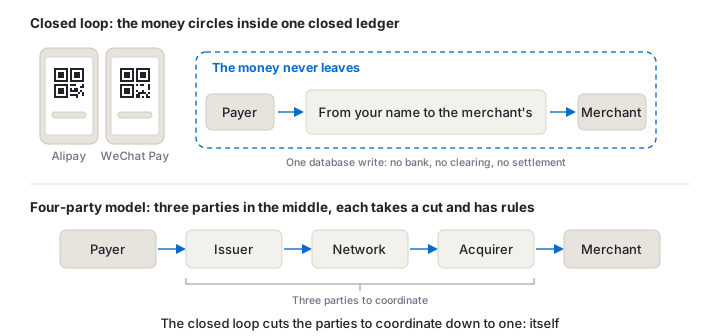
The closed loop has two consequences, and they explain everything that follows.
First, the marginal cost of the transaction is near zero. It is one database write. Not a message, a clearing cycle, and a settlement — one line of bookkeeping. So the wallet operator is perfectly able to charge nothing, because it did not spend much in the first place.
Second, the wallet operator holds the payer and the payee at the same time. It does not have to split revenue with anyone, and it does not have to explain itself to anyone. It sets its own pricing, decides its own subsidies, and decides who may connect.
Compare cards: one card transaction passes through issuer, card network, and acquirer, each taking a share and each imposing rules. A large part of the four-party model's cost is coordination cost. The closed loop cuts the number of parties to coordinate with down to one: itself.
4. Distribution: The Real Weapon
Low cost let them be free. But free does not mean anyone will use it. What actually spread them was something else.
Alipay grew inside Taobao. WeChat Pay grew inside WeChat.
These two apps are things Chinese people already open many times a day. One is where you buy things, the other is where you talk to everybody you know. The payment function does not have to win the user's attention. It is already in the user's hand.
Compare a standalone payment app: it has to persuade you to download, to register, to link a card, and then to remember it exists at the moment you pay. Each of those three steps loses more than half the people.
Alipay and WeChat Pay skipped the first two. All they had left was the last one: getting you to open it at the moment of payment.
Which is what 2014 was about.
5. Why a Red Envelope Was an Acquiring Move
At Chinese New Year 2014, WeChat launched red envelopes. People treated it as an entertaining social feature. From a payments point of view, it was an exceptionally precise piece of user acquisition.
To understand it, look at where the bottleneck was. Before a WeChat user could pay, he had to link a bank card. Linking a card is the hardest step on the whole chain: type in the card number, verify by SMS, accept an agreement — and while doing it the user gets nothing at all. It is pure cost with zero return, so the overwhelming majority never did it.
The red envelope inverted the action.
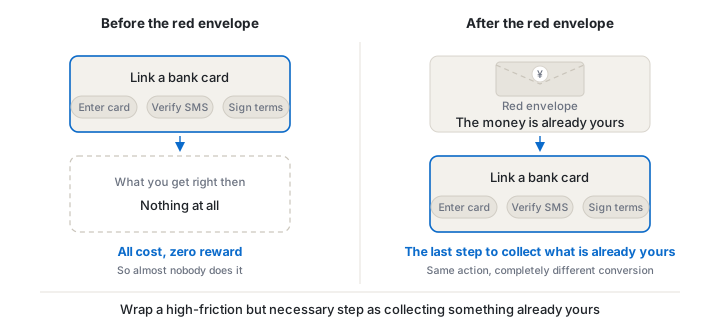
You receive a red envelope. The money is already yours. But to take it out, you have to link a card.
The identical card-linking action stopped being "preparation so that I can spend money later" and became "the final step to collect money that is already mine." The cost is unchanged. The feel of it is completely different.
That is why it worked — not because it was fun. Plenty of features are fun. Only this one moved conversion on the hardest step in the payments industry.
Remember the pattern: take a necessary, high-friction step and wrap it as collecting something you already have. Another version of it turns up in the chapter on buy now, pay later.
6. The Direct-Connection Cutoff: The State Didn't Build the Rail, It Bolted Supervision Onto One Already Running
By the fourth quarter of 2017, Alipay and WeChat Pay together held 92.41% of the Chinese mobile payments market.
That number implies something a regulator finds very hard to accept: two nonbank institutions, each privately wired to several hundred banks, processing the great majority of a country's retail payments, with the central bank unable to see any of those transactions.
In December 2017 the People's Bank of China issued the Barcode Payment Business Specification (Trial), effective 1 April 2018. The core requirement: barcode payment business must be processed through the PBOC's interbank clearing system, or through a properly licensed clearing institution.
The industry calls this the direct-connection cutoff — severing the direct links between payment institutions and banks.
The chain became:
Alipay / WeChat → merchant → acquirer → UnionPay / NetsUnion → Alipay / WeChat
Why NetsUnion exists and what N² problem it solves is covered in Payment Systems, and this course does not repeat it.
What this chapter wants to raise is something else, and it is the most fundamental difference between China's path and the two chapters that follow:
The order was reversed.
In Brazil, the central bank built the rail first and then required everyone to connect. In China, two companies built the rail, filled it, and took more than ninety percent of the market, and only then did the state bolt supervision onto a rail that was already running.
The same act — "payments must pass through a central clearing institution" — is a completely different kind of act in the two countries. In Brazil it was creation. In China it was annexation.
But be precise about which segment got annexed. Transactions where payer and merchant sit inside the same wallet are still just the wallet writing a line on its own ledger. The closed loop itself was never touched.
The code was not touched either. Alipay has its own code format, WeChat Pay has its own, Cloud QuickPass has its own, and they do not read each other. The People's Bank asked institutions to unify barcode payment coding rules in its 2019–2021 fintech development plan, which tells you they were not unified then; real interoperability came from pilots in 2020 and was opened up step by step from 2021 with UnionPay and NetsUnion acting as intermediaries, and WeChat Pay's merchant collection codes only reached full-scenario acceptance on UnionPay's network in June 2024.
So the full shape of the Chinese route is this: ledger, clearing and code standard, all three built by the two companies in one go, with the state later annexing only the middle one. That is the reverse of other markets — Southeast Asia's fragmentation sets it against "a public rail plus an EMVCo code."
When two markets end up different, look for the institutional and incentive difference first. The difference here is not technical. It is who moved first.
7. The Bill for This Route
What does a merchant in China pay to take a QR payment? Around 0.6% for general trades, around 1% for virtual goods like games and entertainment.
That is below typical credit card merchant cost, but it is not zero. China's route is commercially funded: the wallet operators charge merchants, and that revenue pays for the rail, the risk controls, and the support staff.
There was a subsidy period — during the rollout both companies burned enormous sums grabbing merchants and users, which is the two-sided subsidy war: hand money to payers and payees at once and light both sides of a two-sided market together. But a subsidy is an acquisition cost, not a business model. Once the fight was over, the rates came back.
The result, per Worldpay's 2026 report: Alipay and WeChat Pay together account for 89% of Chinese e-commerce volume and 87% of offline POS volume.
In a country whose card network was founded early and which leads the world in cards issued, cards have been pushed to the margins of retail.
8. Three Conclusions
One, the closed loop pushes the marginal cost of a transaction to near zero, which is the precondition for free. Money moving round on your own ledger needs no clearing and no revenue split with anyone. The coordination cost the four-party model can never remove, the closed loop simply never incurs.
Two, the real weapon was distribution, not pricing. Cheap things are plentiful. Things living inside an app a billion people open every day number exactly two. The red envelope's value was not that it was fun; it was that it repackaged the high-friction act of linking a card as collecting money.
Three, China's route ran on distribution two companies already owned, not on a state mandate. No other country can copy it, because no other country has two apps with a billion users each. The state's role here was annexation after the fact, not construction beforehand.
9. The Question This Chapter Leaves Open
China's route needs a precondition: one or two companies in the market with distribution large enough to light a two-sided market on their own.
Most countries have no such company. India does not. Brazil does not. Indonesia does not.
So what does a country with no super-app do? Who builds the rail, and who pays for it?
India gave an answer that is the opposite of China's at almost every point.
10. Self-check questions
- China has led the world in cards issued for years. Why didn't cards take the small-merchant checkout first?
- Why is a closed-loop wallet's marginal cost near zero? Answer from what actually happens in one transaction.
- Which specific bottleneck on the payment chain did the red envelope solve? Why did the identical action convert differently once it was repackaged?
- After the direct-connection cutoff, what extra link appeared in China's QR payment chain? What is the biggest difference in kind between that and Brazil's central bank building Pix?
- "The China model proves mobile payments can be completely free" — where is that sentence wrong?
11. Answers
Answer for yourself before reading on.
- Because cards issued and acceptance coverage are two different things. UnionPay connected the banks to each other, but nobody connected the long-tail merchants in — the cost of a POS terminal is fixed, a small merchant's volume cannot absorb it, and the acquirer will not make the trip. China has tens of millions of such merchants, so the acceptance gap there is not marginal; it is most of retail.
- Because payer and payee are inside the same wallet, so the transaction is just the wallet operator moving a balance from one name to another on its own ledger. No interbank message, no clearing, no netting, no settlement. It is one database write. The coordination cost the four-party model can never remove is simply never incurred.
- The bottleneck is linking a card. Linking a card means typing a card number, verifying by SMS, and accepting an agreement, and the user gets nothing on the spot for doing it — pure cost, zero return, so most people didn't. The red envelope turned it into "you have already received money, and linking a card is the last step to take it out." The action performed is identical, but it went from "preparing for the future" to "collecting something already yours."
- It added the UnionPay / NetsUnion link: Alipay / WeChat → merchant → acquirer → UnionPay / NetsUnion → Alipay / WeChat. The difference in kind is the order: Brazil's central bank built the rail first and then required connection, which is creation; in China two companies built it and took more than ninety percent of the market first, and the state bolted supervision on afterwards, which is annexation.
- Wrong in two places. First, QR payments in China are not free for merchants — around 0.6% for general trades, around 1% for virtual goods; the route is commercially funded. Second, the two-sided subsidy during the rollout was an acquisition cost, not a business model, and once the fight was over the rates came back. "Free" describes one phase of the subsidy period, not the structure of this route.
Previous: Chapter 2 · A Sticker Beats a Terminal: What a QR Payment Actually Is Next: Chapter 4 · India's UPI: What Happens After You Set the Fee to Zero