India's UPI: What Happens After You Set the Fee to Zero
Part II · Three Ways to Turn a Local Rail into National Infrastructure (Chapters 3–7) Builds on: Chapter 3 (closed-loop wallet, distribution) New concepts in this chapter: open rail, virtual payment address, zero MDR, the split between count and value
1. The Question the Previous Chapter Left Open
China's route only works if one or two companies already have distribution large enough to light a two-sided market on their own.
India had none. In 2016 there was no app in India with a billion users, and no company big enough to roll out a national acceptance network by itself.
So India did something that is the opposite of China at almost every point: the rail was built by a national clearing house jointly owned by the banks, and then opened to every app.
This chapter is about everything that choice produced — including one very beautiful result, and one price that is rarely stated clearly.
2. An Open Rail: The Money Never Enters Your Ledger
UPI is operated by NPCI, a national clearing house jointly held by a number of Indian banks and run on a not-for-profit basis.
Its most fundamental difference from a closed-loop wallet fits in one sentence:
On UPI, the money stays in the user's own bank account from beginning to end. The app is only a front end that issues instructions.
You scan a code in some app and pay a hundred rupees. What that app does is push the instruction "move a hundred rupees from my account to this merchant" into UPI, and UPI tells the two banks to complete the transfer. The money never sits on that app's ledger for a single second.
Compare China's closed-loop wallet: there, the money becomes a debt the wallet operator owes you, parked on its ledger.
The consequences of that difference are very large.
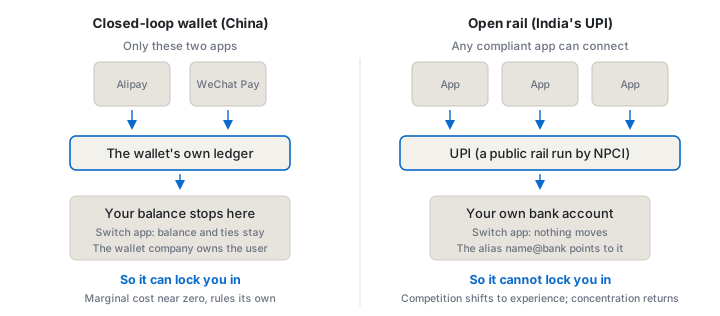
| Closed-loop wallet (China) | Open rail (India) | |
|---|---|---|
| Where the money sits | The wallet operator's ledger | The user's own bank account |
| Who owns the user | The wallet operator | The bank |
| Can the app lock you in | Yes — the balance and the relationships are with it | No — it holds nothing |
| Marginal cost | Near zero (one entry on its own books) | Has to cross the interbank rail |
| Who can connect | The wallet operator decides | Any compliant app |
Look at the third row. On an open rail an app has no balance, no ledger, and nothing whatsoever it can hold over you. Switch apps and not a rupee moves, because the money was never in the app.
In theory that should make the market extremely fragmented: if switching costs nothing, nobody gets big.
The actual result is the reverse.
3. An Open Rail Grew a Duopoly Anyway
As of July 2026, PhonePe alone held 49.06% of UPI transaction count. Add the number two and the pair take most of it.
The open rail killed balance lock-in. It did not kill scale effects. When every app plugs into the same rail and can do exactly the same things, the only thing a user can compare is experience — whose interface is smoother, whose success rate is higher, whose merchant codes are more widely deployed. And those are precisely the things companies with money and people do better.
Remove the lock-in and competition collapses onto experience; experience is a function of scale; so concentration happened anyway, just one layer over.
NPCI has floated a market share cap on any single app, but it has never actually taken effect.
4. The Virtual Payment Address: An Underrated Component
A bank account number is a string of digits nobody remembers and nobody dares read out to a stranger. It cannot serve as an identifier ordinary people use to get paid.
UPI's fix is an alias layer: the virtual payment address (VPA), which looks like name@bank. You give it to someone, they can pay you, and your real account number is never exposed at any point.
The layer sounds trivial and it is the precondition for the whole thing working. Without an alias layer, ordinary people cannot pay each other at all, and QR is a non-starter — the alias is exactly what the code carries.
Remember this component. Brazil independently built an identical one (called the Pix key), Europe's Wero uses phone numbers, Poland's Blik uses a six-digit string. Four unrelated schemes each built the same component. That is not a coincidence. The chapter on the conditions for displacement comes back and uses this as evidence.
5. Setting the Fee to Zero
From 2020, Indian law prohibits charging merchants for UPI and RuPay debit card transactions.
In the payments industry this is an extreme act. It is not "a very low rate." It is the legal abolition of transaction revenue on this rail.
Which forces a question: if nobody is paying, who is keeping this rail alive?
The answer: banks and payment institutions absorb the cost themselves, partly offset by government subsidy. This rail is politically funded, not commercially funded.
The arrangement is stable in India, because financial inclusion is a national goal in its own right — letting the poorest people send and receive money is worth something that does not appear on this rail's income statement.
But it rewrote the business model of every Indian payments company. You cannot make money on the transaction, so you have to make money somewhere else: lending, wealth products, insurance, other businesses sold to merchants. Payment itself became an acquisition channel, not a revenue source.
Which is why India's payments companies look nothing like American or European ones. They look like payments companies and they are actually financial companies that acquire customers through payments.
6. What Happened to India's Debit Cards
This is the most important set of numbers in the course.
| 2021 | 2025 | |
|---|---|---|
| Debit card count | 4.087 billion | 1.336 billion |
| Debit card value | 7.4 lakh crore rupees | 4.5 lakh crore rupees |
| UPI count | 38.73 billion | 228.28 billion |
| UPI value | 72 lakh crore rupees | 300 lakh crore rupees |
Debit card transaction count fell 67% in four years.
Be precise about what that sentence means: not slower growth, not a falling share — the absolute count dropped by two thirds. In a country whose economy is growing and whose digital payments are exploding, one payment instrument went into absolute decline. That is rare in the history of payments.
It is the hardest single piece of evidence for the proposition that a local method really can displace cards. When the course gets to whether the card networks are in danger, this table is the prosecution's exhibit A.
7. But — 85.5% and 9.5%
Now the other set of numbers, from the same central bank, for the same second half of 2025:
UPI is 85.5% of India's payment count, and only 9.5% of the value.
Put the two together and the conclusion writes itself:
UPI won the small, frequent transactions. The large ones it did not win.
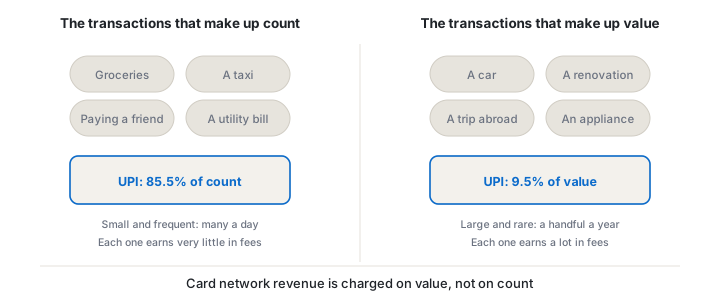
Think about an ordinary day: buying vegetables, taking a cab, paying a utility bill, sending a friend money. Those are count, not value. Buying a car, renovating a flat, a trip abroad, a large appliance. Those are value, not count.
This does not say UPI failed — inside the slice it took, it is overwhelming. It says the slice it took and the slice cards make the most money on were never fully the same slice.
That thread turns into a complete explanation in the chapter on why the financials do not show it. For now, just hold the distinction: count and value are two different things, and looking at only one of them gives you the opposite conclusion.
8. When Credit Comes Onto the Rail, the Fee Comes Back
India later allowed RuPay credit cards to be linked to UPI: you scan a code in UPI, and the money comes out of a credit line instead of your deposits.
Then something very telling happened.
From 1 June 2026, RuPay credit-on-UPI transactions above ₹2,000 started carrying MDR — the merchant discount rate, the fee the merchant pays to accept a payment. On 1 April 2026, NPCI had also cut the payer-side fee on these transactions (from 8 basis points to 6 for non-industry categories, and from 4 basis points to 3 for industry categories) — and a cut presupposes there was a fee there to cut.
Zero MDR has a hole in it on this rail, and the hole is exactly where credit is.
The reason is not hard. Moving your own money from one account to another really does cost close to nothing. Lending you money does not. Lending requires capital, absorbing bad debt, running risk controls, and chasing collections. Someone has to pay those costs, and a law saying you may not charge does not conjure the money from anywhere.
A rail can be free; credit cannot. It is the hardest boundary around A2A schemes, and the chapter on the conditions for displacement expands it into a test you can apply.
Worth noting alongside: over the same period India's credit card spending kept growing. Same country, same rail, same consumers — debit collapsed and credit did not. That contrast says more than any aggregate figure.
9. Three Conclusions
One, an open rail traded "the money never enters the app" for zero switching cost, and concentration happened anyway. With lock-in gone, competition compressed onto experience, and experience is a function of scale.
Two, zero MDR is not "cheap," it is the removal of this rail's entire business model. The price is that Indian payments companies must earn from something other than payments; the benefit is that the acceptance gap got filled completely, because for a merchant there is no reason at all to refuse it.
Three, UPI won count and not value, and the moment credit came onto the rail the fee came back. Both point at the same conclusion: what an A2A rail replaces is the function "move my own money across," not the function "someone fronts the money for you."
10. The Question This Chapter Leaves Open
India's banks were persuaded and pushed onto UPI — NPCI is jointly owned by the banks, the law removed the fee, and the government pays a subsidy.
But there is always a process of coordination here. The banks are, to some degree, volunteers.
What if a central bank has no intention of persuading anyone and simply issues an order?
Brazil tried that road, and it is the fastest of the three.
11. Self-check questions
- On UPI, where does the user's money sit? Why does that make it impossible for an app to lock the user in?
- If switching costs nothing, why did UPI still grow a company holding nearly half the market?
- What problem does the virtual payment address solve? Why is it worth noticing that other countries independently built the same component?
- "UPI is 85.5% of India's payment count" and "UPI is only 9.5% of the value" are both true. What do they say together?
- Why did zero MDR get punched through on RuPay credit-on-UPI? Answer from cost structure, not just "the regulator changed the rules."
12. Answers
Answer for yourself before reading on.
- In the user's own bank account. The app is only a front end pushing the payment instruction into UPI, and the money never rests on its ledger for a second. The app has no balance and no ledger; switch apps and not a rupee moves — there is nothing at all it can hold over the user.
- Because what an open rail kills is balance lock-in, not scale effects. When every app plugs into the same rail and does exactly the same things, the only comparison left is experience: is the interface smooth, is the success rate high, are the merchant codes widely deployed. All of those are bought with money and people, so concentration happened anyway — it just moved from the "lock the user in" layer to the "build a better experience" layer.
- It solves the problem that a bank account number cannot serve as a payment identifier for ordinary people — too long, unmemorable, and not something you want to hand out. The alias layer points a short, publishable identifier at the real account. It is worth noticing because India's VPA, Brazil's Pix key, Blik's six digits in Poland, and Wero's phone numbers in Europe are four unrelated schemes that each built the same component independently. Multiple independent designs converging on one design means the component is necessary, not a preference of any one scheme.
- They say UPI won small, frequent transactions and did not win large ones. Buying vegetables, taking a cab, and sending money contribute count; buying a car, renovating, and large purchases contribute value. So it is overwhelming inside its own slice, but that slice and the slice cards make the most money on do not fully overlap. Look only at count and you conclude cards have been comprehensively displaced; look only at value and you conclude nothing has happened.
- Because moving money and lending money have completely different cost structures. Shifting a user's own money from one account to another really does have a marginal cost near zero, so pricing it at zero is sustainable. But in a credit card transaction somebody fronted the money: capital is tied up, bad debt has to be absorbed, risk controls and collections have to be run. Those are real costs, and a law forbidding a charge does not make them disappear — it only makes nobody willing to carry them. So once credit is on the rail, the fee necessarily comes back.
Previous: Chapter 3 · China: How Two Companies Took a Country's Checkout Next: Chapter 5 · Brazil's Pix: When the Central Bank Builds It Itself