Southeast Asia: Five Countries, Five Rails, and Only Then the Codes
Part II · Three Ways to Turn a Local Rail into National Infrastructure (Chapters 3–7) Builds on: Chapter 3 (closed-loop wallets), Chapter 4 (open rails), Chapter 5 (mandatory participation, the alias layer) New concepts in this chapter: the division of labour between rail, alias and code; switching institutions; a unified QR standard; the acquiring relationship; tiered pricing; rail-level pricing (participation fees and per-transaction fees); volume-banded discounts; bilateral linkage; hub-and-spoke interlinking; wallets and bank rails coexisting; the retail end and the wholesale end
1. The Question the Previous Chapter Left Open
All three paths needed someone in charge: two companies with overwhelming distribution, one national clearing institution, or a central bank willing to give orders.
Southeast Asia has none of them.
And the absence runs two levels deep: no one country calls the shots in the region, and inside most countries no one wallet calls the shots either.
So a fourth case grew here. It deserves its own chapter, not only because you may be in this market, but because it is the one place where you can see exactly what "linkage" can and cannot do.
But before going in, one ordering has to be fixed, or the rest is just a list of names.
2. First, Separate Them: a Code Is Not a Rail, and It Has to Run on One
the cost structure of a QR code laid down a rule: a QR code is a form factor, not a rail. This chapter is where that rule most needs to be used properly.
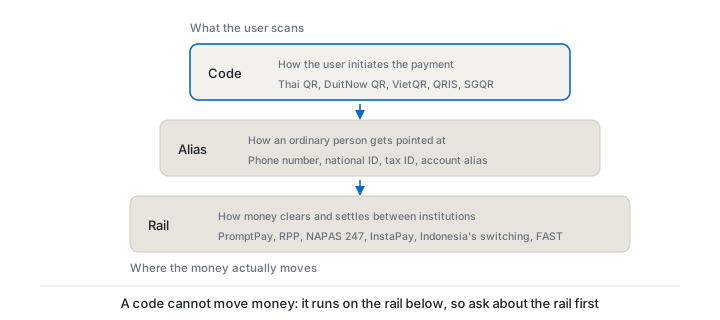
The reason is practical. After a QR payment is scanned, the money still has to travel from one account to another. Which path it takes, how many seconds it takes, who clears it, who carries the intraday risk — all of that lives in the layers underneath the code. The code itself moves nothing.
So every market in this chapter is read in the same order, through three layers:
| Layer | What it decides | What it looks like in Southeast Asia |
|---|---|---|
| Rail | How money clears and settles between institutions | PromptPay, RPP, NAPAS 247, InstaPay, Indonesia's switching institutions, FAST |
| Alias | How an ordinary person gets pointed at | A phone number, a national ID, a tax ID, or an account alias |
| Code | How the user initiates the payment | Thai QR, DuitNow QR, VietQR, QR Ph, QRIS, SGQR |
Ask first who built the rail, who operates it, and how the money settles; ask second what year the code was draped over it and whose specification it follows. Reverse the order and six identical-looking codes read as six identical things, when their biggest difference is in the bottom layer.
While we are here, one very common misreading, and it sits on the opposite side of the same rule.
China's two wallets are not "a code with no rail underneath" — they built all three layers themselves. The ledger is theirs. For a long stretch the clearing was theirs too: Alipay and WeChat Pay each held direct connections to hundreds of banks, which amounts to a privately built clearing network. Even the code format was their own, and the two do not read each other. the Chinese duopoly is the story of how they took all three layers at once. Section 10 of this chapter puts the two regions side by side, because the codes of Southeast Asia and the codes of China look almost identical, and not one of the three layers underneath them is the same species.
3. Thailand: PromptPay the Rail First, Thai QR the Code After
Thailand is the cleanest version of this order — clean enough to use as a template.
The rail came first. The Bank of Thailand launched PromptPay in December 2016, with public use from 2017, turning interbank transfers into instant, low-cost national infrastructure.
The operator was not built from scratch. The central bank picked National ITMX, because it was already running four systems: the ATM switch, the card switch, bulk payments, and single fund transfers. That is worth remembering: a new national rail is usually not conjured out of nothing, it is hung on an institution that already does clearing.
The alias layer followed. PromptPay uses mobile numbers and national ID numbers as the payment handle — the same component as the virtual payment address in India's zero fee and the Pix key in Brazil's central bank answer, in its third incarnation.
The code came last, nearly a year later. Thailand's QR specification was published in October 2017, based on the EMVCo specification with local customisation.
Put the dates together: the rail in December 2016, the code in October 2017. The code is not where this thing starts. It is the last step in getting it onto a street stall.
4. Malaysia: RPP the Rail, DuitNow the Layer on Top
Malaysia is the same shape.
The rail layer is RPP (the Real-time Retail Payments Platform), operated by PayNet, Malaysia's national payments network.
The alias layer is DuitNow, introduced in December 2018, using a mobile number, national ID, passport number or business registration number as the handle.
The code layer is DuitNow QR, which uses the EMVCo merchant-presented format — one code that collects for every participating bank and e-wallet.
Note that DuitNow and DuitNow QR are two different things: the first is alias-based transfer, the second is a layer of code draped over the same RPP. One rail, two ways to initiate. That is exactly the point the Mexico case in the rail map makes — change the form factor without changing the rail and the outcome can differ enormously.
5. Vietnam: NAPAS 247 the Rail, VietQR the Code
Vietnam's rail layer is the 247 fast transfer service operated by NAPAS, the National Payment Corporation of Vietnam: interbank, around the clock.
The code was draped over it later. On 15 June 2021, NAPAS and a first cohort of 14 banks launched the VietQR mark and QR-based transfer running on NAPAS 247. VietQR meets both the EMVCo base specification and the domestic QR base standard the State Bank of Vietnam issued for the whole market.
One detail in the Vietnamese case is worth noticing: VietQR started out selling "scan to transfer," not "scan to buy." Get person-to-person working first, then move towards merchant collection — the same way of rolling out as Pix doing one-off pushes at launch and adding recurring debit years later: build the simplest thing first.
6. The Philippines: InstaPay the Rail, QR Ph the Code
The Philippines writes the ownership of these two layers out unusually clearly.
The rail layer is InstaPay, the instant payment rail driven by the central bank (BSP).
The code layer is QR Ph, established by BSP Circular 1055 in October 2019, governed by PPMI (Philippine Payments Management, Inc., the country's payment system management body), and based on the EMV QR specification. It runs on InstaPay.
The rollout order is the same one again: person-to-person went live in November 2019, with merchant collection filled in afterwards.
Four markets in, the shape is identical: one domestic instant rail, one alias layer, one layer of EMVCo code — and the code is always the last layer to arrive. Now for two more complicated ones.
7. Indonesia: the Switching Was Already There; QRIS Unified the Codes
Indonesia differs from the previous four, because its rail layer is not a newly built instant payment system.
Indonesia's rail layer is a set of switching institutions. Under the GPN framework (Gerbang Pembayaran Nasional, the national payment gateway), Bank Indonesia designated four switching institutions to process transactions: Artajasa, Rintis, Jalin and Alto (behind the ATM Bersama, PRIMA, Link and ALTO networks), with clearing and settlement handled by PTEN.
Those are the parties that process QRIS transactions. This needs saying explicitly, because it is the easiest thing to get wrong: Indonesia did later build BI-FAST, but that was December 2021, more than two years after QRIS, and it is a different system. Saying "QRIS runs on BI-FAST" is wrong.
The code layer is where Indonesia's story actually is. QRIS was launched on 17 August 2019 (under PADG 21/18/PADG/2019 of 16 August) and came into effect on 1 January 2020. Bank Indonesia drew it up with the Indonesian Payment System Association (ASPI) on the EMVCo specification, with the first phase focused on merchant-presented mode.
So Indonesia's order is the reverse of Thailand's: the switching pipes were laid long ago. What was missing was not a rail, it was a way to collapse dozens of mutually unreadable codes into one.
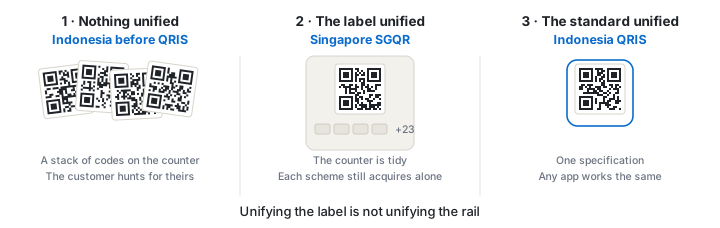
The starting position was this: every wallet had its own code, merchants had seven or eight stickers on the counter, and the customer had to find theirs first. What QRIS did was not "build a new wallet," and not "build a new rail" — it was "make the existing codes read each other": the central bank sets one specification and every institution's code is generated to it.
Tiered Pricing: the Pricing Design Most Worth Learning in This Course
The previous three chapters gave three funding models: China charges commercially, India legislated zero, Brazil made it cheap for everyone.
Indonesia gave a fourth, and it is the most elegant.
The merchant rate Bank Indonesia sets is tiered by merchant size and ticket size:
| Merchant category | Rate |
|---|---|
| Micro (UMI), ticket ≤ IDR 500,000 | 0% |
| Micro (UMI), ticket > IDR 500,000 | 0.3% |
| Small / medium / large (UKE / UME / UBE) | 0.7% |
| Education | 0.6% |
| Fuel stations, public service agencies (BLU), public service obligation (PSO) | 0.4% |
One more rule matters just as much: the merchant bears this cost, and Bank Indonesia expressly forbids passing it on to the consumer.
What makes this design good?
Indonesia did not choose between "charge" and "free." It split the acceptance gap and the funding of the rail into two problems and solved them separately.
- The vegetable stallholder — small tickets, small volume — pays zero. He has no reason to refuse electronic payment. The acceptance gap closes for him.
- A convenience store chain pays 0.7%. It can afford it, and what it pays feeds the whole rail.
Compare India: India set zero for everyone, so there is no transaction revenue and the rail runs on political will and government subsidy. Indonesia has the large merchants feed the small ones, so the rail feeds itself and does not have to ask for a budget every year.
Tiering is not a compromise, it is a smarter funding structure. It is more sustainable than flat-free and reaches further down the tail than flat-charged.
On scale, QRIS had passed 50 million users and 32 million merchants by 2024 (52.55 million users and 33.77 million merchants as of August 2024).
8. Singapore: FAST Is the Rail, PayNow Is the Alias, SGQR Is the Label
Singapore is where these three layers are pulled furthest apart — far enough that each layer has its own name, its own rulebook, and its own owner. When a market will not come into focus, filing the names the way Singapore does usually clears it up.
| Name | Which layer | What it is | Whose rules | Who operates |
|---|---|---|---|---|
| FAST | Rail | The instant transfer system, live 17 March 2014 | SCHA (Singapore Clearing House Association) | BCS |
| PayNow | Alias | Live July 2017, draped over FAST | ABS (Association of Banks in Singapore) | BCS |
| SGQR | Code | The unified label, September 2018 | MAS + IMDA | BCS runs the central repository |
Three layers, three rule-setters, one operator. BCS (Banking Computer Services) also holds interbank GIRO, eGIRO and cheque clearing — essentially all of Singapore's national clearing infrastructure sits in this one company.
Go one level up to ownership: BCS belongs to the NETS group, and NETS is held by three banks: DBS, OCBC and UOB.
That chain deserves a pause. This piece of national infrastructure, treated as "the bank rail," is operated by a company jointly owned by three large banks, under rules written by the banks' own industry association. And the instant transfer technology behind FAST was implemented with help from Vocalink, a Mastercard company — the financials do not show it covers the same irony at the UK's Faster Payments, and in Singapore it is the same shape.
On 12 February 2025, MAS and ABS announced they would consolidate the administration and governance of these schemes into a new entity, pulling together responsibilities currently spread across SCHA, ABS, MAS and IMDA. The definition of a "payment scheme" in that announcement is worth copying out: a set of rules governing participant eligibility, the pricing for using the network, and operational and security standards.
Pricing and eligibility sit in the same sentence. That is not an accident — they are two sides of one thing.
The Label Was Unified; the Acquiring Was Not
Singapore launched SGQR on 17 September 2018, described officially as the world's first unified payment QR code. Twenty-seven payment schemes share one label. Merchants who used to display a row of codes now display one.
That sounds like Indonesia's QRIS. It is not.
SGQR unified the label; QRIS unified the standard. An SGQR label carries the marks of twenty-odd schemes side by side, so the customer still has to find their app's logo on it, and the merchant still has to negotiate an acquiring relationship with each scheme separately — separate reconciliation, separate settlement, separate refunds. The counter got tidy. The layer underneath did not move at all.
That is why paying in Singapore is still confusing: one code, twenty-odd schemes. What is clean is the counter, not the business.
MAS has acknowledged the job is unfinished. In November 2023 it ran an SGQR+ proof of concept at the Singapore FinTech Festival venue and around Changi, aimed squarely at the acquiring layer: let a merchant deal with one acquirer and collect from every scheme. Two technical routes ran in parallel — Liquid Group doing switching, NETS doing master merchant acquiring.
The numbers from the proof of concept show how big the original problem was: the number of payment schemes participating merchants accepted rose from an average of 3 to 12. Same merchants, same label, only the way they connect changed, and the schemes they could accept tripled.
NETS later announced an island-wide rollout covering 24,000 acceptance points, plus more than 35,000 at hawker centres.
Unifying the label collapses seven stickers into one. Unifying the standard collapses seven code specifications into one. Unifying the acquiring collapses seven acquiring relationships into one. The three get harder in that order; Singapore finished the first and is working on the third.
This distinction gets used again when we come to cross-border: whenever you see "unified," ask which layer got unified.
The Rail Layer Has Another Price
Every rate compared so far is at the same layer — how much the merchant pays on one transaction.
There is another price at the rail layer that almost never makes the news: how much an institution pays simply to connect to the rail. Singapore is the easiest place to see this, because its ownership is laid out most plainly.
MAS announced on 30 November 2020 that non-bank institutions holding an MPI licence could connect directly to FAST and PayNow, with the first cohort live on 8 February 2021. By mid-2024, FAST had 30 bank participants and seven non-bank participants: GPay Network, Liquid Group, MatchMove, NIUM, SingCash, Wise Asia-Pacific and Xfers.
But "the regulator lets you connect" and "you can afford to connect" are two different things.
To participate in FAST you must first become a member of SCHA, and SCHA's by-laws set out the "conditions, fees, liabilities and obligations" of members connecting to and using FAST. That phrasing is not my summary; it is verbatim from the decision issued by the Competition and Consumer Commission of Singapore (CCCS) on 8 December 2022. The same document states that SCHA's governance covers "the pricing set by BCS" as well as eligibility to participate in the clearing house.
So what is publicly checkable is: this money exists, who sets it is clear, and where it is written down is clear. What is not checkable is the number. Rail-level rate cards are not published, which is normal in clearing systems worldwide.
Two charges are levied in practice:
A participation fee, paid once on joining. For a non-bank institution this is a real outlay — it is the second gate, after the licence.
A per-transaction fee, paid on each payment, tiered by volume: when network-wide volume reaches a tier, participants get the corresponding discount.
Neither number is public and I have no public source for them, so this covers structure and gives no figures. But the structure alone supports a lot of inference.
Start with the volume tiering, which is not the same thing as Indonesia's: Indonesia prices by your own size; Singapore discounts by the whole network's volume. The second binds every participant's interests together — somebody else growing volume makes it cheaper for you. For a national rail that only works if everybody rolls it out, that pricing makes sense.
Exactly the Reverse of Cards
Set it beside cards and this difference is structural:
| Cards | A local rail like FAST | |
|---|---|---|
| On one transaction, the issuing side | receives interchange | pays a per-transaction fee to the operator |
| Where the rail's money comes from | Merchants | Participants |
| What happens as volume grows | Revenue rises with it | Cost rises with it; only the unit price falls |
A bank earns on every card transaction it runs and spends on every FAST transaction it runs.
That sentence explains a lot. Why do banks push cards harder than A2A? Why did the UK get Faster Payments and still not turn it into a checkout method? It is not a technical question. It is whether this transaction lands in the revenue column or the cost column for the party doing the work.
So Where Is That Money Earned Back
Participants pay a participation fee and per-transaction fees, and it has to be recovered somewhere. Singapore's price lists show where.
At the retail end it is zero. The World Bank's FAST case study puts it plainly: end-user charges are a commercial decision of the banks, and PayNow is free for retail customers.
At the corporate end it is not. Take DBS's corporate account pricing (electronic banking channel):
| Item | Price |
|---|---|
| FAST | S$0.50 per transaction (S$5 per non-commercial payment) |
| GIRO | S$0.20 per transaction |
| PayNow | Waived until 31 December 2028; the bank reserves the right to charge S$0.20 per transaction for specific purposes and industries, with PayNow payments priced at FAST or GIRO rates |
The other two do it differently and point the same way: OCBC's Business Growth Account includes 80 free FAST transactions a month, and UOB's eBusiness and BizTransact accounts make FAST and PayNow free, recovering it through monthly account fees and other services. What they share is this: all the pricing freedom is at the corporate end, and the individual end is zero.
Stack the three layers and the rail's accounts are complete: the operator charges participants, and participants charge nothing to individuals while keeping pricing room on corporates. Free at the individual end is not costless; somebody else paid. Cross-subsidising retail from corporate is one of the oldest moves in banking.
The action this section leaves you with is the same one as earlier in the chapter: when you see a rate, ask which layer it belongs to. Merchant MDR is one layer, participation and per-transaction fees are another, and the line on the end customer's statement is a third. Indonesia's 0.7% and the S$0.50 on a Singapore corporate account are not the same kind of thing, and putting them in one table yields no conclusion at all.
9. Six Markets Side by Side: the Difference Is Not the Code, It Is the Rail
Now put the six markets on one table, split by layer:
| Market | Rail (who operates it) | Alias | Code (year, specification) |
|---|---|---|---|
| Thailand | PromptPay, National ITMX | Mobile number, national ID | Thai QR, 2017, EMVCo + local customisation |
| Malaysia | RPP, PayNet | DuitNow, 2018 | DuitNow QR, EMVCo merchant-presented |
| Vietnam | NAPAS 247, NAPAS | Account / alias | VietQR, 2021, EMVCo base + SBV standard |
| Philippines | InstaPay, BSP-led | Account / alias | QR Ph, 2019, EMV specification, PPMI governance |
| Indonesia | Four GPN switching institutions + PTEN | — | QRIS, 2019, EMVCo, central bank standard |
| Singapore | FAST, BCS (NETS group) | PayNow, 2017 | SGQR, 2018, what got unified was the label |
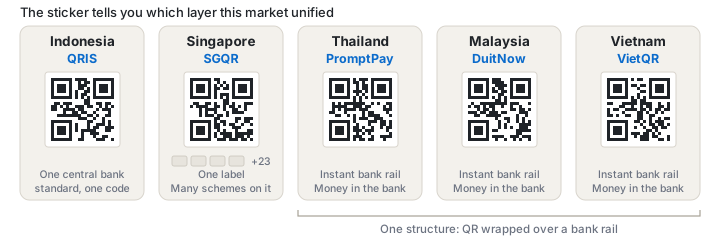
Look at the last column: six codes, five of them EMVCo. From the sticker's point of view these six markets are almost the same thing.
Look at the first column: six rails, and no two match on who built them, who runs them, or when they went live. Some are new central-bank systems (Thailand, the Philippines), some are conversions of existing clearing institutions (Malaysia, Vietnam), one is not an instant payment system at all but a set of switching institutions (Indonesia), and one is operated by a company jointly owned by three large banks (Singapore).
So "the codes in Southeast Asia don't recognise each other" is aimed at the wrong layer. The code formats are in fact highly consistent — they speak one language, and that language was written by the card networks. What genuinely does not match is underneath: six rails, each with its own rules, its own eligibility, its own pricing, its own dispute handling. Interlinking is hard not because the codes differ, but because the rails differ. That sentence is the premise for everything that follows.
10. Against China: Those Two Have Their Own Rail and Their Own Code
Putting China alongside is the sharpest way to make this chapter's point.
| Southeast Asia (these six markets) | China's two wallets | |
|---|---|---|
| Rail | Public: an instant rail built by a central bank or national clearing institution | Their own ledger; the interbank leg long ran on self-built direct connections |
| Alias | Mobile number, national ID, a public directory | The wallet's internal account system |
| Code | The EMVCo specification, one per country | Each sets its own; the two do not read each other |
| Who writes the rules | The central bank or an industry association | The wallet companies themselves |
Every row needs a sentence.
Rail. For a long stretch, Alipay and WeChat Pay each held direct connections to hundreds of banks — that is not "using somebody else's rail," it is having built a clearing network of your own. The People's Bank of China's Document 209 of August 2017 required online payment business to migrate onto the NetsUnion platform, with 30 June 2018 as the line; client reserve funds were centralised over the same period, reaching full transfer by 14 January 2019. The structure went from three parties to four: user — payment institution — NetsUnion/UnionPay — bank. The "absorption" in the Chinese duopoly is this.
But note that it only absorbed the interbank leg. Transactions where payer and merchant are both inside the same wallet are still just the wallet writing a line on its own ledger. The closed loop itself was never touched.
Code. This row is the most telling: China's code standards grew bottom-up, they were not set top-down. Alipay has one, WeChat Pay has one, Cloud QuickPass has one, and merchants displayed several at once — the same picture as Indonesia before QRIS, except Indonesia had a central bank that collapsed it and China did not. The People's Bank asked institutions to unify barcode payment coding rules in its 2019–2021 fintech development plan, which tells you they were not unified then. Real interoperability came from pilots in 2020 and was opened up step by step from 2021 with UnionPay and NetsUnion acting as intermediaries; WeChat Pay's merchant collection codes only reached full-scenario acceptance on UnionPay's network in June 2024.
So the two regions ran the order in reverse. Southeast Asia built public rails first and draped a layer of public-standard code over them. China had two companies finish the ledger, the clearing and the code standard in one go, and the state absorbed the middle segment afterwards.
That also explains why "interoperability" means two different problems. What Southeast Asia has to interlink is six different rails, when the codes already match. What China had to interlink is two different codes and two closed ledgers, when the rail had already been unified by NetsUnion.
Whenever you see "interoperability," ask: interoperability of the code, the rail, or the ledger?
11. Wallets and Bank Rails Coexisting, a Problem Unique to Southeast Asia
In China the wallets won and bank rails largely left retail. In Brazil, Pix won. In India, UPI won.
Southeast Asia is the only place where both kinds have coexisted for years.
On one side are closed-loop wallets: GrabPay, GoPay, OVO, DANA, TrueMoney. They are the same species as China's two, with the money parked on their own ledgers.
On the other side are the bank rails' codes: PayNow, PromptPay, DuitNow.
The result is that one merchant may need to accept several things at once, and those things differ in how you connect, the settlement cycle, the reconciliation format and the refund flow. Note that what differs here is again the rail layer — the codes may all be EMVCo.
This nuisance is not a defect, it is the doorway to a business. The Stripes and Adyens of the aggregator's three reasons sell exactly this: integrate me once and I will integrate the rest for you. Southeast Asia is one of the places where that demand is strongest, and this is why.
12. Interlinking: Lots of News, Very Little Volume
Now for the heart of this chapter.
The most-covered story in Southeast Asia for years has been cross-border QR interlinking: a Thai person in Singapore scanning a local code, an Indonesian in Malaysia paying directly. It sounds like regional integration completing at speed.
Look at the numbers.
As of December 2025 there were 29 cross-border payment connections in the region. Together they processed 36.2 million transactions over the year, worth US$716.4 million.
Seven hundred million dollars. In a year. Across the whole region.
Put it beside this: Brazil's Pix did 79.8 billion payments in the same year.
Not 79.8 billion dollars — 79.8 billion payments. The full-year count across Southeast Asia's 29 cross-border links (36.2 million) is roughly four hours of Pix.
Connected does not mean running.
That is the sentence to keep from this chapter, and the yardstick for every piece of "interlinking" news you will ever read.
And now you know which layer got connected: what got connected is a link between two rails, not the code. The codes were always readable.
13. Why It Is Connected and Still Not Running
A cross-border link solves the technical problem: the messages parse, the clearing path is open, settlement is arranged.
But a transaction actually happening needs far more than technology:
One, somebody has to be in that corridor. A Thailand-to-Singapore link only means something to people moving between those two places. The natural market for cross-border payments is travellers and remittances, and that pool is two or three orders of magnitude smaller than domestic to begin with.
Two, the merchant has to have the right code up. A live link does not mean every shop has finished the upgrade and the signage.
Three, the exchange rate has to beat the card. This is the most overlooked one. Travellers have a default habit of tapping a card, and cards have had decades at cross-border. A new link needs more than "it works" to take business — it has to be visibly better on price, and the user has to know that.
Four, the user has to know it exists. Most travellers do not research the state of QR interlinking at their destination before departure.
Technology solved one of these. The other three are demand problems, and demand does not appear because a link went live.
14. The Arithmetic Problem with Bilateral Linkage, and Three Layers Each Adding a Hub
Now a structural problem.
Those 29 connections were negotiated one at a time: Thailand with Singapore, Malaysia with Thailand, Indonesia with Thailand. Each one needs its own rules, its own FX, its own dispute handling, its own launch.
That is bilateral linkage: N countries connected pairwise needs N×(N−1)/2 links. Add countries and the link count grows with the square.
That shape should look familiar. Payment Systems described the same N² problem when covering correspondent banking and NetsUnion. Every time you see "everyone connecting privately to everyone," expect it to explode as participants multiply.
The fix is structurally always the same too: add a hub and collapse N² into N.
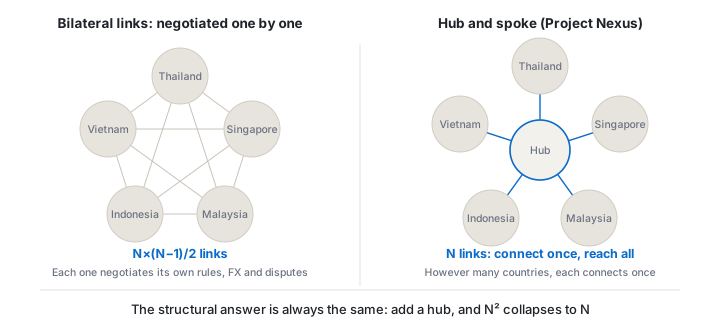
That is what Project Nexus is doing. Led by the BIS Innovation Hub, with India, Malaysia, the Philippines, Singapore and Thailand participating. Proof of concept completed in 2022, blueprint published in July 2024, currently moving from pilot to production, with 2026 progress described as on plan.
It uses a hub-and-spoke architecture: national instant payment systems stop connecting pairwise and all connect to one central hub instead. Note what it connects: national instant payment systems, not codes.
Connect once, reach all. The same old answer, for the Nth time.
Worth keeping the timeline: the real-time link between Thailand's PromptPay and Singapore's PayNow was the region's first, live in 2021. Malaysia's DuitNow and Thailand's PromptPay connected next, and Indonesia and Thailand piloted QR before scaling.
But Nexus is only one of the hubs. Three layers in this region are adding hubs at once, and they are not adding the same kind of thing.
The central bank layer. On 14 November 2022, the central banks of Indonesia, Malaysia, the Philippines, Singapore and Thailand signed a Regional Payment Connectivity (RPC) memorandum of understanding alongside the G20 summit in Bali. Vietnam (25 August 2023), Brunei (29 February 2024), Laos (3 April 2024) and Cambodia (8 April 2025) joined subsequently, bringing ASEAN participants to nine.
The international organisation layer. In March 2025, the central banks of Malaysia, Thailand, the Philippines, Singapore and India formally established Nexus Global Payments, a not-for-profit entity registered in Singapore, to run Nexus development and operations. The blueprint is no longer just a document; it has a legal person.
The industry layer. On 9 October 2025, six clearing institutions from five countries signed the George Town Accord in Penang, Malaysia, launching Next50 to set cross-border technical and operational standards for non-card instant retail payments. The first thing on the list to standardise is not message formats — it is dispute handling, anti-fraud and scam response.
| Layer | Who is doing it | Start | What hub it adds | Which problem it solves |
|---|---|---|---|---|
| Central banks | RPC, nine ASEAN participants | November 2022 | A multilateral commitment | Whether anyone wants to connect |
| International body | Project Nexus, entity established March 2025 | 2021 | A technical hub | How to connect technically |
| Industry | George Town Accord / Next50, six clearing institutions | October 2025 | A common rulebook | Who pays when it goes wrong |
All three are performing the same move — add a hub, collapse N² into N. But the hubs sit at different layers, so none of them substitutes for another. The central bank layer settles whether anyone wants to connect; the international layer settles how to connect; the industry layer settles who pays when a payment goes wrong after connecting. Take any one away and the other two stall — which is why Next50 put dispute resolution first.
One striking contrast to hold on to: to this day there is no genuinely universal unified ASEAN QR standard. AMRO's phrasing is that the vision "remains valid." In policy documents that sentence means it has not happened. What is running is a set of bilateral QR links negotiated one at a time between seven countries, not one standard everybody uses.
15. Retail Is Connected; Wholesale Is Not
All the numbers above are retail: travellers scanning codes, small personal remittances. On this, Southeast Asia genuinely leads — AMRO's assessment that ASEAN+3 is a global leader in cross-border retail payments refers to exactly these QR links and instant payment connections.
But the same assessment immediately covers the other half: wholesale has barely moved. After money lands in a receiving bank's overseas account it can still take days to reach the recipient.
Why can retail connect when wholesale cannot? Because what blocks wholesale is not technology:
- Regulatory and compliance standards differ, especially capital flow management measures — that is institutional, not an interface.
- Technical standards are uneven, with countries at different stages of message migration.
- Local-currency FX markets are too thin. Two small currencies without enough liquidity between them get expensive quotes, expensive enough that routing through the dollar is cheaper.
Only the second of the three can be solved by connecting pipes.
So "connected does not mean running" means two different things at the two ends: the retail end is not running because demand is short — there are not that many people in the corridor; the wholesale end is not running because institutions do not line up — the pipes are connected and the money still cannot get through. Same sentence, two causes, do not mix them.
One more piece of precision, and it changes your picture of where the cross-border money is. Across the 29 links in 2025, QR did 36.2 million payments worth US$716.4 million; person-to-person transfers did only 1.6 million payments, but worth US$305.7 million.
Twenty-three times the count, only 2.3 times the value. The QR end is a pile of twenty-dollar purchases; the remittance end is a small number of payments averaging close to two hundred dollars. The cross-border money is mostly not in travellers scanning codes, it is in remittances — and remittances are inherently few in number.
That explains why the seven hundred million was never going to be large: you are counting tourists' lunches.
16. Five Conclusions
One, read a market rail first, code second. Thailand, Malaysia, Vietnam and the Philippines are the same shape: a domestic instant rail first, an alias layer next, and a layer of code draped over it last. Indonesia is the exception in order — the switching pipes were long in place, and what was missing was a way to collapse dozens of codes into one.
Two, Southeast Asia is a fourth model: nobody dominates, so each central bank sets its own standard and each market has to roll it out itself. Indonesia's QRIS is the most complete version of that path.
Three, tiered pricing is smarter than both flat-free and flat-charged. Zero for small merchants closes the acceptance gap; 0.7% from large ones feeds the rail. Two different problems solved inside one system, and the rail feeds itself.
Four, "the codes don't recognise each other" is aimed at the wrong layer. These markets' codes are almost all EMVCo merchant-presented and highly consistent in format; what does not match is the six rails underneath, each with its own rules, eligibility, pricing and dispute handling. Interlinking solves technology, not demand — 29 links and US$716.4 million a year, against Pix's 79.8 billion payments.
Five, both "unified" and "rate" have to be pinned to a layer. Singapore unified the label, Indonesia unified the standard, and the acquiring layer is unfinished in both; across borders, central banks unified the willingness, the BIS is unifying the technology, and the industry has only started on the rules. Rates are the same: merchant MDR is one layer, participation and per-transaction fees are another, the line on the end customer's statement is a third. When you see a number or a claim of unification, locate its layer first, or every cross-market comparison you make is an illusion.
And back to the anchor: when two markets end up different, look for the institutional and incentive difference first. The difference between Southeast Asia and Brazil is not the calibre of the engineering; it is that Brazil has one central bank that can give an order and Southeast Asia has ten that each go their own way.
17. The Question This Chapter Raises
Four models done: China's subsidy war, India's legislated zero, Brazil's administrative mandate, Indonesia's tiered charging.
Four models grew four different rails, but they are all answering the same question — who ends up paying this bill.
Time to put them on one table.
18. Self-check questions
- Why "rail first, code second"? In a QR payment, what does the code do and what does it not do?
- What years are Thailand's PromptPay and Thai QR? What does that order tell you?
- Indonesia's order is the reverse of Thailand's. What is Indonesia's rail layer, and why is "QRIS runs on BI-FAST" wrong?
- Which layer is each of Singapore's FAST, PayNow and SGQR? Whose rules, whose operations, and who owns it?
- Does a bank book revenue or cost on each FAST transaction it runs? How does that differ from cards?
- Which two problems does Indonesia's tiered pricing solve at once? Why is it more sustainable than India's flat zero?
- SGQR and QRIS are both called a "unified payment QR code." Do they unify the same layer? What does a Singapore merchant still have to do separately after SGQR?
- What is wrong with "the codes in Southeast Asia don't recognise each other"? What genuinely does not match?
- How do China's two wallets compare to these Southeast Asian schemes at the rail, alias and code layers? Why is "interoperability" a different problem in the two regions?
- Southeast Asia's 29 cross-border links processed US$716.4 million in a year. Give at least three reasons a live link carries so little volume.
- Why does bilateral linkage break down as countries multiply? What does Project Nexus's hub-and-spoke architecture connect?
- "Connected does not mean running" has two different causes at the retail end and the wholesale end. What are they?
19. Answers
Answer for yourself before reading on.
- Because the code moves no money. It is a piece of encoded collection information whose job is to tell the phone who to pay and how much; once it is scanned, the money travelling from one account to another goes down the rail underneath — who clears, who settles, how many seconds, who carries the intraday risk, all of that is below. So ask first who built the rail, who operates it and how it settles, and second what year the code arrived and whose specification it follows. Reverse the order and six identical-looking codes read as six identical things.
- PromptPay launched in December 2016 with public use from 2017; Thailand's QR specification was published in October 2017, based on EMVCo with local customisation. It shows the code is not where the thing starts, it is the last step in getting it onto a street stall. Also, the operator National ITMX was already running the ATM switch, the card switch, bulk payments and single fund transfers before PromptPay: a new national rail is usually not conjured out of nothing, it is hung on an institution that already does clearing.
- Indonesia's rail layer is a set of switching institutions under GPN (Artajasa, Rintis, Jalin, Alto), with clearing and settlement handled by PTEN — and those are the parties that process QRIS transactions. "QRIS runs on BI-FAST" is wrong because BI-FAST is a separate system that only went live in December 2021, more than two years after QRIS in 2019. What Indonesia lacked was never a rail; it was a way to collapse dozens of mutually unreadable codes into one.
- FAST is the rail (live March 2014), PayNow is the alias layer (July 2017, draped over FAST), SGQR is the code layer (the unified label of September 2018). Rules: FAST to SCHA, PayNow to ABS, SGQR to MAS and IMDA (announced February 2025 to be consolidated into one new entity). Operations: all three run by BCS. Ownership: BCS belongs to the NETS group, and NETS is held by DBS, OCBC and UOB — the operator of this national rail is a company jointly owned by the very banks it supposedly threatens.
- It books a cost: a per-transaction fee to the operator, plus a one-off participation fee. Cards are the reverse — the issuer receives interchange on every transaction and books revenue. The same action, one side in the revenue column and the other in the cost column — which explains why banks push cards hard and A2A weakly. A cost has to be recovered somewhere, so the retail end is free and the corporate end is charged: cross-subsidising retail from corporate.
- It solves the acceptance gap (micro merchants pay zero on small tickets and have no reason to refuse) and funding the rail (large merchants pay 0.7%, which feeds the whole thing) at once. It beats India because India's flat zero leaves no transaction revenue, so the rail runs on political will and government subsidy and has to fight for a budget every year; Indonesia has the large feed the small, so the system feeds itself.
- Not the same layer. SGQR unified the label — twenty-seven schemes' marks side by side on one sticker, so the counter is tidy but each scheme's acquiring relationship is still separate, with separate reconciliation, settlement and refunds, and the customer still hunting for their logo. QRIS unified the standard — the central bank sets one specification and every institution's code is generated to it. What Singapore still has to fill in is the acquiring layer, which is what SGQR+ is for. In the proof of concept the number of schemes a merchant could accept rose from an average of 3 to 12, which shows how much friction that layer held.
- It is aimed at the wrong layer. These markets' codes almost all use the EMVCo merchant-presented format — Thai QR, DuitNow QR, VietQR, QR Ph and QRIS all do; they speak one language, and that language was written by the card networks. What genuinely does not match is the rails underneath: six rails, each with its own rules, eligibility, pricing and dispute handling. Interlinking is hard not because the codes differ but because the rails differ.
- Rail: Southeast Asia's is public (an instant rail built by a central bank or national clearing institution); China's two built their own ledger, and before the direct-connection ban the interbank leg ran on self-built connections. Document 209 required migration to NetsUnion from 30 June 2018 and client reserve funds were fully centralised by 14 January 2019, but the closed loop itself was never touched. Alias: Southeast Asia uses public directories of mobile numbers and national IDs; China uses the wallets' internal account systems. Code: Southeast Asia uses EMVCo, one specification per country; China's two each set their own and do not read each other, with interoperability piloted from 2020 and opened step by step through UnionPay and NetsUnion as intermediaries, WeChat Pay's collection codes only reaching full-scenario acceptance on UnionPay's network in June 2024. So the two "interoperability" problems are different: Southeast Asia has to interlink six different rails when the codes already match; China had to interlink two different codes and two closed ledgers when the rail had already been unified by NetsUnion.
- Any three of: (a) somebody has to be in that corridor, and the natural cross-border market of travellers and remittances is two or three orders of magnitude smaller than domestic; (b) merchants have to finish the upgrade and display the right code; (c) the rate and fees have to visibly beat tapping a card, which is the traveller's default habit; (d) users have to know it exists, and most do not research interlinking at their destination in advance. Technology solved one precondition; the rest are demand problems.
- Because bilateral linkage needs N×(N−1)/2 links, each with its own rules, FX, dispute handling and launch, so the link count grows with the square of the number of countries. This is the same N² problem correspondent banking and NetsUnion face in Payment Systems. Nexus's hub-and-spoke architecture connects the national instant payment systems, not the codes — each country connects once and reaches all, collapsing N² into N.
- The retail end is a demand problem: the link is live but there were never that many people in that corridor, travellers default to cards, and most do not know interlinking exists. The wholesale end is an institutional problem: regulatory and compliance standards do not line up (capital flow management measures especially), technical standards are uneven, and local-currency FX markets are too thin — of those three only technical standards can be fixed by connecting interfaces. So the same sentence needs two different diagnoses at the two ends.
Previous: Chapter 5 · Brazil's Pix: The Central Bank Steps In Next: Chapter 7 · Five Rails Side by Side: Who Pays the Bill