Brazil's Pix: When the Central Bank Builds It Itself
Part II · Three Ways to Turn a Local Rail into National Infrastructure (Chapters 3–7) Builds on: Chapter 3 (closed-loop wallets), Chapter 4 (open rails, zero MDR) New concepts in this chapter: mandatory participation, Pix keys, the administrative fix for the cold start problem, recurring debit authorization
1. The Question the Previous Chapter Left Open
India persuaded the banks in: the rail was built by an institution the banks jointly own, a law took the fee away, and the government picked up part of the cost. There was coordination in that process, and compromise.
Brazil skipped that step.
Brazil's central bank built the rail itself, then gave an order: institutions above a size threshold must connect.
This chapter explains why that path is the fastest of the three, and what it requires.
2. What Mandatory Participation Actually Solves
Get one thing straight first: the hardest part of a new payment method is never the technology.
The hardest part is the cold start problem. Merchants don't accept it because no consumer uses it; consumers don't use it because no merchant accepts it. Both sides wait for the other, and neither moves. Payment Systems showed how thick that wall is when it covered the four-party model — Visa's predecessor only broke through by mailing cards to every person in an entire city, at the price of an enormous first-year loss.
Mandatory participation demolishes the wall outright.
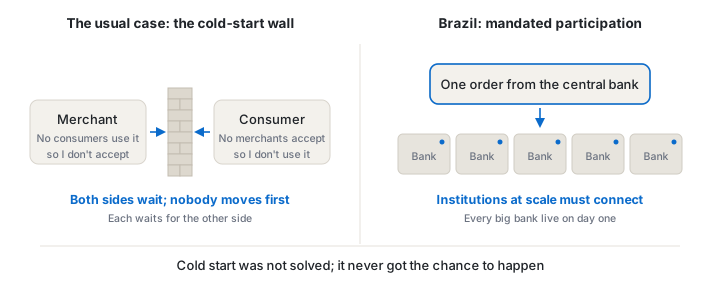
One order goes out, and on day one every large bank is live at once. Consumers open the bank app they already have and it is there; merchants face something everybody already holds. The cold start problem does not need to be "solved," because it never gets the chance to happen.
This is something an administrative instrument can do and a market instrument cannot. China's two companies spent years and enormous subsidies lighting both sides of the market; Brazil's central bank did the same thing on launch day with a document.
Payment Systems already noted that Brazil's central bank required institutions above a size threshold to join Pix, and that a few years after launch the central bank shut down DOC, the old batch transfer pipe, outright. What belongs here is the mechanism behind that: the value of mandatory participation is not "a few more banks joined." It is that a problem which normally takes years of coordination becomes an effective date.
3. Pix Keys: The Same Part, Invented Again
Pix launched in November 2020.
The first thing it did is what India did: add a layer of aliases. A Pix key can be a phone number, an email address, a tax ID, or a random string. Give someone your key and they can pay you.
The virtual payment address in India's zero fee, and the Pix key here, are the same part, built by two countries with no reference to each other.
The alias layer is a required part of this kind of scheme, not an optional one. A bank account number cannot serve as a receiving identifier, so every successful scheme has to solve "how does an ordinary person get pointed at" before anything else. The conditions for displacement will put this on its checklist.
4. The Numbers
| Figure | |
|---|---|
| Payments, full year 2025 | 79.8 billion |
| Value, full year 2025 | R$35.36 trillion |
| Average payments per day | About 219 million |
| Peak day | Routinely above 300 million |
| Payments in 2024 | About 64 billion, up 53% year on year |
Those 64 billion payments in 2024 were 80% higher than Brazil's credit and debit card payments combined.
Counting from the November 2020 launch, Pix passed the combined payment count of both card types within three calendar years.
Compare India: debit cards there lost two thirds of their volume over four years, squeezed out slowly. Brazil went straight past in three. Mandatory participation is the fastest of the three paths, and this set of numbers is the evidence.
5. Something That Has to Be Said Clearly: Pix Is Not Free for Merchants
"Pix is free" is the most widely repeated and most frequently mis-stated sentence about this system.
The accurate version: Pix is free for individuals, not free for merchants.
Merchant cost runs roughly 0.22% to 0.33%, or R$0.30 to R$0.90 per payment, depending on the provider.
Set that against Brazilian cards: debit above 1%, credit up to 2.2% to 2.34%.
So the correct word is "much cheaper," not "zero cost."
The distinction matters because it decides how you read everything that follows. If Pix really were zero cost, there would be no payments business in Brazil, and there plainly is. The rail itself is very cheap, but the layer between the merchant and the rail — collection, reconciliation, refunds, risk, integration — is still a business, and still charges.
Payment Systems has a line about a flaw in infrastructure growing an entire layer of business on top of it. The reverse holds too: however cheap the infrastructure gets, the business of connecting merchants to it still exists.
6. What Had to Be Added After Launch
What Pix could do at launch in 2020 was simple: push money from one account to another in real time.
It could not do recurring debits.
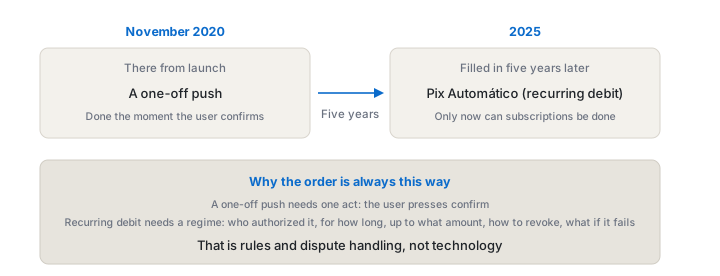
Which means you could not use Pix for a subscription, a monthly fee, or an instalment bill — anything that needs "authorize once, then debit automatically" was out of reach.
Brazil's central bank launched Pix Automático (recurring debits) in 2025 to fill the hole. India added a functionally identical feature to UPI.
This is not an oversight by Brazil or India. It is a pattern, and one worth keeping:
A2A rails usually ship the simplest thing first — a one-off push the user initiates — then spend years back-filling functions cards have had all along.
Why that order? Because a one-off push needs exactly one action: the user presses confirm. A recurring debit needs an authorization regime: who authorized it, for how long, up to what amount, how it gets revoked, what happens when the debit fails. That is rules and dispute handling, not technology.
The chapter on the financials do not show it picks this thread up, because recurring debit is not the only function cards have had for decades while A2A is still building it.
7. Pix and Credit
Brazil runs on instalments. Buying an appliance, a phone, a plane ticket — the default question is not "how much" but "how many instalments."
Pix could not do instalments at launch. The market later built products that hang instalments off Pix, funded by payment providers or by merchants themselves.
No numbers here, because I have not verified reliable data on the mechanism or the scale. But one structural fact is certain, and it is exactly the conclusion from the India chapter:
A rail can carry credit; it cannot create it. The money for an instalment plan has to come off somebody's balance sheet. Pix makes that money move more cheaply; it does not make it unnecessary.
So Brazil's displacement has a shape: what Pix replaced in bulk is cash, Boleto (a Brazilian cash voucher method, covered later), and debit cards; credit cards were hit far less. Brazilian card volume kept growing through the years Pix was rolling out.
8. Three Conclusions
One, mandatory participation is the fastest of the three paths, because it goes straight around the cold start problem. The hardest step in a two-sided market was not solved, it was skipped — one order put every large bank live on the same day. The price is that this path needs a central bank both willing and able to give the order, and not every country has one.
Two, "Pix is free" is wrong; the correct statement is "free for individuals, much cheaper than cards for merchants." Merchants pay 0.22%–0.33%; cards run 1% to 2.34%. A cheap rail does not mean there is no business in the layer that connects merchants to it.
Three, A2A rails do the simple thing first, then spend years back-filling functions cards have had all along. Recurring debit is the first obvious example, not the last. This is not an execution problem — the things being back-filled are fundamentally rules and dispute handling, not technology.
9. The Question This Chapter Leaves Open
That is all three paths: China on the distribution power of two companies, India on one national clearing institution plus a law, Brazil on a central bank's administrative order.
All three needed someone in charge.
So what grows in a place with no super app, no commanding central bank, and every country building its own?
Southeast Asia is the fourth case.
10. Self-check questions
- Which problem does mandatory participation actually solve? Why say the problem "was not solved, it was skipped"?
- The Pix key and India's virtual payment address are the same part. Why is it worth noticing that two countries built the same thing independently?
- What is wrong with "Pix is free"? What is the correct statement?
- Pix could not do recurring debits at launch and only added them five years later. Why do rails like this always add functions in that order?
- Pix replaced cash, Boleto, and debit cards in bulk, but hit credit cards far less. Explain why, using this chapter's conclusion.
11. Answers
Answer for yourself before reading on.
- It solves the cold start problem: merchants don't accept because no consumer uses it, consumers don't use it because no merchant accepts it, and both sides wait. It was skipped rather than solved because mandatory participation put every large institution live on the effective date — the cold start problem was never overcome, it simply never got the chance to happen. A problem that normally takes years of coordination became an effective date.
- Because they had no contact with each other and converged on the same design. A bank account number is too long, unmemorable, and not something people will publish, so it cannot be a consumer-facing receiving identifier — every scheme has to build an alias layer first. When several independent schemes reach the same answer, that is a required part, not a preference. Poland's six-digit code and Europe's Wero using phone numbers are two more versions of the same part.
- It takes "free for individuals" and reads it as "free for everyone." Merchants pay 0.22%–0.33%, or R$0.30–0.90 per payment. The correct statement is "free for individuals, and much cheaper than cards for merchants" — cards in Brazil run above 1% on debit and up to 2.2%–2.34% on credit. A cheap rail does not mean the merchant-integration layer is free.
- Because a one-off push needs the user to press confirm once, while a recurring debit needs a whole authorization regime: who authorized it, for how long, up to what amount, how it gets revoked, what happens when the debit fails. Those are rules and dispute handling, not technology. Technology can ship first; rules have to be negotiated slowly. So the order is always the simple push first, then years of back-filling what cards have had all along.
- Because a rail can carry credit; it cannot create it. What Pix replaces is the act of handing over money you already have — which is exactly what cash, Boleto, and debit cards do, so they got displaced. A credit card does something else: somebody fronts the money for you. That takes capital, tolerance for bad debt, and underwriting, and no amount of cheapness conjures those up — so the credit card block was largely untouched.
Previous: Chapter 4 · India's UPI: What Happens After You Set the Fee to Zero Next: Chapter 6 · Southeast Asia: Five Countries, Five Rails, and Only Then the Codes