The Word "Wallet" Has Been Misleading You
Part III · The Same Rails, Wearing Other Form Factors (Chapters 8–10) Builds on: Chapter 3 (closed-loop wallets), Chapter 4 (open rails), Chapter 7 (whose ledger the money sits on) New concepts in this chapter: a card wrapper, tokenization, a genuine alternative, the three-layer classification of payment methods
1. The Question the Previous Chapter Left Open
One number gets quoted in this industry more than any other:
In 2025, digital wallets accounted for 56% of global e-commerce transaction value.
It is almost always used to support the same conclusion: cards are being displaced.
This chapter explains that the number cannot be used that way, and the way it is misused is very specific.
Because the phrase "digital wallet" puts two things of opposite nature into one bucket.
2. A Five-Second Experiment
Pick up your phone and pay for something with Apple Pay.
Now ask: where did that money come from?
The answer: from the card you loaded into Apple Pay.
That transaction ran the card authorization path. The card network still collected its network fee, the issuer still collected interchange, the merchant still paid the card fee. From Visa's point of view this is an ordinary Visa transaction, with the card number swapped for a token.
Now switch to Alipay. You pay a merchant who also uses Alipay, out of your Alipay balance.
In that transaction Visa and Mastercard do not exist at all. No authorization path, no interchange, no network fee. The money moves from your name to the merchant's name on Alipay's own ledger — the mechanism from the Chinese duopoly.
One word, "digital wallet," pointing on one side at a skin stretched over a card and on the other at a replacement for the card.
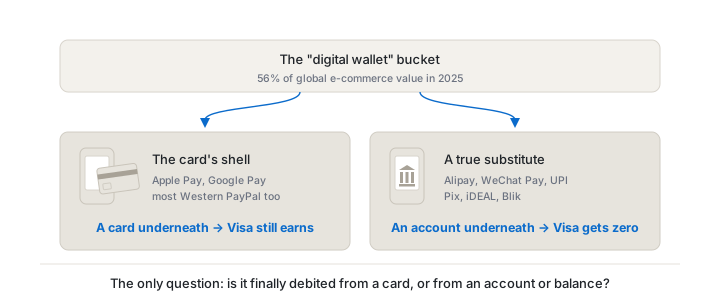
They mean opposite things to the card networks: the first is good news (more transactions, plus a tokenization service fee), the second is pure loss.
3. Tokenization: Why the Card Networks Welcome Apple Pay
A word on tokenization, because it explains the networks' attitude.
Tokenization means the merchant and the app no longer store your real card number, but a substitute number (a token) issued by the card network. That token is only valid in a specific context, and is useless if leaked.
Apple Pay and Google Pay run on exactly this. And the token issuer is the card network itself.
So to Visa, Apple Pay is not a competitor but a front end that makes cards work better: the payment experience improves, authorization rates go up, fraud goes down, and the card number gets locked inside the network's own token system, which makes it harder, not easier, for the merchant to switch rails.
Apple Pay makes cards stickier, not weaker.
4. The Right Classification: What Runs Underneath
"Wallet" classifies by appearance, which is useless. Classify by what runs underneath.
| Category | What runs underneath | What it means for the card networks | Examples |
|---|---|---|---|
| A card wrapper | A card | Good news | Apple Pay, Google Pay, most of PayPal in the US and Europe |
| A genuine alternative | A bank account, or the wallet's own ledger | Pure loss | Alipay, WeChat Pay, UPI, Pix, iDEAL, Blik |
| Mixed | Sometimes a card, sometimes not | Depends on the mix | PayPal (the mix differs by market), Southeast Asian wallets like Grab |
There is exactly one diagnostic question: does the money ultimately come off a card, or off a bank account or a wallet balance?
- Off a card → a card wrapper. The networks earn as usual.
- Off an account or a balance → a genuine alternative. The networks get nothing.
That is also the first question to ask about any new payment product you meet. No matter whether it calls itself a wallet, a super app, or something more advanced-sounding.
5. Taking the 56% Apart
Now go back to the figures in Worldpay's 2026 report. Global e-commerce transaction value by method:
| Method | Share |
|---|---|
| Digital wallets | 56% |
| Credit cards | 20% |
| Debit cards | 10% |
| Account-to-account (A2A) | 7% |
| Buy now, pay later (BNPL) | 4% |
"Wallets 56%, cards 30% combined" — it looks like cards have already lost.
But inside that 56%, the Apple Pay part is cards and the Alipay part is not. The table counts them together.
Regional data helps set the direction:
- China: Alipay and WeChat Pay take 89% of e-commerce value and 87% at physical POS. These are essentially all genuine alternatives.
- India: wallet-type methods take 68% online and 61% offline. UPI is a genuine alternative.
- US: wallets take 40% online and 17% at physical POS. The bulk of US wallets is Apple Pay, Google Pay, and PayPal — mostly card wrappers.
So inside that 56%, the large Asian block is essentially genuine alternatives, while the US and European block is largely card wrappers.
The same 56% means completely different things in the two regions. Treating it as global evidence that cards are losing share is wrong.
While you're here, note the A2A 7% row. That is account-to-account payment broken out separately — iDEAL, Blik, and their kind. Worldpay forecasts A2A at 13% of e-commerce and 15% of physical POS by 2030.
That is the row worth watching. It is growing, but it is 7% today, not 56%.
6. Why This Distinction Deserves Its Own Chapter
Because almost every argument that the card networks are finished rests on mixing these two categories.
The argument runs: digital wallets are past half → wallets are not cards → therefore half of cards has been displaced.
Step two is wrong.
And the error runs in one direction systematically: it always makes cards look more endangered than they are. The reason is simple — a card wrapper is counted as a "wallet" in the statistics but is still a card in economics. As long as the classification is done by appearance, the networks' actual revenue will always be higher than the charts show.
Where cards lost and the chapter on the financials do not show it both lean on this repeatedly. In fact it is the first piece of the puzzle explaining the contradiction of "cards are being displaced while the card networks earn more."
The second piece is this: the markets the genuine alternatives won are mostly markets the networks were never earning in anyway. That one is for later.
7. Three Conclusions
One, classifying by appearance is useless; classify by what runs underneath. The only question is whether the money ultimately comes off a card, or off an account or balance.
Two, Apple Pay and Google Pay are not rivals to cards; they are front ends for cards. The networks issue the tokens, the experience improves, authorization rates rise, fraud falls, and the card number gets locked into the networks' own system. They make cards stickier.
Three, "digital wallets at 56%" is not evidence that cards are losing share. The row to watch is A2A at 7%, and whether it really reaches 13% by 2030.
8. The Question This Chapter Leaves Open
Among the genuine alternatives, QR codes are only one branch.
There is a whole other category that never scans anything: in the Netherlands you jump into your own bank app to confirm; in Poland you type six digits; in Brazil you print a slip and take it to a convenience store to pay cash.
What does each of these solve? And their pricing works nothing like the QR family — some charge a flat amount per payment, some charge a percentage.
That difference looks trivial, but it decides which basket sizes a method makes sense at and which it does not. The next chapter settles it with a piece of primary-school arithmetic.
9. Self-check questions
- You paid ¥30 at a convenience store with Apple Pay. Did Visa earn anything on that transaction? Why?
- Deciding whether a payment product is a card wrapper or a genuine alternative takes one question. What is it?
- Why does tokenization make the card networks more willing to back Apple Pay rather than treat it as a threat?
- "Digital wallets are 56% of global e-commerce, so half of cards has been displaced" — which step of that reasoning is wrong, and why?
- Wallets are 89% of e-commerce in China and 40% online in the US. Why do those two numbers mean completely different things to Visa?
10. Answers
Answer for yourself before reading on.
- Yes. What sits inside Apple Pay is the card you loaded, and the transaction runs the card authorization path: the network collects its network fee, the issuer collects interchange, the merchant pays the card fee. To Visa it is an ordinary Visa transaction with the card number swapped for a token.
- Does the money ultimately come off a card, or off a bank account or wallet balance? Off a card and it is a wrapper, and the networks earn as usual; off an account or balance and it is a genuine alternative, and the networks get nothing.
- Because the networks issue the tokens themselves. Apple Pay improves the payment experience, raises authorization rates, and cuts fraud, while locking the card number inside the networks' token system — which makes switching rails harder for the merchant, not easier. It is a front end that makes cards stickier, not a competitor.
- Step two is wrong — the "wallets are not cards" step. Inside the wallet bucket, Apple Pay, Google Pay, and most of PayPal in the US and Europe have a card underneath. Counting them as non-card moves card revenue away statistically while economically the money still belongs to the networks. The error runs in one direction systematically: it always makes cards look more endangered than they are.
- Because what runs underneath is different. China's 89% is mostly Alipay and WeChat Pay, running on the wallets' own ledgers, with Visa entirely absent from the path — pure loss. The US 40% is mostly Apple Pay, Google Pay, and PayPal, largely card wrappers, and Visa still gets paid. The same "wallet share" metric is lost ground in one place and its own business through a new entrance in the other.
Previous: Chapter 7 · Five Rails Side by Side: Who Pays the Bill Next: Chapter 9 · Local Methods Without a QR Code: The Netherlands, Poland, and the Convenience Store