Five Rails Side by Side: Who Pays the Bill
Part II · Three Ways to Turn a Local Rail into National Infrastructure (Chapters 3–7) Builds on: Chapters 3–6 (China, India, Brazil, Indonesia — four models) New concepts in this chapter: who funds a rail, revocable versus irrevocable, where risk sits, form factor listed separately from rail
1. One Question to Answer
The last four chapters covered four countries. It is easy to file them as four stories.
This chapter compresses them into one question:
Somebody is paying for every rail. Find that somebody and you know why the rail looks the way it does.
Pricing, features, reach, whether it can extend credit, who you turn to when something goes wrong — these look like independent design choices. They are all decided by who pays.
2. Five Rails
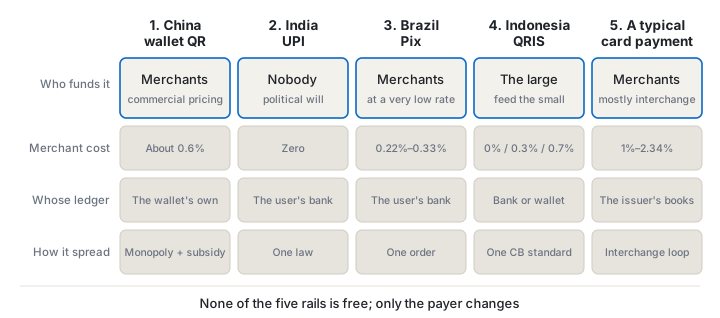
| Dimension | China's wallet QR | India's UPI | Brazil's Pix | Indonesia's QRIS | A typical card transaction |
|---|---|---|---|---|---|
| How a payment is initiated | QR | QR, VPA, intent links | QR, Pix keys | QR | Card, contactless, card number |
| Who operates it | Two private companies | NPCI (jointly owned by banks) | Brazil's central bank | Bank Indonesia sets the standard | Card network + issuer + acquirer |
| Who funds it | Merchants, commercially priced | Nobody pays on the transaction; political will and subsidy | Merchants, at a very low rate | Large merchants subsidise micro merchants | Merchants; the biggest slice goes to the issuer as interchange |
| Merchant cost | About 0.6% (about 1% for virtual goods) | Zero | 0.22%–0.33%, or R$0.30–0.90 per payment | Micro small-ticket 0%; micro large-ticket 0.3%; mid and large 0.7% | Varies widely; Brazil debit above 1%, credit up to 2.2%–2.34% |
| Consumer cost | Zero | Zero | Zero | Zero, and passing it on is prohibited | Zero, and often cashback on top |
| Whose ledger the money sits on | The wallet company's own ledger | The user's bank account | The user's bank account | The user's bank account or wallet | The issuer's ledger, possibly against a credit line |
| Can it extend credit | The wallet builds separate lending products | Not the rail itself; credit rides in on a RuPay card — and the fee comes back with it | Not the rail itself; instalments need a separate funder | Not the rail itself | Yes. That is its day job |
| Recurring debits | Yes | Added after launch | Added after launch (Pix Automático, 2025) | Depends on the institution | Always had them |
| When something goes wrong | The platform's own rules | Push payment, irrevocable in principle | Push payment, irrevocable in principle | Push payment, irrevocable in principle | The cardholder can initiate a chargeback — an institutionalised right |
| How it spread | Distribution monopoly + two-sided subsidy | One law | One administrative order | One central bank standard | The virtuous circle interchange paid for |
Start with the first row, which explains almost nothing. Four of the five rails are initiated with a QR code, and not one of their funding models, ledger locations, credit capabilities or dispute mechanisms matches. That is exactly why form factor and rail have to be read as separate things — the previous four chapters were all describing the same code, and every real difference is in the rows below it. the rail map extends this table across eleven markets, where the form-factor row also holds phone numbers, one-time six-digit codes, and bank redirects.
The last row needs a note. A card chargeback is a right at the level of the network's rulebook: under defined conditions the cardholder can demand the money back, the issuer executes it, and there is a documented process with evidence standards. A2A push payments are designed so that the payer pushes the money out and once it is out, it has arrived — there is no equivalent cross-institution dispute mechanism. I have not verified the specific remedy rules of each scheme, so only the structural difference is claimed here. This one difference matters far more than it looks, and the chapter on the financials do not show it opens it up.
3. Four Conclusions
One, none of the five rails is free; only the payer changes.
China: merchants pay about 0.6%, and the wallet companies spend it on the rail and on risk — commercial funding. India: nobody genuinely pays on the transaction, at the price of banks and PSPs absorbing the cost with the government covering part — that is political funding, not the absence of cost. Brazil: merchants pay 0.22%–0.33%, individuals free. Indonesia: large merchants pay 0.7%, micro merchants pay zero on small tickets — the large feed the small. Cards: merchants pay, and the biggest slice flows to the issuer as interchange.
In payments, free almost always means someone else is paying. When you see free, go find the payer.
Two, the cheaper the rail, the less it can offer.
Look at the middle rows. The lower the rate, the more likely the rail is to have no credit, no recurring debit at launch, and no institutionalised remedy when something goes wrong.
That is not a coincidence, and it is not these countries falling short. Credit needs somebody to carry bad debt, recurring debit needs a full authorization and revocation regime, dispute handling needs an arbitration body and evidence standards. All of it costs money, and it costs money continuously. A rail that charges nothing has nothing to feed them with.
Turn it around and look at cards: expensive, but the expensive part buys specific things — a credit line you can spend immediately, one set of dispute rules that works across borders, a trust framework that spares you from caring who the other party is.
You can argue cards are overpriced. You cannot argue the money buys nothing. That judgement is decisive in the next two chapters.
Three, whose ledger the money sits on determines what kind of rail it is.
Closed-loop wallet: the money is on the operator's ledger, so marginal cost is near zero, the operator owns the user, and the operator can change the rules whenever it likes. Open rail: the money is in the user's bank account, so the app cannot lock anyone in, competition gets pushed onto experience, and concentration happens in a different way. Cards: the money is on the issuer's ledger, and it can carry money that does not yet exist — a credit line.
The "whose ledger" row predicts a rail's long-run direction better than the pricing row does.
Four, five ways of spreading, five different kinds of power.
| How it spread | What power it used | Who can use it |
|---|---|---|
| Distribution monopoly + subsidy | Commercial force | Only a company that already has a billion users |
| One law | Legislative power | A government that treats financial inclusion as a national goal |
| One administrative order | Regulatory power | A central bank willing to give orders to big banks |
| One standard | Standard-setting power | A central bank with authority that does not intend to run the thing |
| The virtuous circle interchange paid for | Pricing power | A system that can pay issuers enough to make them want to issue |
The last row is the card's own, and it is the easiest one to miss. It needs nobody's order: a slice of what the merchant pays goes to the issuer, so banks want to issue, cardholders get cashback, and the acceptance network gets built — that circle is what cards assume three things is about. It is the slowest of the five, taking decades, and the only one that needs no state to act. The price is that its fuel can be taken away, and where cards lost covers the three-way squeeze on interchange now under way.
Not one of the five is "better technology."
The QR code is the same QR code; instant clearing is the same set of principles. The five rails ended up different because the power in their hands was different.
Which is exactly what the line from Payment Systems means: when two markets end up different, look for the institutional and incentive difference first. Whether a country can build a Pix depends on whether its central bank can give that order, not on the calibre of its engineers.
4. The Question This Chapter Leaves Open
So far, the five rails happen to share one form factor: the QR code.
But a QR code is only one of the form factors that can sit on top of these rails. In global e-commerce the ways to pay without a card go well beyond scanning — and when the form factor changes, the bill underneath does not necessarily change with it.
And there is a trap here. The most-quoted number in the industry is this: digital wallets accounted for 56% of global e-commerce transaction value in 2025.
It gets used constantly as proof that cards are being displaced.
It cannot be used that way. Because the bucket labelled "digital wallets" holds two things of opposite nature, and those two things mean opposite things for Visa and Mastercard.
Miss the difference and your read on the whole industry will be wrong.
5. Self-check questions
- Nobody genuinely pays on an Indian UPI transaction. Why does this chapter still say no rail is free?
- Why are the rails with the lowest fees also the ones that cannot extend credit and shipped without recurring debit? Answer from cost structure.
- From the table: whose ledger does the money sit on for China's wallet QR and for India's UPI? What did that one difference cause in each case?
- Indonesia and India both wanted to close the acceptance gap. Why is Indonesia's approach more sustainable on funding?
- Five ways of spreading map to five kinds of power. Why is none of the five "better technology"?
6. Answers
Answer for yourself before reading on.
- Because cost does not disappear, it moves — only the funder changed. UPI's cost is absorbed by banks and PSPs, partly offset by government subsidy. That is political funding: it lasts because financial inclusion is a national goal, not because the rail is free to run. In payments, free almost always means someone else is paying.
- Because credit, recurring debit, and dispute handling all cost money continuously: credit needs somebody to carry bad debt and tie up capital, recurring debit needs an authorization and revocation regime, dispute handling needs an arbitration body and evidence standards. A rail that charges nothing has no steady revenue to feed them. Low fees and thin features are two sides of the same constraint, not a gap in execution.
- China's money sits on the wallet company's own ledger: marginal cost near zero, the operator owns the user, the operator writes the rules. India's money sits in the user's bank account: the app holds no balance so it cannot lock anyone in, competition is pushed entirely onto experience, and concentration reappears at that layer instead — whoever builds the better experience wins (PhonePe holds close to half).
- Because India set zero for everyone, leaving the rail with no transaction revenue, dependent on political will and government subsidy, fighting for a budget every year. Indonesia tiers it: micro merchants pay zero on small tickets, which closes the acceptance gap, while mid and large merchants pay 0.7% to feed the rail — the large feed the small, and the system feeds itself without outside appropriations.
- Because the technology is identical: the QR code is the same QR code and instant clearing is the same set of principles. The five rails diverged this far because of what power they held — commercial distribution, legislative power, regulatory command, standard-setting authority, and, in the card's case, the slowest and least state-dependent of them all, pricing power: paying a slice of the merchant fee to the issuer so it wants to issue. Whether a country can build a Pix depends on whether its central bank dares to give orders to big banks, not on the calibre of its engineers.
Previous: Chapter 6 · Southeast Asia: Five Countries, Five Rails, and Only Then the Codes Next: Chapter 8 · The Word "Wallet" Has Been Misleading You