Two Jobs Between Banks: Clearing and Settlement
Part I · Foundations (Chapters 1–3) Builds on: Chapter 1 (ledger, book transfer, atomicity) New concepts in this chapter: clearing, settlement, interbank obligations, netting, settlement risk, finality, RTGS and DNS
This is the most important chapter in the course. Every rail that appears from here on, you will come back and take apart with the two words defined here.
1. One Hard Constraint
The book transfer in the previous chapter was simple because there was only one ledger.
Now Dean is at Bank A and Alice is at Bank B. And here sits a constraint nothing gets around:
Each bank can write only its own ledger.
Bank A has no permission to edit Bank B's ledger, and vice versa. So the atomicity from the previous chapter — two lines changing together — breaks outright in the interbank case. It becomes one line changed on each of two ledgers, and the two edits are carried out by two institutions neither of which answers to the other.
Most of the machinery in the rest of this course exists either to route around this constraint or to catch the consequences it drops.
2. The Naive Solution, and the Tail It Leaves
The most direct idea: Bank A sends Bank B a message saying "please add 100 to Alice."
Bank B complies. But notice: the 100 that Bank B just credited to Alice is Bank B's own money — Bank B's liability to Alice grew by 100, and it hasn't received a cent.
So what the message actually produced is this:
| Whose ledger | Entry | Change |
|---|---|---|
| Bank A | Dean's deposits | 1,000 → 900 |
| Bank A | Payable to Bank B | 0 → 100 |
| Bank B | Alice's deposits | 500 → 600 |
| Bank B | Receivable from Bank A | 0 → 100 |
Read off the table what just happened: at the customer layer, a claim that used to be "Dean against Bank A" became "Alice against Bank B"; at the bank layer, a debt from A to B has appeared out of nowhere. That second item is called an interbank obligation.
Alice can already spend her 100. But Bank A still owes Bank B 100, and that debt has to be extinguished — otherwise B's exposure to A piles up without limit as volume grows.
That tail is what clearing and settlement exist to deal with.
3. Split It in Two
| Step | Term | What it does | State once done |
|---|---|---|---|
| 1 | Clearing | Exchange payment instructions; work out who owes whom how much | The obligation is confirmed; the money hasn't moved |
| 2 | Settlement | Actually move the money | The debt is gone; the transaction is completely over |
A long time can pass between these two steps. That is the key to understanding every payment rail there is.
In the window after clearing and before settlement, Bank B has already given Alice the money but hasn't yet received it from Bank A. If Bank A fails right then, Bank B eats the loss. This risk is called settlement risk; how to manage it comes later, when the course reaches the five risks of payments.
From here on, every time you meet a new rail, ask it three questions:
- When does clearing happen?
- When does settlement happen?
- How long is the gap, and who carries the risk while it lasts?
4. Why Split Them: The Power of Netting
If settlement is the part where money actually moves, why not settle every payment immediately and skip clearing altogether?
Because once the two steps are separated, something very cheap becomes possible in between — netting: settling only the difference.
A worked example, one day's worth:
| Step | Calculation | Result |
|---|---|---|
| Total Bank A sent to Bank B | 10,000 payments, accumulated | 500 million |
| Total Bank B sent to Bank A | 9,800 payments, accumulated | 490 million |
| Gross flow, both directions | 500 + 490 | 990 million |
| Net amount | 500 − 490 | 10 million, direction: A pays B |
| Funds actually transferred, as a share of gross flow | 10 ÷ 990 | About 1.0% |
990 million of payments in one day, and a single 10 million transfer at end of day clears all of it. The funds settlement requires just shrank by 99%.
Cross-check the logic: if the two directions carried exactly equal flow, the net would be 0 — and the whole day's payments would complete without a single cent moving. It holds — what netting saves is precisely the part where the two directions cancel each other out.
This also explains how systems like ACH get down to a few cents per payment: they compress a whole day's settlement into one, the fixed cost of settling is spread across tens of thousands of transactions, and no single payment has to tie up its own funds. ACH is the US system for batch transfers between bank accounts, the flagship of the batch-up-and-net-at-day's-end family; a full chapter on it comes later.
5. Two Settlement Modes
Out of this comes the first great fork in payment systems.
| Dimension | Real-time gross settlement (RTGS) | Deferred net settlement (DNS) |
|---|---|---|
| How each payment is handled | Money moves immediately, payment by payment | Batched up; only the difference moves at end of day |
| Gap between clearing and settlement | None — they happen together | Hours to days |
| Capital it ties up | High — every payment needs a full balance behind it | Low — only the net difference needs covering |
| Settlement risk | Near zero | Exposure the whole time until settlement |
| Cost per payment | High | Extremely low |
| Typical systems | Fedwire (US), CHAPS (UK) | ACH (US), check clearing |
| Built for | Large, urgent, must-not-fail | Small, bulk, delay-tolerant |
RTGS: every payment settles in full, in real time. DNS: settlement is deferred, and only the net moves.
For the system names in the table, the roughest impression will do for now. Two of them get a chapter each later:
| Name | What it is | Covered later? |
|---|---|---|
| Fedwire | The Fed's wire system; moves money payment by payment in real time, mostly large amounts | Yes, later |
| CHAPS | The UK's counterpart; plays the same role as Fedwire | Not separately |
| ACH | The US system for batch transfers between bank accounts; payroll and utility auto-debits run on it | Yes, later |
The core trade-off: tied-up capital vs risk exposure.
To save capital, you batch and net — and must then live with the exposure until settlement. To kill the exposure, you move money immediately, payment by payment — and every bank must keep a fat pile sitting in its settlement account.
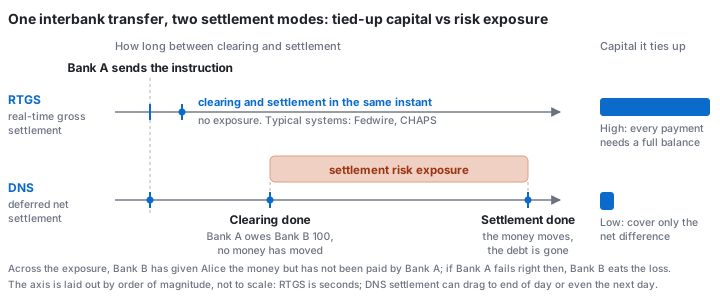
The length of that exposure stretch on the left and the length of that tied-up-capital bar on the right move in opposite directions. Every new rail in the rest of this course is picking a spot between those two lengths.
This trade-off keeps coming back. You will meet it again in cross-border prefunding, in the Wise model, and in stablecoins' "clearing and settlement in the same act." Remember this pair of trade-offs, and a lot of things that look foreign later will suddenly look familiar.
6. Finality: Arrival Is Not the End
Finality asks one question: from what moment on can this money never be taken back?
| Scenario | When the user sees the money land | When settlement actually completes | Reversal window afterward |
|---|---|---|---|
| Book transfer | Instant | Instant | None |
| Card payment (customer to merchant) | "Success" the moment authorization clears | T+1 to T+2 | Chargeback window can run past 120 days |
| ACH | 1 to 3 business days | Net settlement at end of day | Returnable for up to 60 days |
| Wire | Minutes | Real time, payment by payment | Essentially irreversible |
The chargeback in that table: the cardholder goes around the merchant and complains directly to their own issuing bank, demanding that money already paid come back. It gets a full treatment later, when the course reaches card transactions.
For a product manager, this table is more useful than any definition. "Funds received" on a screen and the money belonging to the payee in the legal and accounting sense are two different things. The gap between them is the risk your product carries, and the ground your risk rules have to cover.
The previous chapter said one of cash's hardest properties to replicate is finality on receipt. Of the three interbank roads — wire, ACH, cards — wire comes closest. It is also the most expensive.
Not a coincidence. What makes wire expensive is tied-up capital: it runs on real-time gross settlement, every bank has to stock its settlement account in advance, and the capital sitting there is the price. ACH and cards push settlement later and net it — far cheaper, at the cost of each keeping a back door marked "the money can still be asked back": ACH has returns, cards have chargebacks. The two back doors have different origins; each gets its own chapter later.
7. The N² Problem, and Where It Pushes Us
Everything above had exactly two banks in it. The real United States has more than 4,000 depository institutions.
If every pair of them had to set up a direct clearing relationship:
| Number of banks | Bilateral relationships to maintain | Arithmetic |
|---|---|---|
| 10 | 45 | 10 × 9 ÷ 2 |
| 100 | 4,950 | 100 × 99 ÷ 2 |
| 4,000 | About 8 million | 4,000 × 3,999 ÷ 2 |
Each relationship means opening accounts, signing agreements, monitoring the other side's credit exposure, reconciling every day. Eight million of them is impossible.
Only one solution exists: everyone settles with the same center. The number of bilateral relationships drops from 8 million to 4,000.
But that creates a new problem — this center must be trusted unconditionally by every bank, and the thing it settles with must be accepted unconditionally by every bank.
Who gets to be that center? And what does it settle with? The next chapter answers both.
8. Self-check questions
- An interbank transfer has cleared but not yet settled. What has changed on the receiving bank's balance sheet, and what risk is it carrying?
- A clearing system carries 10 billion in each direction in a day, perfectly symmetrical. How much money moves at end of day, and why?
- Why is a wire fast and irreversible, yet hundreds of times more expensive than ACH? Answer with this chapter's two words.
9. Answers
Answer for yourself before reading on.
- Liabilities up (it owes its receiving customer more), and assets up by the same amount (a new receivable from the paying bank). What it carries is settlement risk: the money has already gone to the customer, the receivable from the paying bank hasn't been honored yet, and if the paying bank fails in that window, the loss is its own to eat.
- Zero. The net is 0; every payment cancels against the opposite flow, and no funds need to move at all. This is netting's limiting case, and it shows why the more symmetrical a clearing system's flows, the more capital-efficient it is.
- Wire runs on real-time gross settlement: clearing and settlement complete together, so arrival is final. The price is that every bank must keep its settlement account stocked to pay each transfer in full — the tied-up capital is expensive, and the system handles every payment individually. ACH runs on deferred net settlement: the cost is spread until it is nearly nothing, the price is delayed settlement — and the exposure during the delay has to be caught by the return mechanism. Cheap, but not final.
Previous: Chapter 1 · The Nature of Payment: Money Never Actually Moves Next: Chapter 3 · The Hierarchy of Money: Whose Money Is Hardest?