The Hierarchy of Money: Whose Money Is Hardest?
Part I · Foundations (Chapters 1–3) Builds on: Chapter 1 (ledger), Chapter 2 (clearing, settlement, settlement risk) New concepts in this chapter: central bank reserves, the hierarchy of money, the liability view, segregation of customer funds, moving between layers
This chapter hands you a table for judging how hard any given "money" is. E-wallets, neobanks, stablecoins — when the course reaches them, you will come back and look them up in it.
1. What the Previous Chapter Left Open
The previous chapter closed on two questions: who gets to be the center that every bank settles with? And what does it settle with?
The two need separate answers: the first asks who, the second asks what thing.
This chapter answers the second one first. Because once that answer is pinned down, the first is all but forced — you will see that the moment you spell out what the settlement asset has to look like, exactly one institution is left that can be the center.
Blow the scene up from two banks to all of them. Every bank in the country hands its payment instructions to the center each day; the center nets everything and works out, at end of day, what each bank is due to receive or pay. Suppose today Bank A must pay out 10 million, split among a few dozen banks — B, C, D, and the rest.
What does Bank A pay with?
First instinct: "with money." But the word "money" is not precise enough here — what exactly does Bank A hold?
What it holds most of is customer deposits — but those are money it owes its customers: a liability, not an asset. It could also write a deposit certificate of its own and hand it to the center: "you all now hold 10 million on deposit with me."
That certificate gets rejected. Not because the others don't know Bank A or doubt it — the reason is far harder than that.
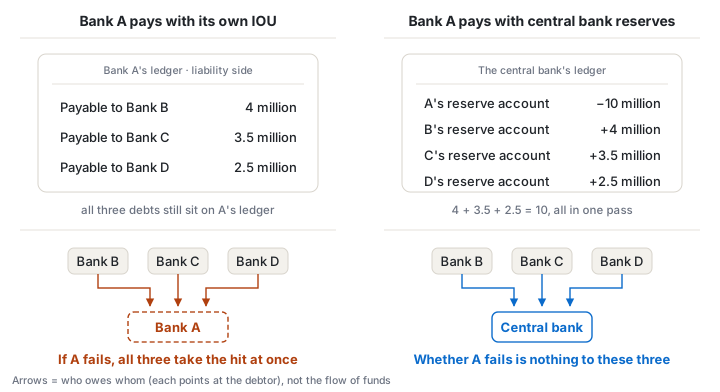
Because the certificate is still Bank A's IOU. Whoever takes it becomes A's creditor. The debt hasn't disappeared; it has merely changed hands. Worse, the 10 million is to be split across a few dozen banks — which means a few dozen institutions all acquiring exposure to A at once. The day A fails, everyone takes the hit.
Settling the whole network with one participant's IOU spreads that participant's credit risk onto everyone. The point of settlement is to extinguish debt, not to hand it to somebody else to carry.
So the thing used for settlement must meet two conditions at once:
- Every bank in the settlement accepts it unconditionally.
- It is not the liability of any bank in the settlement, so no participant defaulting on it is even possible.
The second condition rules out every commercial bank. Who is left?
2. The Answer: Central Bank Reserves
The central bank is left. The previous chapter's two questions share one answer: the center is the central bank, and the thing that settles is central bank reserves.
Commercial banks keep accounts at the central bank. Bank A's reserve account goes down 10 million; the reserve accounts of B, C, D, and the rest go up 10 million between them; the debt is gone.
Set the two ways of paying side by side and the difference is visible at a glance (the figure trims the few dozen receiving banks down to three):
Reserves — the money commercial banks themselves keep on deposit at the central bank — meet both conditions exactly:
| Condition | Why reserves meet it |
|---|---|
| Accepted by every bank in the settlement | Every bank holds an account at the central bank, so every bank can hold reserves |
| Not the liability of any participant | They are the central bank's liability. The central bank doesn't send or receive payments as a party inside this network, and it cannot default — it can create its own currency without limit |
The second row is the key: the central bank can be the center precisely because it is not a player. It doesn't compete with commercial banks for customers and doesn't send or receive payments inside this clearing network, so its IOU is neutral to everyone.
Only by not competing with the participants do you get accepted by all of them as the center. This structure appears twice more in this course — once with the card networks, once with CPN. When the course reaches CPN, you will see what happens the moment this condition fails: the network splits.
And here the course's first loop-back appears:
At the central bank's layer, the interbank settlement problem turns back into the book transfer from the nature of payment. One ledger, one bookkeeper, two lines changing together.
Pushed one layer up, the complicated problem collapses back into the simplest form. You will watch this move three more times — with correspondent banking, with Wise's internal netting, with on-chain transfers. When it happens, you will recognize it.
3. The Core Intuition: Every Kind of Money Is Somebody's Liability
One line in the nature of payment already said it: the balance you see in your app is the row in the bank's ledger that says how much the bank owes you. The last two sections used the same lens twice more without naming it — the customer deposits in Bank A's hands are the bank's liability; the reserves that settle everything are the central bank's liability. Push the lens across every form money takes, and you get the one sentence this chapter asks you to carry away —
Every kind of money is somebody's liability.
Even the cash in your wallet is no exception. It is the central bank's liability — but the central bank cannot default and never has to redeem cash into anything else, which is why the question of who stands behind it never crosses your mind. The two examples above don't "prove" this sentence; it is a way of seeing that generalizes. What actually grounds it is laying all five kinds of money out at once and finding, for every one, a party who owes you.
Judging how good any "money" is comes down to two questions: Who owes you? What do they redeem with, and where are the reserves?
Commit these two to memory. Every new form of balance the course meets from here on gets asked them all over again.
| The money in your hand | Whose liability it is | Redeemed with what | If it goes wrong, what then |
|---|---|---|---|
| Cash | The central bank | Needs no redemption — it is itself the end of the line | Almost nothing can happen to it |
| Central bank reserves | The central bank | Same as above | Only banks can hold them; you never touch them |
| Bank deposits | A commercial bank | Cash or reserves | Deposit insurance pays out, up to its cap |
| E-wallet balance | The wallet company | Bank deposits | Depends on whether customer funds are held segregated |
| Stablecoins | The issuer (Circle, say) | Bank deposits + liquidated Treasuries | Depends on whether the reserves are fully there and redeemable at any moment |
This table is the hierarchy of money.
The five rows really occupy just three bands — within one band, the party owing you is the same kind of entity, so the credit risk is the same grade:
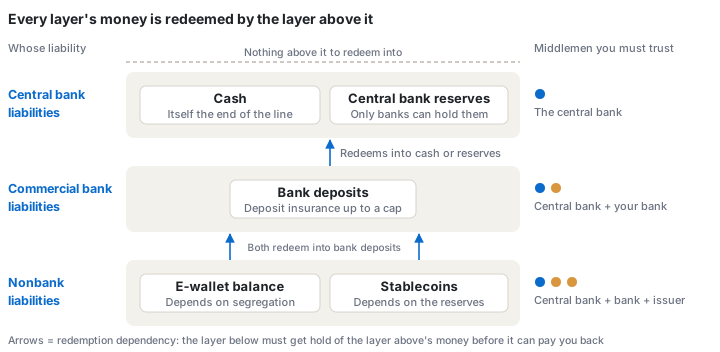
Top to bottom, credit risk rises — and so does usability:
- The higher the layer, the safer, and the harder to use (reserves you cannot hold at all; cash can't shop online).
- The lower the layer, the handier — and every layer you step down, you shoulder one more layer of credit risk.
There is no free convenience. Every payment tool you use in daily life is trading a little credit risk for a little convenience.
What this table measures is credit risk — whether the party owing you will default. It does not measure purchasing power: the central bank cannot default, but it can debase its own currency; that is risk on a different axis, and this course leaves it alone. So "top of the hierarchy" reads as "least likely to default," not "holds its value best."
4. A Concrete Exercise
You hold 100 yuan three times over: cash in your wallet, a deposit in your banking app, a balance in Alipay. In everyday use the three are perfectly equivalent; you never think to tell them apart.
Don't jump to the table yet. Run the two questions — who owes you? What do they redeem with, and where are the reserves? — for yourself: when each of the three events below hits, which of the three 100s is still there, and which is suddenly in doubt?
- The issuing institution fails
- The institution gets frozen
- Network and power go out
Think it through, then check. The hierarchy-of-money table's "if it goes wrong" column already answered the failure case; here it gets filled in with actual numbers, plus the two cases it never covered:
| Event | Cash 100 | Bank deposit 100 | Wallet balance 100 |
|---|---|---|---|
| The issuing institution fails | Not applicable | Deposit insurance pays out (capped at ¥500,000 in China, $250,000 under FDIC in the US) | Depends on whether customer funds are 100% deposited at the central bank or held in segregated custody |
| The institution gets frozen | Unaffected | Your account may be frozen along with it | Same as the deposit |
| Network and power go out | Works as always | Unusable | Unusable |
The value of this exercise is not to send you off to withdraw cash. It is to install a habit: at the sight of any "balance," ask first: who owes you? What do they redeem with, and where are the reserves?
Where a neobank actually keeps the money, what sits behind a stablecoin's reserves — when those chapters come, they run this exact same move.
5. What a Payment Really Does: Moving Between Layers
With this table in hand, payment can be redefined. In the nature of payment, a payment was an edit to a ledger. Now it can be said more precisely:
Every payment is either a move within one layer or a conversion between layers.
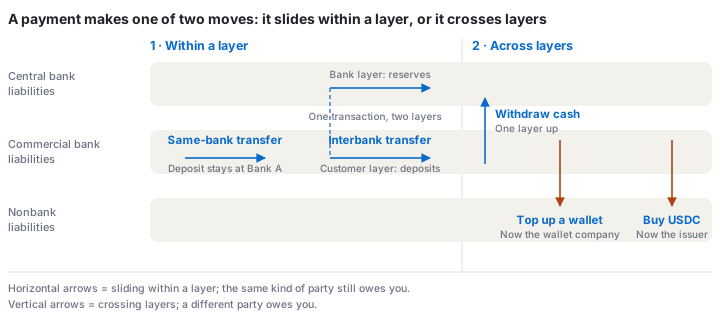
| What you do | What actually moves in the hierarchy |
|---|---|
| Same-bank transfer | A move within one layer (Bank A deposit → Bank A deposit) |
| Interbank transfer | A move at the customer layer + settlement in reserves at the bank layer; two layers touched |
| Withdrawing cash | Bank deposit → cash; one layer up |
| Topping up Alipay from a bank card | Bank deposit → wallet balance; one layer down |
| Buying USDC with dollars | Bank deposit → stablecoin; one layer down |
The buying-USDC row you should now be able to read unaided: buying a stablecoin is not "turning money into another kind of money." It is swapping a claim on a bank for a claim on the issuer — taking on one more layer of credit risk in exchange for something else.
In exchange for what, exactly? The two stablecoin chapters later in the course answer that one question.
6. Planted for Later: Stablecoins Innovate Nothing in the Hierarchy
It can now be said plainly. File this away:
Stablecoins innovate nothing in the hierarchy of money. A stablecoin is its issuer's liability, on the same layer as an e-wallet balance — for a while with even weaker regulatory protection. The innovation is entirely off this table. It is in the shape of the ledger — the ledger has been moved to a place every participant can read and write directly.
Much of the stablecoin debate mixes these two things together, and so ends up either crowning them "a new form of money" or sneering that they are "just an e-wallet." Keep the two apart and neither claim stands.
When the course reaches stablecoins, it will set them back onto this chapter's hierarchy-of-money table — and then take up, separately, what the change in ledger shape actually buys.
7. The Question This Chapter Leaves Open
With that, Part I's foundation is poured: ledgers, clearing and settlement, the hierarchy of money. For banks and their customers, the system runs beautifully.
But it cannot handle the most everyday scene there is — you walk into a coffee shop and buy a coffee.
| Obstacle | What it means |
|---|---|
| The merchant doesn't know you | No way to know whether you will pay |
| The merchant can't see whether you have money | Your bank's ledger is invisible to him |
| The transaction must finish in seconds | Waiting on T+1 clearing is out of the question |
| Small amounts, huge counts | Cost per transaction must be near zero |
The next chapter is about how cards solve all four.
8. Self-check questions
- At end of day, Bank A owes a few dozen banks 10 million between them. Why can't it pay by writing a deposit certificate of its own?
- You keep 10,000 yuan with a wallet company. To judge how safe that money is, which two things do you go check?
- In one sentence: why is "the lower the layer, the handier" no coincidence?
9. Answers
Answer for yourself before reading on.
- Because the certificate is still A's IOU. The debt doesn't disappear; it only changes hands. Worse, the 10 million gets split across a few dozen banks, giving a few dozen institutions simultaneous exposure to A — the day A fails, everyone takes the hit. To truly extinguish the debt, A must hand over an asset that is no settling bank's liability and that every participant accepts unconditionally: central bank reserves.
- The same two questions. First, who owes you — the wallet company does, not a bank. Second, what does it redeem with and where are the reserves — is your 10,000 deposited 100% at the central bank or held in a segregated custodial account at a bank, or has it been put to work in some investment? The second answer decides how much you get back if the company fails.
- Because the lower the layer, the more middlemen there are and the more services they can offer (bookkeeping, credit, instant arrival, interoperability across institutions) — and every added middleman is an added layer of credit risk. The convenience is provided by the middlemen themselves, so convenience and risk can only grow together.
Previous: Chapter 2 · Two Jobs Between Banks: Clearing and Settlement Next: Chapter 4 · The Origin of Cards: Solving Credit Between Strangers