The Origin of Cards: Solving Credit Between Strangers
Part II · Cards (Chapters 4–8) Builds on: Chapter 1 (the ledger), Chapter 2 (clearing and settlement), Chapter 3 (the hierarchy of money) New concepts in this chapter: the three-party model, guaranteed payment, two-sided networks and the cold start, the earliest form of the merchant discount rate
1. A Dinner in New York, 1949
The previous chapter ended with the four obstacles in the coffee-shop scene: the merchant doesn't know you, the merchant has no idea whether you have money, the transaction must finish in seconds, and the amounts are small while the volume is huge. The banking-ledger machinery of the first three chapters solves none of them. This chapter is about how the first solution appeared.
The most widely told version goes like this: in 1949, Frank McNamara was hosting a dinner at a New York restaurant, discovered he had left his wallet in another coat, and had to phone his wife to bring money; from this he got the idea that there should be a card that could stand in for cash.
That version is made up. The man who made it up was Diners Club employee number one, a PR man named Matty Simmons, and he later admitted it himself: the business needed a good origin story. The real process was far duller. McNamara had the idea long before, and he and Simmons spent months going restaurant to restaurant in Manhattan before the first one agreed to take the card. That difference gets used later in this chapter — what decided success wasn't the dinner; it was the months.
In 1950, McNamara and his lawyer Ralph Schneider founded Diners Club as partners, and the first batch of cards — about 200 — went out in February.
Those 200 cards went to the two men's friends and contacts, mostly Manhattan businessmen who regularly took clients out to eat. The card itself was a piece of cardboard: the holder's name printed on the front, and on the back a list of restaurants — 27 in New York, and those 27 were the only places on earth that took the card.
Using it was simple: eat at any restaurant on the list, show the card, sign the bill, and walk out without paying a cent on the spot. The restaurant mailed the signed bills to Diners Club for its money; at month end, Diners Club rolled all of that cardholder's bills into one statement and mailed it to him to settle in a single payment. The cardholder paid $3 a year; the restaurant gave up 7% of every bill.
The demand was real: 20,000 members by the end of 1950, and 42,000 a year later.
File away one detail now. The statement had to be paid in full at month end; miss it, and the card stopped working the next month. So strictly speaking, Diners Club was not a credit card. It was a charge card: it only pushed the payment date back and lent nothing in installments. The true credit card — pay part, carry the rest at interest — doesn't arrive until BankAmericard in 1958. The course uses this distinction later, when it explains why the issuer gets to take the biggest slice of the fees.
The Diners Club story usually ends here, but that leaves out the most important thing: before it appeared, "how do strangers buy on credit" already had a solution. That solution just couldn't scale.
2. The Old Solution: The Regular's Tab
Before the credit card, merchants sold on credit through the tab: a regular signed his name in the shop's book and settled up at the end of the month.
That arrangement ran for centuries, and it rested on exactly one premise: the shopkeeper knows you.
He knows where you live, what you do, and whether you stiffed him last time. The credit information lives in the shopkeeper's head, and the credit limit is his own judgment call.
Which is exactly where the problem lies:
| Limitation | Consequence |
|---|---|
| Works only for regulars | Out-of-towners and passersby can't use it at all |
| Every store assesses you separately | Your spotless record at store A is worth nothing at store B |
| Limits rest on gut feeling | The shopkeeper's risk exposure is uncontrolled; one bad debt can sink a small store |
| Collection runs on personal ties | Chasing a deadbeat costs a fortune in effort |
The banking system from the three foundation chapters can't catch this either, for a concrete reason: that machinery works between account holders, and you have no account relationship with the coffee shop at all.
3. The New Solution: Insert a Middleman Both Sides Know
What Diners Club did fits in one sentence:
It knows both the buyer and the seller, so it takes "the shopkeeper knows you" out of every individual store and concentrates it in one company.
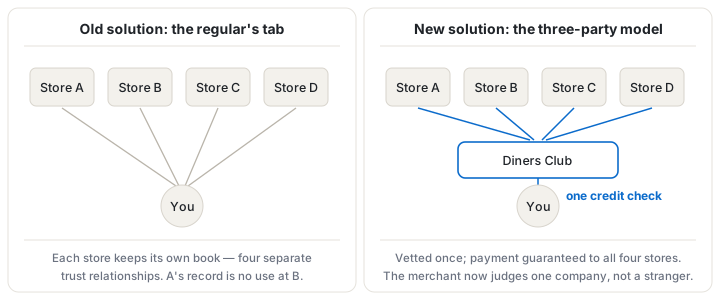
It runs the credit check on the consumer and guarantees payment to the merchant. The merchant no longer has to judge whether you can be trusted — only whether Diners Club can.
This is called the three-party model (a closed loop: the same company both issues the cards and signs up the merchants):
| Role | What it does | What risk it carries |
|---|---|---|
| Cardholder | Pays by card, repays the card company at month end | None |
| Merchant | Accepts the card, collects from the card company at face value minus the fee | None (payment is guaranteed by the card company) |
| Card company | Vets cardholders, fronts the money, collects at month end | The full loss when a cardholder doesn't pay |
How the money moves on a $100 dinner (Diners Club's early take was 7%):
| Step | Action | Amount |
|---|---|---|
| 1 | Cardholder signs the bill | 100.00 |
| 2 | Card company pays the restaurant | 93.00 |
| 3 | At month end, the card company collects from the cardholder | 100.00 |
| 4 | Card company's gross revenue | 7.00 |
That 7 has to cover three things: bad-debt losses, operating costs (in those days: printing statements, reconciling by hand, postage), and profit.
This percentage, deducted on the merchant's side in proportion to the sale, is the earliest form of today's merchant discount rate (MDR). Later in the course you'll watch the 7% shrink to around 2% and get split among three different roles — but the structure never changes.
4. Another Version of the Goldsmith Story
Recall the opening of the nature of payment: a cloth merchant needs to pay 50 gold coins to a merchant 200 miles away, and the coins have to ride the whole distance under guard; then everyone deposits their coins in the goldsmith's vault and trades the receipts instead, and the coins never move again. Set the goldsmith and the card company side by side, and the structure repeats:
| Point of comparison | The goldsmith (the nature of payment) | The card company (this chapter) |
|---|---|---|
| The original problem | Gold coins are too heavy to move | Strangers have no credit with each other |
| The solution | Everyone trusts the same goldsmith | Everyone trusts the same card company |
| The result | The coins no longer move | The merchant no longer needs to know you |
| What the middleman earns | Storage fees, later a lending spread | Merchant fees, cardholder annual fees |
The same structure both times: concentrate scattered trust in one middleman, and buy efficiency for the whole network.
The course will see it three more times: the card networks in the next chapter, then correspondent banks and CPN further on — all doing exactly this. The only difference is what each of them concentrates.
5. The Counterintuitive Part: Why Merchants Accepted 7%
7% is not a small number. A full-service restaurant typically nets 3% to 5% — the 7% is more than the entire profit on the meal.
Merchants accepted it because of what they got back — four things:
| What the merchant gets | Meaning |
|---|---|
| Bigger tickets | Spending is no longer capped by the cash in the customer's pocket |
| New traffic | The card company's member roster is itself a source of customers |
| Certainty of getting paid | Payment is guaranteed by the card company; deadbeat risk moves off the merchant |
| Lower cash-handling costs | No counting bills, no armored transport, no robbery risk, no reconciling the till |
This table is the test for whether any payment product can gain adoption.
A merchant is forever doing the same arithmetic: does the rate I pay come back to me through those four items? If it does, accept. If it doesn't, resist.
The test gets reused again and again in this course. Later, you'll use it to answer three questions:
- Why, on the same card payment, a US merchant gives up several times what a European merchant does — and both accept it.
- Why a merchant would add a stricter identity check even though it turns away some business.
- Whom stablecoins can convince, and whom they can't.
6. The Wall the Three-Party Model Hit
Diners Club, and American Express after it, ran into the same wall: one company has to finish two jobs at once.
- Sign up every merchant in the country willing to accept the card.
- Run a credit check on every consumer who wants one.
That stacks up three difficulties.
First, every new city starts from zero. Both sides — merchants and cardholders — need fresh field sales: people knocking on doors, talking one store at a time. The months McNamara and Simmons spent working Manhattan's restaurants at the start of this chapter are the smallest-scale version of exactly this — not a story about inspiration, but a cold start done by hand.
Second, the two-sided network's cold start. This is the critical one:
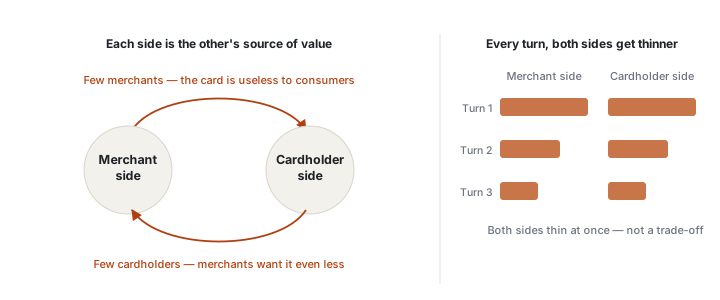
The loop feeds on itself: with every turn, both sides come out thinner than the turn before. Breaking it means pouring subsidy money into one side first, at scale — and that takes enormous capital.
Third, the funding strain. The card company fronts every payment first and waits until month end to collect. Every time the business doubles, the money it must front doubles with it.
American Express's answer was not to break the loop but to route around it. That road still works today — the next chapter sets it beside the other road for comparison.
7. The Question This Chapter Leaves Open
If one company can't finish both jobs, can it split them off and let others do them instead?
In 1958, a bank ran an experiment to answer that question. It paid dearly, and the result changed the entire industry. The next chapter covers that experiment, and the four-party model that grew out of it.
8. Self-check questions
- The regular's tab and the credit card are, at bottom, two versions of the same thing. Name the single structural difference between them.
- A new payment company wants merchants to switch to its rails, at a rate 1 percentage point below cards. Using this chapter's four-item table of what the merchant gets, name at least two questions it still has to answer.
- What is the cold-start problem of a two-sided network? Why can a three-party model rarely break it with its own money?
9. Answers
Answer for yourself before reading on.
- Where the trust is stored. The tab keeps credit information in each shopkeeper's own head, so it can't travel and can't be reused; the card concentrates it in one institution, so a single credit assessment gets reused at every signed merchant. That one difference produces all of the economies of scale.
- At least these two. First: can it match the certainty of getting paid — is payment guaranteed, and can it be clawed back? If the 1% saved buys back bad-debt risk, merchants won't switch. Second: can it deliver the same traffic and ticket size? If consumers don't use the rail, no rate is low enough to matter. These two are precisely where stablecoin payments most often stall on the merchant side.
- The two sides of the network are each other's source of value: with few merchants, consumers won't get the card; with few cardholders, merchants won't accept it — a self-reinforcing death spiral. Under the three-party model, the money to break the loop can only come from the card company itself: whichever side gets subsidized, it foots the bill, and the field sales and credit checks on both sides also land on it alone — capital needs swell in step with scale. Is there a way to make someone else share that bill? That is the subject of the next chapter.
Previous: Chapter 3 · The Hierarchy of Money: Whose Money Is Hardest? Next: Chapter 5 · The Four-Party Model: Why Visa and Mastercard Won