The Four-Party Model: Why Visa and Mastercard Won
Part II · Cards (Chapters 4–8) Builds on: Chapter 2 (clearing and settlement, netting), Chapter 4 (the three-party model, the two-sided cold start) New concepts in this chapter: the four-party model, issuer, acquirer, card network, authorization and funds flowing in opposite directions
1. The Wall From the Previous Chapter
One company vetting every cardholder and signing every merchant at the same time: it can't be done. And the two-sided cold-start death spiral can't be broken — unless someone is willing to dump a massive subsidy on one side first.
In 1958, Bank of America decided to be the one to dump it.
2. The Fresno Drop: A Costly Experiment
On September 18, 1958, Bank of America mailed BankAmericard cards directly to 60,000 residents of Fresno, California.
No application, no vetting, no credit check. The card simply landed in your mailbox, ready to use the moment you opened the envelope.
It is the most direct attack on the cold start: manufacture the cardholder side in one stroke, and the merchants will follow. The logic was sound. The cost was enormous — first-year delinquency ran around 22%, while the bank's other consumer installment loans were running at about 4%. First-year losses were on the order of $10 million (sources put the figure anywhere from $8.8 million to nearly $20 million), and the man running the program was fired before the planned rollout across the rest of California.
But the drop bought two conclusions:
- The demand was real. Wherever the card worked, people used it.
- One bank's capital and customer base cannot carry a national card network.
The second conclusion decided everything that followed.
3. The Real Solution: Outsource Issuing and Acquiring
In 1966, Bank of America began licensing the BankAmericard brand to banks in other states. In 1970 the operation was spun out of BofA into an organization owned jointly by its member banks, and in 1976 it renamed itself Visa.
Almost simultaneously, a group of banks that refused to join BankAmericard formed their own alliance in 1966; after several renamings, it settled on Mastercard in 1979.
The essence of the move: Bank of America gave up exclusive ownership of cardholders and merchants, and got back a network every bank was willing to join.
Three parties became four.
| Role | What it does | What risk it carries | Example |
|---|---|---|---|
| Cardholder | Spends, repays | None | You |
| Issuer | Vets cardholders, issues cards, sets credit limits, fronts the money, collects | Losses when cardholders don't pay | Chase |
| Acquirer | Signs merchants, settles money to merchants, manages merchant risk | Losses when a merchant vanishes or refunds pile up | Wells Fargo Merchant Services |
| Merchant | Gets paid | Losses from chargebacks | The coffee shop |
The card network (Visa, Mastercard) is not a fifth party. It is the rules and the connections between the four: it sets the rules, runs the network, does the clearing, and nets positions between member banks the way clearing and settlement described. It issues no cards, signs no merchants, and holds no transaction funds.
The structure from the previous chapter — concentrate scattered trust in one middleman — gets upgraded one level here. What the card network concentrates is not trust in any particular consumer but trust in the rules: an issuer trusts that an acquirer will play by the rules, because everyone is bound by the same set.
4. How One Transaction Runs Across the Four Parties
One detail is easy to memorize backwards: authorization information and funds flow in opposite directions.
The authorization path (information, seconds)
Merchant → acquirer → card network → issuer. The issuer decides approve-or-decline, and the answer travels back along the same path to the merchant.
The funds path (money, a day or two later)
Issuer → (transferred in the net amounts the card network computed) → acquirer → merchant. The money never touches the card network's own accounts; it only does the math and sends the instructions — this is what "holds no transaction funds" meant above.
Why opposite? Because the paying side is the cardholder's, while the side asking for approval is the merchant's — the side getting paid. Information starts from the party receiving the money; money flows out from the party paying it.
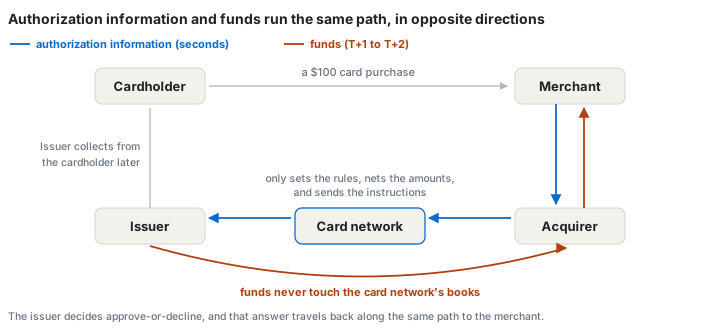
Notice that the funds path along the bottom goes around the card network: it sits on the information path but not on the funds path. That is the literal meaning of "holds no transaction funds."
Later, the course takes this path apart in full along a timeline. For now, hold on to one thing: the directions are opposite.
5. Three-Party versus Four-Party
| Dimension | Three-party (Amex, Discover) | Four-party (Visa, Mastercard) |
|---|---|---|
| Who issues the cards | The network itself | Thousands of banks |
| Who signs the merchants | The network itself | Thousands of acquirers |
| Who pays the cold-start cost | The card company, all of it | Spread across every member bank |
| Speed of expansion | Slow, city by city | Fast — every bank pushes to its own customers |
| Merchant fees | High | Comparatively low |
| Merchant coverage | Narrow | Vast |
| Who holds cardholder data | The card company, in full | Scattered across issuers |
| Who keeps the profit | The card company, alone | Mostly the member banks; the network collects only scheme fees |
Amex is alive and well today. Its choice was to route around the cold-start loop rather than break it: serve only high spenders, charge higher rates, and spend that money on the perks those people want. The price is merchant coverage that never catches Visa and Mastercard — the "No Amex" sign you keep seeing in small shops is exactly this.
This is not "four-party always wins." It is a trade between two business models: Amex trades coverage for margin; Visa trades margin for coverage.
6. The Key Insight: The Cold-Start Cost Got Split Up
This is the four-party model's real killer move, and it deserves to be spelled out on its own.
Under the three-party model, adding a million cardholders means the card company itself finds a million strangers, credit-checks them one by one, and eats the full acquisition cost.
Under the four-party model, the card network does none of that. It only has to convince a bank to join — and that bank pushes cards to existing customers it has already vetted, already holds accounts for, and already knows the income of.
| Three-party model | Four-party model | |
|---|---|---|
| Acquisition work per new cardholder | The card company finds and vets from scratch | The bank cross-sells to existing customers |
| Where credit information comes from | The card company builds its own | The bank already has it |
| The network's own marginal cost | High | Near zero |
This is why Visa and Mastercard rank among the highest-margin companies on earth: they outsourced the network's two most expensive jobs — acquisition and risk — in their entirety, and keep for themselves a toll that is razor thin but rock steady.
When the course reaches CPN, you'll see the same play copied wholesale onto stablecoins: hold no funds, do no on- and off-ramps, only set the rules and connect the participants.
7. The New Problem This Model Creates: Who Sets the Price
The four-party model has one headache the three-party model never had.
In the three-party model, the card company faces both the merchant and the cardholder; it sets its 7% and that's that. In the four-party model, the issuer and the acquirer are two different companies that don't know each other — they may even be competitors.
So two questions demand answers.
First: where does the issuer's income come from?
It does the most work, fronts the most money, and carries the most bad debt — yet the cardholder may pay no annual fee at all (the $3 fee from the previous chapter got competed away entirely on a large share of cards). Why should it authorize and guarantee a transaction for a merchant it has never met?
Second: how does the fee get divided?
Let every issuer negotiate with every acquirer, pair by pair? That is the N² problem from clearing and settlement all over again. The US has more than 4,000 depository institutions, any of which might both issue and acquire; the pairwise negotiations would still number in the millions.
The answer to both questions is a single number, and its name is interchange. For the past two decades, the main battlefield of payments regulation and litigation worldwide has been this number.
The next chapter takes it apart.
8. Self-check questions
- What exactly does the card network provide in the four-party model? Answer without using the word "network."
- Why was the Fresno Drop, for all the money it lost, a necessary precondition for the four-party model?
- Amex's merchant coverage trails Visa's, yet it remains highly profitable. Using the previous chapter's four-item table of what the merchant gets, explain what kind of merchant accepts Amex's higher rate.
9. Answers
Answer for yourself before reading on.
- It provides a rulebook every member obeys, and the mutual trust built on that rulebook. An issuer dares to guarantee a transaction at a merchant it has never met because it knows the acquirer is bound by the same rules, disputes follow one adjudication process, and clearing runs on one timetable. What the card network sells is the enforceability of rules — not cables.
- Because one expensive experiment proved two things: the demand genuinely exists, and a single bank's capital and customer base can't carry a national network. The second point directly forced the decision to license the brand to other banks — which is the four-party model. Without that loss, Bank of America would most likely have kept going it alone.
- Merchants with big tickets and a customer base that overlaps Amex's cardholders — high-end restaurants, hotels, airlines, the business-travel trades. For them, the lift in ticket size and the new traffic Amex brings more than covers the higher rate. For a low-margin, high-frequency merchant like a convenience store, the extra point-and-change eats straight into net profit — so they refuse the card.
Previous: Chapter 4 · The Origin of Cards: Solving Credit Between Strangers Next: Chapter 6 · Interchange: The Economic Core of the Payments Industry