Interchange: The Economic Core of the Payments Industry
Part II · Cards (Chapters 4–8) Builds on: Chapter 4 (the 7% fee, the charge card), Chapter 5 (the four-party model, issuers and acquirers) New concepts in this chapter: interchange, MDR, scheme fees, merchant category codes (MCC), product tiers and benefit tiers, commercial cards, value-added services (VAS), on-us vs off-us, the Durbin Amendment, the EU's IFR
This chapter has a numbers example you should work through as you read — grab pen and paper. Do the arithmetic once and you will remember this fee split for good.
1. The Two Questions to Answer
The previous chapter ended with two questions. They are really two faces of the same one.
First: where does the issuer's income come from? List out what it carries, item by item: vet the cardholder, extend a credit line, front the money to the merchant, eat the loss when the cardholder doesn't pay, eat the loss on fraud, run customer service, handle disputes. And the cardholder may pay no annual fee at all.
Second: how does the fee get divided? The issuer and the acquirer are two companies that don't know each other and may be competing with each other. Neither has any reason to yield.
The card network's answer is a default price that requires no negotiation and applies to every member directly. That price is called interchange, and it is what this chapter is about from start to finish — what it is, why the big slice goes to the issuer, why it grew into two different shapes in the US and the EU, and who, in the end, is actually paying it.
2. Getting the Definition Right
The most misunderstood thing about interchange is its direction.
Interchange is not money the merchant pays the card network. It is money the acquirer pays the issuer.
The merchant never pays interchange directly. What the merchant pays is the MDR (merchant discount rate — the all-in rate a merchant pays in order to get paid), and out of that money the acquirer passes a slice on to the issuer and keeps the rest.
How the three fee terms relate:
| Term | Who pays whom | Who sets the price |
|---|---|---|
| MDR (merchant discount rate) | Merchant → acquirer | Agreed by contract between acquirer and merchant |
| Interchange | Acquirer → issuer | Set uniformly by the card network |
| Scheme fees | Acquirer and issuer → card network | Set by the card network |
Getting the directions straight matters: the MDR is something a merchant can negotiate; interchange is something neither the acquirer nor the overwhelming majority of merchants can (merchants of Walmart's size are the exception — more later in this chapter). Which means the acquirer's pricing room is only whatever is left of the MDR after interchange and scheme fees come out.
3. The Worked Example: A $100 Purchase
Follow along.
Step 1: the rate the merchant signed
Say the merchant's contract with its acquirer sets the MDR at 2.30%.
Merchant receives = 100.00 − 100.00 × 2.30% = 100.00 − 2.30 = 97.70
Step 2: what the acquirer has to pay out
Say the interchange that applies to this card is 1.80%, and scheme fees total 0.13%.
Acquirer pays out = 100.00 × 1.80% + 100.00 × 0.13% = 1.80 + 0.13 = 1.93
Step 3: what the acquirer has left
Acquirer gross margin = 2.30 − 1.93 = 0.37
Step 4: where the $100 finally lands
| Who takes it | Amount | Basis |
|---|---|---|
| Merchant | 97.70 | Transaction amount minus the MDR |
| Issuer | 1.80 | Interchange |
| Card network | 0.13 | Scheme fees |
| Acquirer | 0.37 | MDR minus the two lines above |
| Total | 100.00 | — |
Cross-check: 97.70 + 1.80 + 0.13 + 0.37 = 100.00. The total equals the transaction amount, so nothing is missing and nothing is double-counted.
(To keep the arithmetic clean, all the scheme fees above sit on the acquiring side. In reality the issuer also pays the card network a cut, out of its 1.80 — small, and not worth unpacking here.)
Now the most important thing in that table: of the 2.30 taken from the merchant, the acquirer kept just 0.37. The issuer took 1.80.
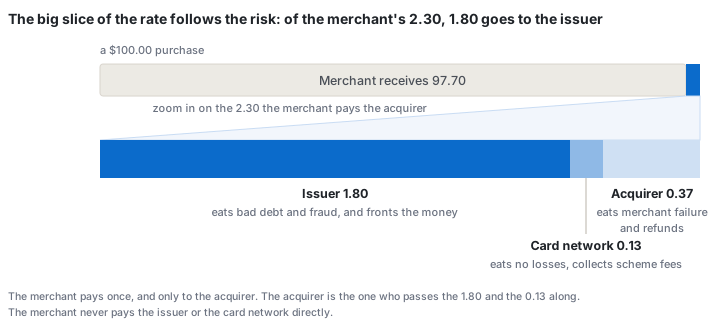
The second bar in the figure blows that thin 2.30 slice up to full width. The two bars are on different scales — don't compare their lengths side by side.
Most people assume the companies you can actually see on the acquiring side — Stripe, Square — are the main profit takers. They are not. The most profitable seat in the payment chain is on the issuing side. The course leans on this judgment directly later, when it explains why every neobank is in a hurry to issue cards.
(Strictly speaking, Stripe and Square are not acquiring banks but service providers on the acquiring side; there is a division of roles in between. The course splits that square open when it reaches the industry role map — for now, read them as "the acquiring side.")
4. Why the Issuer Gets the Big Slice: Money Follows Risk
List what the issuer carries, and the answer explains itself.
| What the issuer carries | Kind of cost |
|---|---|
| Credit vetting and limit management | Fixed cost |
| Fronts money to the merchant, collects from the cardholder only at month end | Funding cost |
| Cardholders who don't pay | Risk cost |
| Fraud losses (in most cases the issuer eats them — unpacked later) | Risk cost |
| Points, cash back, miles | Acquisition cost |
| Customer service and dispute handling | Operating cost |
Go back to the origin of cards: the 7% Diners Club charged covered exactly these items — it's just that one company carried them all.
There is also a distinction the origin of cards left waiting to be cashed in, and this is where it pays off. Diners Club was a charge card — the statement had to be paid in full at month end — so it fronted at most one month's money, and a bad debt either happened or it didn't. Today's credit card lets you pay part and carry the rest at interest, so the issuer's fronting period stretches from one month to indefinitely, and bad debt changes shape from "won't pay" to "owes it for years and can't." Rows two and three of the table above carry the extra weight of exactly this distinction.
The four-party model split the Diners Club company into an issuer half and an acquirer half, and the 7% split along with it. The rule:
In a payment chain, whoever carries the losses takes the biggest slice of the rate.
The course uses this rule three more times: to judge whether payment service providers or acquiring banks make more money, to judge where a neobank's revenue comes from, and to judge who the money in a stablecoin corridor will flow to. When you meet a new role, first ask what losses it carries.
5. Interchange Is Not One Number — It's a Table Hundreds of Rows Long
The same $100 payment can carry interchange that differs by a factor of ten: a regulated debit card sits around 0.3%, while a premium credit card on a cross-border online transaction can top 3%. Plenty of things move the number; below are the seven you meet most often:
| Factor | The contrast | Which way it pushes |
|---|---|---|
| Kind of card | Debit / credit | Debit is held down by regulatory caps and sits below credit |
| Card product | Consumer standard / consumer premium / business / corporate | The higher the product, the higher the rate; commercial cards higher still — the next section is about this |
| How the card is used | Chip or swipe in person / typing the number online | Card-not-present rates are higher, because fraud risk is higher |
| Same institution or not | off-us / on-us | Same institution on both sides, and the money never leaves it |
| Merchant industry (MCC) | Supermarkets and gas stations / general retail / online subscriptions | The merchant category code picks which family of rows applies; some categories are priced cheap on purpose |
| Merchant size | Big chains / corner stores | Scale earns a cheaper row — and at the very top, a rate off the table |
| Where the card was issued | Domestic / foreign | Cross-border transactions cost noticeably more |
(These seven are nowhere near all of it. A real schedule keeps subdividing by ticket size, terminal type, industry code, whether 3DS was used — which is how one table reaches hundreds of rows.)
Of the seven, the row people skip entirely is the fourth. The definition is short:
On-us: the issuer and the acquirer are the same institution. Off-us: they are not.
The difference is not bookkeeping, it is a different journey for the message. On an off-us transaction the acquirer looks at the card, sees an account it does not hold, and routes the authorization out to the network, which passes it to the issuer and carries the answer back. On an on-us transaction the acquirer looks at the card and recognizes itself. There is nobody to ask. It approves the transaction against its own records and settles it internally, and the message never goes through Visa or Mastercard at all.
You can see this on a paper receipt:
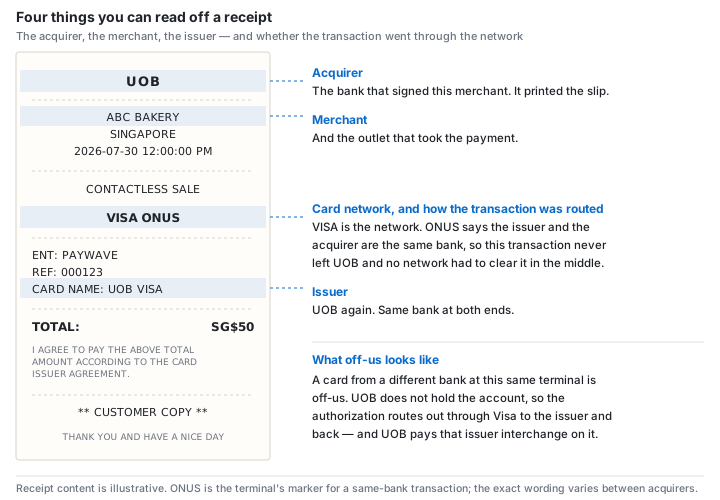
Read it top to bottom. UOB at the head of the slip is the acquirer. ABC BAKERY is the merchant. CARD NAME: UOB VISA is the issuer. And the line in the middle, VISA ONUS, is the terminal telling you both the network and the routing: the card is a Visa, and the transaction was on-us, so it stayed inside UOB. Hand over a card from another bank at the same terminal and that line changes.
Back to the nature of payment: two accounts on the same ledger, and the marginal cost of moving between them is near zero — that chapter already noted banks call it an on-us transfer. On-us in cards is the same thing. Interchange stops being money paid to another company and becomes one company's internal transfer price, left hand to right hand. The bank can set it at anything it likes, including zero, because the money does not leave the building.
That row explains three things that look unrelated. First, why the three-party model has no interchange to split: issuer and acquirer are the same house, every transaction is on-us, and that 7% doesn't have to be divided with anyone — it took the four-party model splitting the company in two for this line item to surface at all. Second, why in markets where banking is concentrated, the bank that is big in both issuing and acquiring can quote more aggressively: on part of its volume, this money never goes out the door, and it can price that part down to win the merchant. Third, why on-us rates tend to be faster and to fail less often — there is no network hop, no second institution to time out, and no interbank dispute process to run if something goes wrong.
(How much on-us volume a bank sees depends entirely on the market. In Singapore, Hong Kong or the Nordics, where a handful of banks hold most of the cards and most of the terminals, it is a large share. In the US, with thousands of issuers and acquiring concentrated in processors that issue nothing, it is close to nil.)
The industry row runs on a four-digit number. When an acquirer signs a merchant it assigns it a merchant category code — 5411 for grocery stores, 5541 for service stations, 8398 for charities, 4111 for local transit. That code rides along with every transaction the merchant sends, and it is what mechanically decides which family of rows the transaction can land in. The merchant does not pick it and in most cases never sees it.
Open Visa's US schedule and the categories are sitting there as separate rate families: supermarket, fuel, restaurant, taxi, charity, government, education, healthcare, real estate, insurance, travel. Same card, same $100, same country — but a charity is charged 1.35% + $0.05 while an ordinary retailer on that same card pays 1.51% + $0.10 and a taxi pays 2.10%. Other schedules define the categories by listing the codes outright: Mastercard's published Swiss schedule defines "airlines" as MCCs 3000–3350 and 4511, and prices that whole block flat at 0.50%.
Read the cheap categories carefully, because they are not the output of a cost calculation. Supermarkets, fuel, utilities, government, transit, parking, fast food, charity — high-volume, thin-margin, cash-heavy categories, priced down deliberately to pull cash onto cards. The industry name for them is strategic merchant segments, and in some markets they land near 0.5% no matter which card is presented. That is a useful thing to know about any rate table you are handed: some of its rows are priced off risk, and some are priced off a growth target.
Merchant size works at two levels. The first is inside the schedule. Visa's US table sets explicit performance thresholds — clear 133.4 million transactions and $8.83 billion of volume in a year, hold disputes under 0.020%, stay PCI compliant, and your retail transactions move to a cheaper row; at the other end there is a small-merchant program for merchants under $280,000 a year. The second level is outside it: Visa's and Mastercard's US rate tables are public, but merchants at Walmart or Amazon scale pay rates that are on no table at all. That is also why the published schedule and what a given company actually pays so often fail to match — earlier this chapter said interchange is negotiable for neither the acquirer nor the overwhelming majority of merchants; this row is the exception. How such a rate actually gets negotiated has a section of its own later in this chapter, on the time Amazon did it.
The row about how the card is used plants a seed: online transactions cost more not because the technology costs more, but because fraud risk is higher, and that risk ultimately lands on the issuer — so the issuer charges more. How that risk got squeezed down, step by step, comes later in the course.
The first two rows, which are both about what kind of card it is, are worth opening up on their own. The next section does that.
6. The Product on the Card
Of those seven factors, the issuer decides almost none. Merchant industry, merchant size, how the card gets used, whether the transaction turns out domestic or cross-border, whether it happens to be on-us — all of that is decided by where the cardholder walks and who the acquirer is. What it puts in the wallet is the lever the issuer actually holds.
Every card is registered with the network as a specific product, and that product has a code. Visa calls it the product ID, Mastercard calls it the product code. It is assigned when the issuer sets up its BIN ranges, and it travels with every authorization, so the acquirer knows what it is looking at before it approves anything.
These codes are the actual product list, and it is a long one. Visa Gold is P, Visa Platinum is N, Visa Classic is F, Visa Signature is C, Visa Infinite is I. Mastercard Gold is MCG, Platinum is MPL, Standard is MCS, World is MCW, World Elite is MWE. Mastercard's published list runs past two hundred codes.
Now the part that trips people up, and it is a question of mapping, not of names:
The product is real in every market. Whether it earns an interchange row of its own is decided market by market.
Visa's US consumer credit schedule has six rate columns. There are far more than six consumer products. So the mapping is many to one, and in the US a Visa Gold, a Visa Platinum and a Visa Classic all settle into the same column — All Other Products, the cheapest one on the page. Not because Gold and Platinum are marketing fiction, but because the US schedule prices its premium band starting at Signature and lumps everything below it together.
Change region and that mapping changes with it. Across much of Asia Pacific and EMEA, Gold and Platinum carry interchange rows of their own. Switzerland runs the mapping to the opposite extreme: Mastercard's published Swiss schedule names Consumer, Electronic, World and World Elite as four separate products and applies the same rates to all four, so the mapping collapses to a single row. Same products, three different answers.
This section works through the US because its schedules are published and most others are not. Read the tables as a worked example of how a schedule is built, not as a global price list.
Three families
Products sort into three families by who holds the card — a person, a small business, a large company — and each family carries both credit and debit products:
| Family | Visa products (examples) | Mastercard products (examples) |
|---|---|---|
| Consumer, entry to mid | F Classic, A Traditional, B Traditional Rewards, P Gold, N Platinum |
MCS Standard, MCG Gold, MPL Platinum |
| Consumer, premium | C Signature, D Signature Preferred, I Infinite, I1 Infinite Privilege |
MCW World, MWE World Elite, MWJ World Legend |
| Consumer, debit | L Electron and the debit range, regulated or exempt |
MDS Debit, MDG Debit Gold, MDP Debit Platinum, MDW World Elite Debit |
| A small business | G Business, G1 Signature Business, G4 Infinite Business, G5 Business Rewards |
MCB BusinessCard, MAB World Elite for Business |
| A large company | K Corporate, S Purchasing, S1 Purchasing with Fleet |
MCO Corporate, MCP Corporate Purchasing, MCF Corporate Fleet |
Three things fall out of that table before a single rate is quoted.
Both networks run the same ladder shape and share no vocabulary. Gold and Platinum exist on both, but Visa's premium band is Signature and Infinite where Mastercard's is World and World Elite, and nothing translates cleanly across.
The consumer family is the one everyone knows, and it is not where the expensive rows are. The two commercial families sit above it.
Debit versus credit is where regulation bites hardest. A regulated US consumer debit card earns a flat 0.05% + $0.21 on any ticket at all, which on $100 is 26 cents, against $2.40 for the top consumer credit row. Same network, same merchant, nine times the money.
The consumer rows, in numbers
Visa's US consumer credit schedule prices six columns: All Other Products, Traditional Rewards, Visa Signature, Visa Signature Preferred, and Visa Infinite split in two. Lay the same $100 purchase across them:
| Product tier | Card present, ordinary merchant | Card present, largest merchants | Card not present |
|---|---|---|---|
| All Other Products | 1.51% + $0.10 | 1.43% + $0.10 | 1.89% + $0.10 |
| Traditional Rewards | 1.65% + $0.10 | 1.43% + $0.10 | 2.04% + $0.10 |
| Visa Signature | 1.65% + $0.10 | 1.65% + $0.10 | 2.05% + $0.10 |
| Visa Signature Preferred | 2.10% + $0.10 | 2.10% + $0.10 | 2.50% + $0.10 |
| Visa Infinite (cardholder spend not qualified) | 1.90% + $0.10 | 1.90% + $0.10 | 2.20% + $0.10 |
| Visa Infinite (cardholder spend qualified) | 2.30% + $0.10 | 2.30% + $0.10 | 2.60% + $0.10 |
(Figures from Visa's US consumer credit interchange schedule effective 18 April 2026. "Ordinary merchant" is the Product 2 row, "largest merchants" is Retail Credit—Performance Threshold I, "card not present" is Product 1. The schedule is revised twice a year, in April and October; check the current one whenever you rely on it.)
Three things in this table.
First, on the same $100 at an ordinary merchant, the interchange runs from $1.61 to $2.40. Same goods, same amount, same way of accepting the card. The extra $0.79 — 49% more on an identical sale — comes from one thing: which card the customer pulled out of their wallet. And at checkout the merchant neither knows which tier it is about to be charged nor gets to choose.
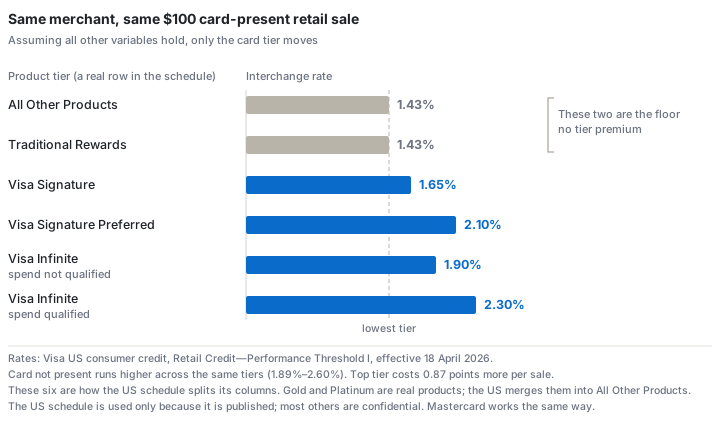
Second, compare the two card-present columns. The second one is reserved for merchants clearing 133.4 million transactions and $8.83 billion a year, meaning a handful of retailers at the very top of the American economy. What does all that scale buy? Eight basis points off the bottom column, and Traditional Rewards down from 1.65% to 1.43%. Above Signature the two columns are identical. Scale discounts cheap cards. It does not touch premium ones. (The figure above draws the second column: $1.53 to $2.40.)
Third, the easiest rows to miss are the two Infinite rows. On one and the same Visa Infinite, the rate depends on whether the cardholder has spent enough — the schedule's term is spend qualified. So interchange tracks not just the card but the cardholder's past behavior: part of what the merchant pays on the transaction in front of it was set by how much this particular customer spent over the past year.
Business and corporate: where the expensive rows live
Now the families most course material skips. Same schedule, same April 2026, same network:
| Fee program (Visa US commercial) | Rate |
|---|---|
| Visa Business, card present (Business Product 2) — spend tier I to V | 1.90% + $0.10 rising to 2.25% + $0.10 |
| Visa Business, card not present (Business Product 1) — spend tier I to V | 2.65% + $0.10 rising to 3.00% + $0.10 |
| Corporate and Purchasing, card present | 2.50% + $0.10 |
| Corporate and Purchasing, card not present | 2.70% + $0.10 |
| Corporate and Purchasing with full invoice data (Commercial Product 3) | 1.75% + $0.10 |
| Commercial large ticket | 1.30% + $35.00 |
| Purchasing, card not present, $100,000 to $500,000 | 0.50% + $55.50 |
Three readings.
The most expensive standard row in the whole US schedule is a small-business card used online: 3.00% + $0.10. Higher than any consumer card, premium tiers included. (Only the non-qualified rows sit above it, at 3.15% — and those are the penalty rate a transaction pays when it fails to qualify for anything.) If you run a SaaS business selling to small companies, this row is your actual cost of getting paid, and no amount of growth moves it — the business spend tiers run the wrong way, with bigger spenders costing the merchant more.
On commercial cards the data incentive reverses. On a consumer card you pay extra for typing the number in. On a corporate card, sending the network full line-item invoice data takes 2.70% down to 1.75%. The card is doing a procurement job there, and the network prices the data it gets back out of it.
Above a certain ticket the percentage has to break. At $200,000, 2.70% is $5,400, which no company would ever pay for a card payment. So the schedule switches shape entirely — a near-flat 1.30% + $35.00, and on the largest purchasing rows 0.50% + $55.50.
Interchange is a price, not a cost. Above a certain ticket the price has to bend, or the card simply doesn't get used.
One more thing about the commercial families, and it matters more than the rates: this is where the uncapped money sits. The EU's caps exempt commercial cards. Australia's 2026 reforms cut domestic consumer credit to 0.3% and left commercial credit at 0.8%. Nearly every regime that caps consumer interchange leaves a door open on commercial, and issuers walk through it.
How an issuer moves a card up
So what decides whether a bank issues MPL Platinum or MWE World Elite? Not the marketing department on its own. The network sets conditions for each product, and the issuer has to meet them and pay for them.
A benefit package it is required to carry. Every product above the entry band comes with a mandatory set — purchase and return protection, travel and rental insurance, concierge, lounge access, hotel and car-rental status. Mastercard's ladder from Standard through Gold and Platinum to World and World Elite is built exactly this way: a core set every card at that level must carry, a menu the issuer picks further items from, and whatever the issuer adds itself. Visa runs the same structure across Signature and Infinite. It is why two World Elite cards from two different banks feel so different while settling on the same rate row.
Portfolio conditions. Visa Infinite in the US carries a $10,000 minimum credit line. Higher products come with conditions on who gets approved, what they earn, and what they spend, and the network audits against them. A rewards or points scheme rich enough to drive spend is usually part of the case an issuer makes.
Money to the network. The issuer pays for the branding and the benefits: licensing and program fees, plus per-card charges for the benefit package, typically billed quarterly. Those figures sit in the issuer's agreement with the network and are published nowhere.
So moving a card up is a trade. The issuer takes on a fixed cost per card to reach a higher interchange row, and the trade only pays if the cardholder spends. That is what Visa's spend qualified and spend not qualified split is testing. The network is asking whether the card earned the product it was issued as, and repricing it downward when the answer is no.
The benefits ladder and the rate schedule are two different things. Both networks keep adding rungs at the top of the benefits ladder:
| Network | Entry | Middle | Premium | Top (new) |
|---|---|---|---|---|
| Visa | Classic, Gold, Platinum | Signature | Infinite | Infinite Privilege, Infinite Private |
| Mastercard | Standard, Gold, Platinum | World | World Elite | World Legend |
That last column is all recent. Mastercard's World Legend saw its first US card in 2025 (Citi's Strata Elite); per Visa and UOB's announcement of 16 July 2026, Infinite Privilege and Infinite Private roll out first in Singapore, Malaysia, Thailand, Indonesia and Vietnam, with UOB upgrading 300,000 Infinite cardholders in one go.
And Visa's US rate table has no Infinite Privilege row and no Infinite Private row. A new rung on the benefits ladder does not automatically buy a new rate row, and in a market like Switzerland it buys none at all. When a market announces a new premium product, that tells you what the cardholder gets. It tells you nothing about what the merchant will pay until you find the row.
The second lever: value-added services
The product is not the only thing that moves the number. Both networks sell services on top of the rails — tokenization, authentication, fraud scoring, account updater — and using them changes the rate. The industry calls them value-added services, or VAS.
Visa's US schedule prices two of them in the open. Both discount the card-not-present rate:
| Service used on the transaction | Discount |
|---|---|
| A network token in place of the real card number | 0.05% |
| 3-D Secure authentication, which Visa calls DCAP | 0.10% |
| Both together | 0.15% |
Note which way these run. They cut the rate, and the saving lands on the acquiring side. That is the online premium working in reverse: the extra points on a card-not-present transaction pay for fraud, so remove the fraud and the points come off.
Switzerland shows the same idea taken all the way. Since the four Mastercard consumer products there all take one rate, the only thing left to price is how the transaction was authenticated. A base transaction is 0.55%. Merchant UCAF or Full UCAF, which are Mastercard's names for a 3-D Secure authenticated transaction, is 0.35%. On debit, a contactless tap is 0.12% and a digital wallet transaction is 0.28%. Where the product ladder has been flattened, the technology is the only lever left.
Which direction the lever runs, and which side keeps the difference, is set market by market. Issuers negotiate in the other direction too — taking on a network's services in return for a better spread on their own side. Those deals sit in bilateral agreements and are not published anywhere.
The scale of this business shows up in the networks' own accounts. Visa's value-added services brought in $17.5 billion of roughly $40 billion in FY2025 revenue. Mastercard's have been running near 45% of net revenue and growing faster than the rest of the company. As interchange gets capped market by market, the networks have moved their growth to services priced outside interchange.
Why you usually can't look this up
Every number in this section came out of a published schedule. Publication is the exception.
The US publishes under years of antitrust and merchant litigation. Switzerland publishes because its competition authority made domestic interchange the subject of a settlement. The EU publishes because the caps are written into law. Most of Asia Pacific, and Southeast Asia in particular, publishes nothing. The schedule goes to member institutions under NDA, and rates are treated as commercially sensitive information. Ask what a premium card costs a merchant in Indonesia and there is often no public answer. You get that number from an acquirer under contract, or you don't get it.
And it has been going up. Two reasons, and the second matters more.
The top of the published schedule has crept up. The highest standard card-present retail row on Mastercard's 2015–16 US schedule was World Elite at 2.20% + $0.10. The highest card-present retail row on Visa's April 2026 consumer schedule is spend-qualified Infinite at 2.30% + $0.10. Different networks, so not a clean series, but the ceiling has moved up over a decade in which everything else in payments got cheaper.
The bigger reason is that the wallet changed. Every cardholder an issuer moves from Traditional Rewards to Signature Preferred raises what merchants pay, and no published number has to change for that to happen. Meanwhile the top of the ladder keeps growing: World Legend in 2025, Infinite Privilege and Infinite Private in 2026. A merchant's effective rate drifts up year after year even when it never renegotiates and no schedule moves.
(A premium card is worth more to the issuer than interchange alone. Annual fees, revolving interest, the FX spread on foreign transactions, and cross-selling into a wealthier customer base are all in there. But the steadiest of those revenues is still interchange, because it lands on every transaction and doesn't depend on the cardholder carrying a balance or going abroad. The course takes the other lines separately later.)
7. One Mechanism, Two Worlds: The US and the EU
In 2015, the EU passed the IFR (Interchange Fee Regulation), putting hard caps on consumer-card interchange: 0.2% for debit, 0.3% for credit.
The US caps only debit. Under the 2010 Durbin Amendment, issuers with over $10 billion in assets face a debit ceiling of 21 cents + 0.05% of the transaction amount, plus a 1-cent fraud-prevention adjustment. Credit has no cap at all.
That debit cap is in limbo right now — check the current state whenever you need to rely on it. Two things are stacked on top of each other:
- In October 2023 the Federal Reserve proposed lowering it to 14.4 cents + 0.04% + 1.3 cents. The proposal has never been finalized.
- In August 2025, the federal district court in North Dakota ruled that the Fed had exceeded its statutory authority and vacated Regulation II in its entirety — but stayed its own judgment pending appeal, so the 21-cent tier remains in force for now. The Fed has appealed to the Eighth Circuit; as of July 2026 the case is still open.
In other words, the US debit cap is currently propped up by a single stay order. If it is ultimately struck down, the US column of the table below has to be redrawn from scratch.
Every cap has edges, and the edges are where the money goes. The EU's caps cover consumer cards issued and acquired inside the EEA. Commercial cards sit outside them — the Commission's own review kept that exemption. So do transactions where one side is outside the region: an EU-issued card buying from a US merchant is inter-regional, priced on a separate schedule several times higher. Which is the other half of the Amazon story in the next section — nothing about Visa's economics changed at Brexit; the UK simply moved to the other side of a line, and the price followed within months.
The pattern repeats wherever caps land. Australia's central bank closed its review in March 2026: domestic consumer credit cut to 0.3%, domestic debit to 8 cents, commercial credit left alone at 0.8%, and — for the first time — a 1.0% cap on foreign-issued cards, which is a regulator admitting in public that the domestic-only design had a hole in it. The US, meanwhile, caps debit and leaves credit entirely alone.
A cap is a boundary, and interchange flows to whichever side of the boundary is uncapped: to commercial cards, to cross-border transactions, to whatever the drafting left out.
For an issuer, that means a domestic cap is survivable in a way the headline number doesn't suggest. A European bank earns 0.3% when its cardholder buys at home and multiples of that when the same cardholder buys from a merchant outside the region, or when the card in question was issued to a company.
The result:
| US | EU | |
|---|---|---|
| Credit interchange | Typically 1.5%–2.5% | Capped at 0.3% |
| All-in merchant rate (MDR) | Typically 2%–3% | Typically 0.5%–1% |
| Consumer points and cash back | Lavish | Essentially none |
| Premium-card ecosystem | Thriving | Weak |
The core insight: the rules decide the shape of the product.
US issuers' room to subsidize comes from exactly this interchange — with two things to pin down.
One: where the money for a premium card's "2% cash back" comes from. The 1.8% in the worked example is a middling tier; the cards giving 2% back are premium cards, and on the tier table in the previous section they sit on the Signature Preferred and Infinite rows — above 2% to begin with. Besides, interchange is not the issuer's only income: interest on carried balances and premium annual fees subsidize the cash back too — the rewards aren't funded by interchange alone.
Two: who the subsidy goes to. The perks concentrate on premium cards, and a premium card takes good credit and high spending to get — a small slice of people hold them, not all cardholders. As for who ends up footing their bill, a later section does that arithmetic.
A European issuer gets 0.3% and can't afford subsidies, so a European bank card is basically a payment instrument, with hardly a perk to speak of. The same business logic, under different caps, grew into two different shapes.
The argument regulators are actually having
It would be easy to read the table above as a scoreboard the EU won. Regulators who have looked at this hardest don't read it that way, and the disagreement is worth understanding because it decides which markets get capped next.
The chain a cap sets off is short and well documented. Cap interchange → issuer revenue falls → issuers cut rewards, withdraw fee waivers, raise annual fees → some marginal cardholders drop the card. On the other side merchants' acceptance costs fall, and how much of that reaches shelf prices depends on how competitive their market is and how long you are willing to wait.
The European Commission's evaluation put its own numbers at roughly €2.7 billion a year off interchange, of which about €1.2 billion a year landed with merchants as lower acceptance cost, with an estimated two-thirds of that eventually passing through to consumers. That is the optimistic reading, and the EU acted on it.
Regulators who ran the same arithmetic and declined to act reached a different verdict, on three grounds:
- The merchant gain is concentrated; the consumer gain is diffuse. A few basis points off every price in the economy is hard to observe and easy for merchants to keep. The loss to cardholders — rewards cut, annual fees up — is immediate and shows up on a statement. Post-reform studies of Australia, Spain, the EU and the US all found the same thing on the card side.
- Issuers replace the revenue somewhere else. After the US capped debit interchange, free checking receded and account fees rose. The money does not evaporate; it moves to a line item with less political visibility.
- A cap is a floor as well as a ceiling. Categories deliberately priced below the cap to win volume — the strategic merchant segments from earlier in this chapter, supermarkets and utilities and transit and charity — have room to drift up to it once a cap exists. Cap the top and you can raise the bottom.
Set that against the finding at the end of this chapter, that all consumers together subsidize the minority holding premium cards, and the shape of the argument comes clear. Capping interchange doesn't hand that subsidy back to consumers. It redirects it to merchants and hopes competition passes it along. Whether that is an improvement is an empirical question about one number — the pass-through rate — and reasonable regulators reading the same evidence have landed on both sides of it.
This method gets reused throughout the course:
When product forms differ between two markets, don't blame user habits first. Go find the difference in the rules.
Explaining why the US has been so slow to adopt instant transfers, why European neobanks lean harder on subscription fees, and why stablecoins land differently across jurisdictions — later chapters use the same move every time.
8. Why Amazon Could Afford to Stop Taking Visa
This chapter has said it twice: interchange is priced uniformly by the network, and neither the acquirer nor the overwhelming majority of merchants can negotiate it; only merchants at Walmart or Amazon scale get rates off the schedule. This section opens up how that negotiation actually works — because the bargaining chip is not price.
Start with the trigger. It is the previous section's method playing out in real life.
After Brexit, transactions between the UK and the EU no longer fell under the EU's IFR caps. In October 2021, Visa raised interchange on credit card payments made online or over the phone between Britain and the EU from 0.3% to 1.5%, and debit from 0.2% to 1.15%. The boundary the cap applied to moved once, with Brexit, and the price was immediately reset to the new boundary — five times over. The rules decide the shape of the product; here the product had no time to change shape at all, and the price moved first.
On 17 November 2021, Amazon announced that from 19 January 2022 its UK site would stop accepting Visa credit cards issued in the UK. It had already begun surcharging customers paying with Visa credit cards in Singapore and Australia. Amazon's stated reason: these fees "should be going down over time with technological advancements, but instead they continue to stay high or even rise."
Notice what weapon it used.
It cannot negotiate interchange — it isn't even the party that pays interchange (the acquirer is, as this chapter established earlier), and it doesn't set the schedule. The one thing it holds is acceptance: taking Visa off its own checkout page.
In an industry priced off a published schedule, a merchant's bargaining chip is not price. It is acceptance.
How heavy that chip is depends on one thing. The wall in the origin of cards was the cold start of a two-sided network: each side is the other side's source of value. Read it backwards: Amazon is large enough that when it stops taking Visa, what loses value is Visa's network, not just Amazon's own customer count. Network effects hand the network its pricing power, and hand any sufficiently large single node in it the power to walk away from the table.
It wasn't the first time either. In 2016 Walmart's Canadian arm announced it would stop accepting Visa credit cards; about twenty stores actually stopped, and seven months later the two sides settled.
This time Amazon had a second chip as well: it was simultaneously in talks to move its US co-branded card from Visa to Mastercard. It is both one of the largest merchants on the acquiring side and one of the largest co-brand partners on the issuing side — pressing from both sides at once.
The timeline:
| When | What happened |
|---|---|
| October 2021 | Visa raises UK–EU online credit interchange from 0.3% to 1.5% |
| 17 November 2021 | Amazon announces its UK site will stop taking UK-issued Visa credit cards from 19 January 2022 |
| December 2021 | Amazon says it will hold off while the two sides negotiate |
| 17 February 2022 | A global agreement is reached: the ban is dropped, and the Visa credit surcharges in Singapore and Australia come off with it |
The terms were never published. That is what "a rate off the schedule" means literally: you can see the outcome, you cannot see the price. Which is why the public schedule and what a given company actually pays so often fail to match — the row about merchant size in that seven-factor table is describing exactly this.
One boundary has to be drawn, or this section reads as a counterexample: the overwhelming majority of merchants do not have this chip. An online retailer doing tens of millions a year that drops Visa is the one that loses value — customers buy somewhere else and the network loses nothing. So what this chapter said earlier — that interchange is not negotiable for the overwhelming majority of merchants — still holds. Amazon is the exception that proves the rule, not a refutation of it, and the exception only works on one testable condition:
To judge whether a merchant has bargaining power, ask one question: if it walks away, who hurts — the merchant, or the network?
The merchants with no chip at all go and do something else: they route around the card. That thread gets picked up in this chapter's self-check questions, and the course takes it head-on when it reaches Pay by Bank.
9. An Easy Question to Get Wrong: Who Really Bears Interchange
The merchant gives up 2.3%. Is the merchant the loser?
In the short run, yes. In the long run, no — the merchant builds the cost into its prices.
So the real flow of money ends up like this (and "premium card" here means the Signature Preferred and Infinite rows from the tier table above):
| Participant | What actually happens |
|---|---|
| People paying with premium cards | Enjoy 2% cash back and the full stack of perks |
| People paying with ordinary cards | The fee is baked into the prices they pay, but the perks are thin |
| People paying cash | The same fee is baked into their prices, and they get no perks at all |
| Merchant | Passes the cost on, but its pricing room shrinks |
| Issuer | Keeps the bulk of the interchange |
The conclusion: all consumers together subsidize the small minority paying with premium cards. Cash payers subsidize most completely — the fee is in their prices and they collect none of the perks. And the share of people paying cash rises as income falls, so the net direction of the subsidy runs from lower-income people to higher-income people.
This is the root reason regulators worldwide keep interchange under watch, and the policy basis on which the EU dared cut it to 0.3%. The occasional "3% card surcharge" or "cash discount" you see at US merchants is a merchant trying to route that cost precisely back onto the people paying by card.
That 3% is not a number the merchant made up. Two lines hold it down: one is the rate the merchant itself pays — this chapter's MDR; a surcharge exists to pass that through as is, and the rules forbid marking it up for profit. The other is the card networks' hard ceiling (Visa sets it at 3%). The lower of the two wins. Nor does the merchant negotiate it with cardholders — it just notifies its acquirer in advance and follows network rules; on top of that, some US states ban surcharging outright. So that "3%" is not price gouging; odds are it is simply what this merchant actually pays to accept cards.
10. The Question This Chapter Leaves Open
This chapter covered how the money gets divided. One thing is still unaccounted for: when does the money actually move?
You pay by card at a store, and three seconds later the screen says "payment successful." Does the merchant have its 97.70 at that moment? Has the 100 left your account?
The next chapter answers by cutting those three seconds into three phases.
11. Self-check questions
- When a merchant negotiates its rate with an acquirer, what is the ceiling on the acquirer's room to concede? Answer using this chapter's three fee terms.
- A merchant sells mainly online subscriptions: $20 average ticket, 15% gross margin. Operating in the US versus the EU, how hard does payment cost hit its net profit? A rough estimate is fine.
- Why is card-not-present interchange higher? Whose losses, of what kind, does the higher rate compensate?
- Same merchant, same $100 in-store purchase: one customer pays with a Visa Signature, the next with a spend-qualified Visa Infinite. How much more interchange does the merchant pay on the second one? Can it know in advance, and can it refuse the more expensive tier?
- An online retailer doing $30 million a year decides to copy Amazon's move and announces it will stop taking Visa credit cards in exchange for a lower rate. Predict the outcome, and name the one testable condition on which it differs from Amazon.
- You sell software online to small companies; your customers pay with their business cards. Where does that land you in the schedule, why does landing there get worse as your customers get bigger, and why has no regulator capped it?
12. Answers
Answer for yourself before reading on.
- The ceiling is the MDR minus interchange minus scheme fees — that is, the acquirer's own markup. In this chapter's example, only 0.37% of the 2.30% is negotiable; the other 1.93% is rigid cost (1.80% interchange + 0.13% scheme fees, both of which the acquirer pays out as is). This explains why competition in acquiring ultimately comes down to scale and value-added services, not rates — the rate simply can't be pushed any lower.
- In the US, at a 2.5% MDR, a $20 transaction costs $0.50 in fees; gross profit is 20 × 15% = $3.00, so fees eat about 17% of it. In the EU, at a 0.8% MDR, fees are $0.16 — about 5% of gross profit. Same business, but payment cost bites into net profit more than three times as hard in the US. This is why low-margin online merchants in the US are so acutely rate-sensitive, and why payment methods that skip the card and save that 2% find a readier market there — say, debiting the customer's bank account directly and bypassing the card-network stack (Pay by Bank, which this course reaches later, is one such family).
- Because with the card not present, there is no way to verify that the cardholder is physically there or is who they claim to be, so fraud is markedly more likely — and most of those fraud losses fall on the issuer. The higher interchange compensates exactly that extra fraud loss the issuer absorbs. It also means cutting the fraud rate cuts the price directly — the entire fraud-prevention stack covered later in the course has its business motive right here.
- Signature is 1.65% + $0.10, so $1.75 on a $100 sale; a spend-qualified Infinite is 2.30% + $0.10, so $2.40. That is $0.65 more — the same sale costs 37% more to accept. The merchant cannot know in advance: the tier rides in with the card number's prefix and only reaches the acquirer at authorization, while all the merchant sees is a card. Nor can it really pick — network acceptance rules let a merchant decide whether to take a brand at all, and even decide separately about debit, but not to take the cheap tiers of a brand's credit cards while refusing the expensive ones. This is where interchange differs most from ordinary procurement cost: the price is set by what the other side chose, and you have to close the sale before you learn it. The only compliant way to treat tiers differently is the surcharge or cash discount covered later in this chapter.
- It will almost certainly be the one that gets hurt: customers move the order elsewhere, Visa's network value barely changes, so Visa has no motive to concede while the retailer straightforwardly loses sales. The condition it differs from Amazon on is that its exit hurts itself more than it hurts the network. The testable form of that is not absolute revenue but this question: how many cardholders would switch to a different card because this store doesn't take Visa, versus how many would just shop somewhere else? In the UK, most of Amazon's customers were the former; for an ordinary retailer, most are the latter. Which is why the realistic path for these merchants is not walking away from the table but routing around the card — pushing customers onto a rail that debits their bank account directly, and saving the whole 2%.
- Business card, card not present — the single most expensive standard row in the US schedule, running from 2.65% + $0.10 up to 3.00% + $0.10. It gets worse as your customers get bigger because the business spend tiers run the opposite way from consumer performance thresholds: on consumer cards, scale on the merchant side buys a cheaper row, while on business cards, scale on the cardholder side pushes the rate up, and the merchant has no say in either. And no regulator has capped it because every cap so far has been written around consumer cards — the EU's IFR exempts commercial cards outright, and Australia's 2026 reforms cut consumer credit to 0.3% while leaving commercial credit at 0.8%. Which is the general lesson: check which side of a cap's boundary your revenue actually lands on before you assume a regulated market is a cheap one.
Previous: Chapter 5 · The Four-Party Model: Why Visa and Mastercard Won Next: Chapter 7 · The Three-Phase Life of a Card Transaction