The Four US Rails, Side by Side
Part III · Bank Account Rails (Chapters 9–12) Builds on: Chapter 2 (RTGS and DNS, finality), Chapter 3 (central bank reserves), Chapter 9 (push and pull, return windows) New concepts in this chapter: Fedwire, RTP, FedNow, prefunded pool, front-loaded fraud controls
1. The Question the Previous Chapter Left Open
The previous chapter ended on this: the batch-net rail is slow and not final, and some scenarios can tolerate neither. A home closing needs the money confirmed received that day, with no possibility of a return; a business invoice can't wait three days. These scenarios need a rail that is both fast and irrevocable.
The US has three such rails, each with a different origin story. This chapter puts them and ACH side by side in one table.
2. Fedwire: The Oldest, the Priciest, the Hardest
The Federal Reserve was already moving funds between its reserve banks by telegraph in 1918. Fedwire is the modern version of that.
Its mechanism was covered in clearing and settlement: real-time gross settlement, RTGS.
Every payment is processed on its own — no batching — and settles immediately across the two banks' reserve accounts at the Fed.
Go back to the hierarchy of money: reserves sit at the top of that hierarchy. So a Fedwire transfer completes directly on the hardest layer there is. That explains its two defining traits:
- Arrival is final. Once the money moves, it has moved; there is no return mechanism of any kind.
- It's expensive. Every payment ties up its full amount in reserves, the system handles each one individually, and the cost has nothing to spread across.
"Expensive" is easy to misattribute. FedNow, coming up in the next section, also settles payment by payment in real time, yet costs two orders of magnitude less — so the expense doesn't come from "one at a time, in real time." Fedwire is expensive because it was built for large amounts: a fee of a few tens of dollars vanishes into a multi-million-dollar transfer, and using it to send $50 would be absurd. What decides cheap or expensive isn't the mechanism. It's who the system was designed for.
What it's used for: home closings, M&A payments, large B2B invoices, broker-dealer settlement. The common thread: the amount is large enough that the fee doesn't matter, and the payment absolutely cannot go wrong.
3. RTP and FedNow: Why the US Has Two Instant Payment Systems
This is a piece of industry history worth knowing, because it explains why the US fell behind on instant payments.
RTP (Real-Time Payments) launched in 2017, run by The Clearing House — a private clearing company owned jointly by a few dozen of the largest US banks.
FedNow launched in 2023, run by the Federal Reserve.
A natural question: if RTP already existed in 2017, why did the Fed build another system in 2023?
The reason is ownership. RTP belongs to the big banks. Small and mid-sized banks worried they would have no say over pricing and rules, and lobbied the Fed for years to build a public utility of its own. This is not a technology problem. It is a governance problem.
Apply the method from interchange — when you see markets differ, look for the institutional difference first. Why did the UK have Faster Payments in 2008, India have UPI, Brazil have Pix, while the US got a central-bank-operated instant payment system only in 2023? Because in those countries, the central bank or regulator has the power to simply require every bank to connect. In the US, the only forces available are voluntary adoption and competition.
The two systems also settle differently:
| RTP | FedNow | |
|---|---|---|
| Operator | The Clearing House — a private company owned by a consortium of the largest banks | The Federal Reserve — a public institution |
| Where the settlement money comes from | Money banks park in advance in a shared account (the prefunded pool); the account sits at the Fed, but the pool is run by this private operator | The reserve accounts banks already hold at the Fed; no separate pool to fund |
| What it is at bottom | Park money in the pool first; move it within the pool in real time | Payment-by-payment real-time gross settlement (RTGS); the money moves directly on reserve accounts |
| The barrier for smaller banks | High: the prefunded money doesn't count as reserves and earns no interest — dead money tying up capital; and the big banks set the rules and pricing | Low: it uses reserves the bank already has, which keep earning interest as usual, and the operator is neutral |
The settlement money for both systems actually sits at the Fed. The divide isn't in the money — it's in who runs the system and who can get in. The last two rows of the table are what "a governance problem" looks like once it lands in mechanism: the dead prefunded money is the barrier to entry, and who signs off on the rules is the say. A rail controlled by the few biggest banks makes everyone else uneasy.
Who controls the rail, and who it is neutral toward, is a thread that runs through this whole course. Visa in the four-party model was one instance — while BankAmericard sat in Bank of America's hands alone, the other banks never felt safe; it won only after spinning out into a neutral, member-owned organization. CPN, later in the course, will be another.
While you're here, file away the term "prefunded pool": for money to land in real time, someone has to have parked money there in advance, waiting to move. When the course reaches cross-border, the idea returns as "the cost of prefunded liquidity" — the single biggest pain point in the entire cross-border industry.
4. The Four Rails, Side by Side
This is a table worth saving.
| Dimension | ACH | Fedwire | RTP | FedNow |
|---|---|---|---|---|
| Operator | Nacha (the rulemaking body for US ACH) sets the rules; clearing operators execute | The Federal Reserve | The Clearing House (a bank consortium) | The Federal Reserve |
| Launched | 1974 | 1918 (telegraph era) | 2017 | 2023 |
| Settlement | Net, in batches | Gross, real time | Prefunded pool | Gross, real time |
| Speed to arrival | 1–3 business days; Same Day ACH is faster | Minutes | Seconds | Seconds |
| Operating hours | Business days | Business days, business hours | 24/7 | 24/7 |
| Who can receive | Nearly every US bank | Effectively universal: about 4,700 direct participants, and everyone else reachable through correspondents | About 1,280 institutions, directly reaching about 70% of accounts | About 1,500 institutions |
| What the system itself charges per payment | Under a cent | Around a dollar or less | A few cents to tens of cents | A few cents to tens of cents |
| What banks charge end users | Typically free to $3 | Typically $15–50 | Typically free to $1 | Typically free to $1 |
| Per-payment cap | High in practice; set by institution policy | None | $10 million | $10 million |
| Reversible? | Returnable, up to 60 days | Essentially irrevocable | Irrevocable | Irrevocable |
| Push (credit) or pull (debit)? | Both | Push only | Push only | Push only |
Two notes:
- The caps have been playing catch-up: RTP moved to $10 million in February 2025, FedNow in November 2025. The caps are now equal, so choosing between these two is no longer about amount — it's about whether both sides' banks are connected.
- Fedwire's hours will change: in October 2025 the Fed approved expanding them to 22×6 (Sunday through Friday, weekday holidays included), with implementation slated for 2028–2029. If you're designing for the long run, don't assume "wires run business days only, forever."
Numbers like these shift often; check the current rules whenever you actually need them.
An Illusion This Table Invites
Fedwire is slower than the instant rails, two orders of magnitude more expensive, and runs only on business days. It loses on almost every row. So how is it still the workhorse of large-value payments in America?
Three reasons. Two are in the table:
- No cap. The instant rails top out at $10 million. A $50 million acquisition payment, a several-hundred-million-dollar broker settlement — only a wire can carry them. That is a hard constraint, not a preference.
- Everyone can receive it. The instant systems still cover only a thousand-plus institutions each. If the other side's bank isn't in the network, that road simply doesn't exist for you. Wires don't have this problem.
The third reason doesn't fit in the table, and it's the one that matters most:
Fedwire is not just one of the four rails. It is also where the other rails finally come to rest.
The end-of-day net positions ACH computes, the end-of-day net positions CHIPS computes (the private US large-value netting system for dollars), the net positions the card networks compute between member banks — all of those numbers ultimately get wiped clean for real, on reserve accounts, through Fedwire or the Fed's National Settlement Service.
So putting it in a pick-one-of-four table undersells it: it is half a rail, and half the foundation under the other rails.
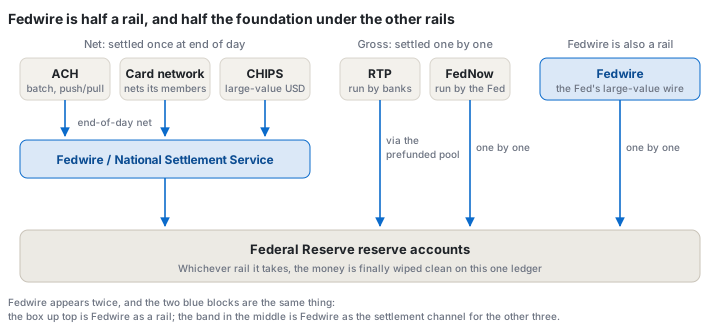
The two blue blocks in the figure are the same Fedwire: the box on top is Fedwire standing in the row of rails; the band in the middle is Fedwire standing under everyone else's feet.
5. Three Key Trade-offs
Trade-off 1: speed and reversibility are locked together
Look at the "Reversible?" row in the big table. The three fast rails are all irrevocable; the one slow rail can be returned.
That is not a coincidence. Reversibility requires a window for changing your mind, and the existence of that window is exactly what "not final" means. You cannot demand finality in seconds and the right to take it back later.
The direct consequence for products:
| Rail | Where fraud control has to live |
|---|---|
| ACH, cards | Can sit after the fact — discover the fraud, and you can still claw the money back |
| Fedwire, RTP, FedNow | Must move entirely to before the transaction |
In the UK and the US this has already become a real social problem. Scammers no longer bother stealing card credentials; they talk the victim into sending an instant transfer themselves. The UK calls this APP fraud — authorized push payment fraud, a push payment the victim authorized after being deceived.
The money reaches the scammer's account in seconds, irrevocably — and in technical terms nothing was violated. What the bank's risk system sees is an ordinary transfer, duly authorized by the customer in person.
Instant payments turned fraud losses from "the system got breached" into "the user got persuaded" — and no technology can stop the latter. Since 2024 the UK has required the banks on both sides, sender's and receiver's, to share these losses — precisely because purely technical defenses can't solve it.
Trade-off 2: cost structure decides the amount range
ACH charges a few cents per payment; Fedwire charges a few tens of dollars. Hence:
| Amount | Which rail | Why |
|---|---|---|
| $50 | ACH or RTP | A $25 wire fee would eat half of it |
| $5,000 | Depends how urgent | The wire fee is 0.5% — acceptable |
| $5 million | Fedwire | The fee is negligible; finality matters most |
Cards charge a percentage; bank rails charge per payment. That one difference draws the boundary between the two families: small and frequent belongs to cards, large and infrequent belongs to wires, and the stretch in between is contested ground between ACH and instant payments.
Trade-off 3: who carries the prefunding
RTP runs on a prefunded pool, which means banks must park money in it ahead of time. Park too much, and the money sits idle earning nothing. Park too little, and the pool runs dry — payments stop going out.
This is the tied-up-capital versus risk-exposure trade-off from clearing and settlement, making another appearance. Remember it — later you will watch cross-border magnify it a hundredfold.
6. The Question This Chapter Leaves Open
At this point the map of US domestic payments is complete: small retail spending goes on cards, batch collections and disbursements go over ACH, large amounts and urgent items go by Fedwire or the instant rails.
But all four rails share one premise that has gone unsaid —
Every one of them is built on the fact that all participants hold accounts on the same central bank's ledger.
The hierarchy of money covered this: final settlement happens between reserve accounts at the central bank. ACH, Fedwire, RTP, FedNow — the last step of each lands on the Fed's ledger. Saying earlier that Fedwire is where the other rails come to rest was half of this same fact.
Inside the United States, the premise holds, of course. But it holds only inside the United States.
Switch countries, and the entire stack — the public pipes, the settlement destination, the gateways and payment methods that grew on top — gets built again, and grows differently. The next chapter takes the same questions to four other currency zones and asks them one by one.
7. Self-check questions
- Why does the US have two instant payment systems, while the UK, India, and Brazil each have one?
- A company needs to pay a domestic supplier $80,000, and the supplier wants the money the same day, with no possibility of reversal. Why is Fedwire the safest answer? (Hint: eliminate the rails one by one.)
- Using the pair of concepts from clearing and settlement, explain why "arrives in seconds" and "can be returned" cannot both be true.
8. Answers
Answer for yourself before reading on.
Because the US central bank has no power to force every bank onto one system; adoption is voluntary. The private RTP got built first, but it belongs to the big banks, smaller banks worried about their say, and they pushed the Fed to build a public alternative. In the UK, India, and Brazil, the central bank or regulator can simply require the whole industry to connect, so one system is enough. The difference is governance structure, not technology.
Eliminating one by one:
- ACH: can't arrive the same day, and keeps a return window open — fails "no reversal."
- RTP and FedNow: speed and finality both check out, and the amount is no problem ($80,000 is nowhere near the $10 million cap). What trips them up is coverage — both sides' banks must already be connected, and each system covers only a thousand-plus institutions. If the supplier's bank isn't in the network, that road is closed.
- Fedwire: in practice any US bank can receive it, arrival in minutes, final on arrival. Amount, speed, certainty, coverage — all four hold.
Hence "safest," not "only" — if both banks happen to be on an instant rail, RTP or FedNow works too.
"Can be returned" means a window for undoing stays open after clearing completes; until that window closes, settlement isn't truly finished — no finality. "Arrives in seconds" demands the exact opposite: clearing and settlement completing together, final on the spot. The two demand contradictory states at the same moment in time, so they cannot both hold. Either accept delay and get reversibility, or accept irrevocability and get speed.
Previous: Chapter 9 · Push and Pull: The Two Directions Money Moves Next: Chapter 11 · Push Rails Around the World: The Same Three Layers, Grown Differently