Domestic and Global: Fragmented at Home, Two Roads Across Borders
Part III · Bank Account Rails (Chapters 9–12) Builds on: Chapter 9 (push and pull), Chapter 10 (the four US rails), Chapter 11 (push rails around the world) New concepts in this chapter: local payment methods (LPMs), front-end aggregation, authorization rates, data residency, the two truly global channels
This chapter pulls apart two words: "local" and "global." The previous chapter surveyed each country's pipes; this chapter looks at the ecosystems that grew on top of them, then asks one more question: so what do countries run on between each other?
1. The Question the Previous Chapter Left Open
The previous chapter's conclusion: one set of pipes per currency zone — same recipe, incompatible implementations, all of them taking only local currency and reaching only local territory. It ended by pointing in two directions:
Upward: with the pipes disconnected, what will the ecosystems above them grow into?
Outward: if every zone is a world unto itself, what do countries run on between them?
This chapter answers both. In one sentence: the fragmentation at home replicates itself all the way up the stack; step outside the border, and the choices collapse to just two.
2. Layer First, or You Can't Compare
The most common beginner mistake is lining up SWIFT, SEPA, UPI, and Alipay for comparison. They aren't even on the same layer.
Sort the layers first:
| Layer | What it does | Examples |
|---|---|---|
| Messaging | Carries instructions; never touches money | SWIFT |
| Clearing | Works out who owes whom | ACH, SEPA SCT, NetsUnion |
| Settlement | Actually moves the money | Federal Reserve reserve accounts, TIPS, Brazil's SPI |
| Front-end aggregation | The button the user actually taps | WeChat Pay, iDEAL, PhonePe |
The two words from clearing and settlement govern the middle two layers; the chapter on no global central bank covers the messaging layer. The previous chapter was about what the middle two layers look like country by country. This chapter is about why the top layer — the front end — looks so different from place to place.
One immediate corollary: SEPA and SWIFT are not competitors. One is a rulebook plus a clearing system; the other is a messaging network. Comparing them is comparing a railway network to a telegraph system.
3. The Ecosystem Above Grows in the Shape of the Pipes Below
The previous chapter was all bottom layers. What this chapter really exists to hand you is this line:
The localization of clearing does not stop at the clearing layer. It travels all the way up, localizing every layer above it.
First effect: local payment methods take the place of cards
In the US, an online checkout page is mostly a handful of card logos. In other countries, cards may not even be the lead:
| Country | The option that matters most at checkout | What it runs on |
|---|---|---|
| Netherlands | iDEAL | Direct bank-account connection; the majority of Dutch e-commerce payments |
| Brazil | Pix, local installments | The central bank's instant pipe; local issuers' installment capability |
| India | UPI | The instant pipe under the central bank's system |
| Saudi Arabia, Kuwait | mada, KNET | Local card networks — not Visa / Mastercard |
| China | WeChat and Alipay QR codes | The wallets' internal ledgers; the bank-card leg clears through NetsUnion |
These go by the collective name local payment methods — LPMs: ways to pay that are specific to one country and don't run through the international card networks. In many markets, not supporting LPMs means writing off most of the market's users.
Second effect: the gateways localize too
The role map will explain that the acceptance front end, in its online form, is called a gateway. In the US, standalone gateways are disappearing — swallowed into a feature of payment service providers (PSPs) like Stripe.
Switch markets and the conclusion flips. Gateway companies rooted in their home turf are thriving there — Razorpay in India, 2C2P and Xendit in Southeast Asia, dLocal and EBANX in Latin America, PayTabs and Tap in the Middle East.
They hold their ground on three things global players find hard:
| The local gateway's moat | What it actually is |
|---|---|
| Full coverage of local pipes | Every LPM is its own integration, with its own reconciliation and refund flows |
| Higher authorization rates | A local acquirer processing a local issuer's card gets approved distinctly more often than cross-border processing does; cross-border transactions are natively more suspicious to the issuer's risk models |
| Data can't leave the country | India, Saudi Arabia, China, and others require financial data to be stored locally; a purely offshore gateway has no way in |
The second row is the most underrated. Same card, same amount: routed locally and routed cross-border, the odds of approval are different. For a large e-commerce company, a few percentage points of authorization rate matter far more than a few basis points of fees.
Third effect: even the merchant's job changes
Further up still, localization seeps into product detail:
| Dimension | Example |
|---|---|
| Installments | E-commerce in Latin America must support local issuers' installment plans; without them, nothing sells |
| Identity checks | Brazilian checkout validates the CPF tax ID; India has the UPI ID system |
| Delivery and collection | Cash on delivery holds a large share in the Middle East, producing transitional forms like "cash-on-delivery converted to online payment" |
| Refund paths | Every LPM refunds differently; some don't support refunding to the original payment method at all |
So for a payment product, "entering a new country" is never a matter of translating the interface. It means integrating the local pipes, finding a local acquirer, adapting to local risk controls, satisfying local data law, and rebuilding refunds and reconciliation from scratch.
The Wise model will say that every new country is a heavy investment — this section is the itemized bill of where that investment goes.
4. And So Payment Orchestration Had to Appear
String the last few sections together, and a company doing global business faces this:
- Every country has different local pipes and LPMs.
- In every country, the local gateway gets better authorization rates.
- But integrating a dozen-plus gateways means maintaining a dozen-plus interfaces and a dozen-plus reconciliation processes.
The contradiction has exactly one solution: add another layer between the merchant and the many gateways.
That layer is payment orchestration: expose one interface to the merchant, connect downward to a dozen gateways and local channels, and route each transaction — by country, amount, and card type — to whichever path approves most and costs least. One route for the US, another for Southeast Asia, another for Latin America.
The role map will place orchestration on the industry map. For now, remember why it exists — it is not a clever business idea; it is the inevitable product of localized clearing. As long as the countries' pipes stay un-unified, someone will build this layer.
It is also one more instance of the law from push and pull: a defect in an infrastructure grows a whole layer of business on top of it. The defect here isn't that any one pipe is bad — it's that they don't connect.
5. Across the Border, the Differences Suddenly Collapse
By now you may have formed an expectation: if a single country is this fragmented, surely between countries it's worse.
The opposite. Outside the border, the choices are startlingly few:
Only two payment standards today are truly global: SWIFT messaging plus the correspondent banking system, and the Visa / Mastercard card networks.
Everything else is local. UPI doesn't leave India, Pix doesn't leave Brazil, iDEAL doesn't leave the Netherlands, and WeChat Pay abroad is just a skin stretched over local acquiring.
Why only two? Because "works everywhere" sets an extremely high bar. A standard has to do four things at once:
| The bar | What it means |
|---|---|
| Institutions from every country can join | It can't serve just one currency zone |
| One rulebook everyone obeys | Message formats, deadlines, exception handling, dispute adjudication |
| It never touches national monetary sovereignty | The moment a standard asks countries to hand over their clearing, no country will agree |
| Decades of accumulated trust | The moat of a payment standard isn't technology — it's "everyone already uses it" |
The third row is the crux. These two standards survived because neither ever tried to unify the world's clearing — each found its own way around it.
6. Push and Pull: Two Channels, Two Ways Around
Push and pull drew this line, and the card-not-present chapter said cards are pull by nature. Take the pair to global scale, and it slices the only two channels cleanly apart:
| Push (credit) | Pull (debit) | |
|---|---|---|
| Who initiates | The payer | The payee (the merchant) |
| The global standard | SWIFT messaging + the correspondent banking system | Visa, Mastercard |
| Typical scenarios | Remittances, B2B invoices, cross-border payroll | Retail spending, subscription charges |
| Amount and frequency | Mid-to-large, infrequent | Small, frequent |
| How it's priced | Fixed fee per payment + FX spread | A percentage of the transaction |
| Arrival | 1 to 5 business days | Authorization in seconds; funds T+1 to T+2 |
| Can the money be taken back afterward? | Essentially no | Yes — a chargeback window of 120 days or more |
The division of labor between the two channels is, at bottom, a cut along direction. Whoever initiates the transaction decides which channel it takes. Which explains a curiosity of the industry: a company collecting cross-border e-commerce payments and a company doing cross-border remittances have almost no technology in common — they run on two entirely different global rails.
What is really worth remembering is that they route around national clearing in completely different ways:
| Channel | Its way around | The price it pays |
|---|---|---|
| SWIFT + correspondents | Never touch the money. Funds move entirely within each country, locally; only the information crosses the border (the chapter on no global central bank takes this apart) | Every hop needs someone's prefunded money, and every hop takes a fee — slow and opaque |
| Card networks | Never touch the local. Write your own rulebook, outsource issuing and acquiring to each country's local banks, and let those banks plug into local clearing (covered in the four-party model) | Priced as a percentage, so large amounts don't pencil out; covers only scenarios where cards are accepted |
Neither one unified the world's clearing. Each just found a way to be global without having to.
One chose to let information cross the border while the money stays home; the other chose to let rules cross the border while clearing stays local.
That also frames what each of them can never fix — the SWIFT road can't escape prefunding and per-hop fees; the card road can't escape percentage pricing and limited acceptance. Stablecoins, coming in Part VI, attempt a third way around: bring your own globally accepted settlement asset, so neither end has to depend on the other's local clearing. Whether that works comes down to whether the price it pays is smaller or larger than these two.
7. The Question This Chapter Leaves Open
Put this chapter's two halves together and the terrain map of global payments is complete:
- At home: fragmentation. One set of public pipes per currency zone, with its own gateways, payment methods, and merchant playbooks on top.
- Across borders: convergence. Just two global channels, one push and one pull, each routing around national clearing in its own way.
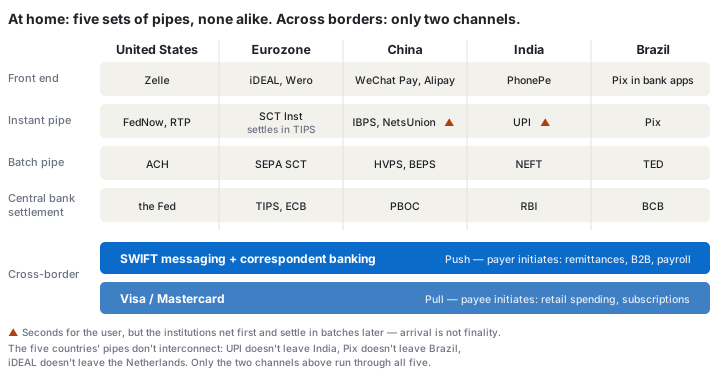
The shape of the figure is the conclusion: not one horizontal line between the five pillars up top, and only two horizontal lines running all the way through below.
The two channels now need separate treatment. Push goes first: why it has to hop, what happens at each hop, and whether the money ever actually crosses the border.
The next chapter starts from a more fundamental question — why does cross-border have to be this roundabout at all?
8. Self-check questions
- A US e-commerce company already collects payments with Stripe and now wants to enter Brazil. Why isn't "Stripe supports Brazil too" enough to put it at ease? Name at least two problems it still has to solve on its own.
- Why is payment orchestration not a business idea, but the inevitable product of localized clearing?
- Why are there only two truly global payment standards? Explain how each routes around "unifying national clearing," and what price each way leaves behind.
9. Answers
Answer for yourself before reading on.
At least three:
- Local payment methods. The bulk of Brazilian e-commerce runs on Pix and local installments; supporting only international cards means forgoing most orders.
- Authorization rates. Cards from Brazilian issuers processed through an offshore channel get declined distinctly more often. Getting local approval rates usually means processing through a local acquiring entity.
- Local product requirements. Checkout has to validate the CPF tax ID, installment counts and interest-subsidy rules follow local convention, and refund paths differ from cards.
"Supports this country" and "does well in this country" are two different things, and these are what stand between them.
Because what it resolves is a structural contradiction, not an experience problem. National clearing pipes don't interconnect, so local channels beat global ones on both authorization rates and cost; yet no multinational merchant can maintain a dozen-plus interfaces and a dozen-plus reconciliation processes.
As long as "local is better" and "nobody wants a dozen integrations" hold at the same time, the layer in between is bound to appear — who builds it is settled by market competition, but that it appears is settled by structure. Conversely, if the world's pipes ever truly interconnect, the value of this layer falls with them.
Because "works everywhere" demands four things of one standard at once, and the hardest is that it must not touch national monetary sovereignty — no country will ever agree to a scheme that asks it to hand over clearing.
Neither standard tried to unify national clearing; each routed around it:
- SWIFT plus correspondents: never touch the money. Funds stay inside each country the whole way, moving locally; only information crosses the border. The price: every hop needs someone's prefunded money and every hop takes its own fee — so it is slow, expensive, and the amount that lands is uncertain.
- Card networks: never touch the local. Write one global rulebook, outsource issuing and acquiring to each country's local banks, and let those banks plug into local clearing. The price: fees are a percentage of the transaction, large amounts don't pencil out, and only card-accepting scenarios are covered.
One lets information cross the border while the money stays home; the other lets rules cross the border while clearing stays local. The price each way leaves behind is exactly what the newer rails, later in the course, take aim at.
Previous: Chapter 11 · Push Rails Around the World: The Same Three Layers, Grown Differently Next: Chapter 13 · The Root Problem of Cross-Border: There Is No Global Central Bank