The Wise Model: Cross-Border Remittances That Never Cross a Border
Part IV · Cross-Border and Regional Clearing Rails (Chapters 13–19) Builds on: Chapter 2 (netting), Chapter 13 (correspondent banking, multi-hop), Chapter 18 (the four cost sources) New concepts in this chapter: local-in, local-out; internal netting; rebalancing; prefunded float and safeguarding
1. The Question the Previous Chapter Left Open
The previous chapter ended on a question: intermediary fees are the price of the hops — so can a remittance just not go through correspondent banks?
The answer is yes. Wise has been doing exactly that since 2011.
How big is the gap? Start with the World Bank's 2025 statistics: remittances through banks cost over 13% on average, digital channels about 3.5% — nearly a fourfold difference. And Wise's own pricing sits a notch below even the digital average, between 0.5% and 1%.
Did it find cheaper correspondents — or did it stop using them altogether?
2. It Stopped Using Them Altogether
Wise's approach fits in one sentence:
Stop hauling money across the border. Collect locally on one side, pay out locally on the other.
Wise keeps a local bank account in every major market it serves, prefunded with local currency.
In a UK-to-Germany transfer, here is what actually happens:
| Step | In which country | On which rail |
|---|---|---|
| The user pays pounds into Wise's UK account | Inside the UK | UK domestic clearing |
| Wise pays euros to the recipient out of its own German account | Inside Germany | Euro-area domestic clearing |
Both legs are local transfers. Neither one crosses a border — so no correspondent banks, no intermediary fees, no SWIFT messages.
That explains the speed. Wise's published figures (as of 2025): 74% of transfers complete within 20 seconds, 90% within 24 hours. Because it runs on local instant-clearing rails (the kind covered in the four US rails), not the four-hop chain from the chapter on no global central bank.
Push that all the way down and it turns out not to be new. The nature of payment made the point that inside a single bank money never actually moves: two numbers on a ledger change, one down and one up. Wise does the same thing, just stretched from inside one bank to across two countries. It did not invent a faster way to haul money. It invented a way of booking money so that the money never has to leave its own country.
3. How the Two Sides Square Up
Start by correcting step 2 of that picture. It says Wise "automatically matches her euro-to-pound transaction with other users who want to send money in the opposite direction," which reads as though Wise pairs up two specific people: Kathrin's euros go to somebody sending money into Germany, and that person's pounds go to John. It is a useful mental model, and it is how Wise explained itself for years, but it is not what happens — Wise never matches two individuals.
Every payout leaves Wise's own local pool, and every payment in lands in that same pool. The "matching" is a whole day of two-way flow cancelling out in aggregate on the books: the offset happens at the level of totals, not transfer by transfer. The difference is practical. If this really were pairwise matching, anyone without a counterparty would have to queue. Nobody queues — because the money in the pool was put there in advance.
Which is where the problem starts: the UK account keeps gaining pounds, and the German account keeps losing euros. Left alone, the German side runs dry.
The answer is the netting from clearing and settlement, transplanted to a new setting.
A worked example. Suppose on one day:
| Direction | Transfers | Amount |
|---|---|---|
| UK → Germany | 8,000 | £5 million equivalent |
| Germany → UK | 7,500 | £4.7 million equivalent |
| Net | — | £300,000, direction UK → Germany |
So on this day, 94% of the funding need cancels naturally against the opposite flow. Only £300,000 has to be moved from the UK to Germany by Wise itself.
Natural offset = 4.7M ÷ 5.0M = 94%
Actually moved = 5.0M − 4.7M = £300,000
Cross-check: if the two directions matched exactly, the amount to move would be zero — Wise wouldn't haul a single pound across a border. That agrees with the conclusion in clearing and settlement that the more symmetric the flows, the more efficient the capital — it is the mechanism from clearing and settlement, lifted from between banks to inside one company.
The £300,000 that does need moving, Wise handles periodically in large batches (by wire, or through the FX market), spreading one expensive cross-border trip across thousands of small transfers.
4. What the Picture Leaves Out: The Float
Netting explains how the books balance at the end of the day. It does not explain the other thing: twenty seconds after the user hits send, where did the euros in the German account come from?
They were already there. Wise put them there in advance.
Netting is the accounting afterwards; prefunding is the money beforehand. Between them sits a gap in time — the user has the money in twenty seconds, while the reverse flow that offsets it might turn up hours later, or might not turn up today at all. That gap is where every bit of this business's funding pressure comes from.
For a sense of scale: as of September 2025, customers held close to £20 billion in their Wise accounts, plus £5.6 billion in Wise Assets. Regulators class this as safeguarded money — held apart from the company's own funds, not lendable, parked in cash at investment-grade banks, government bonds and high-grade money market funds. It is not Wise's money, but Wise has to manage it every single day.
The money is not sitting at one bank
The common misreading is that Wise opens one account per country and is done. The real structure is far denser, and every layer of it exists to get around a specific risk.
- Several partner banks per currency. The same currency is spread across different institutions, so no single one is holding all the customer money. That is not redundancy, it is concentration-risk control written into the risk policy: one partner bank failing must not stop the business.
- Direct connections into local clearing. In 2018 Wise became the first non-bank granted a Bank of England settlement account and direct membership of UK Faster Payments. Since then it has connected to the euro area (its first direct access inside the EU came through the central bank of Hungary), Singapore's FAST, Australia's NPP, the Philippines' InstaPay and PESONet, Brazil's Pix, and Japan's Zengin system — where it is likewise the first non-bank with a settlement account at the central bank. These connections are not decoration: every intermediary bank cut out of the local leg is one less deduction, one less wait, and one less pile of money parked on somebody else's books.
- Central-bank settlement accounts. The top of that ladder. The money lands directly on the central bank's own ledger instead of passing through a commercial bank — go back to the table in the hierarchy of money, and this step lifts Wise's settlement asset up a whole level.
Holding a currency and being payable in it are two different things
A multi-currency account invites one false assumption: if you can hold dozens of currencies, those dozens must all work the same way. They do not. Two separate capabilities are involved, and the bar for each is very different:
| The capability | What the user sees | What it takes underneath |
|---|---|---|
| Holding a balance in a currency | Your account can show a sum in ringgit | Wise can get hold of ringgit somewhere, and can keep it there |
| Getting local account details | People can pay you by ordinary domestic transfer in that country | A local entity, a local license, and a connection to local clearing |
Concretely: a Singapore-based Wise user can get local account details in Australia, the United States, New Zealand, Canada, Belgium (for euros), Türkiye and more — a payer in any of those countries sends an ordinary domestic transfer, and that money never leaves that country. The same user cannot get Malaysian local account details, even though they can perfectly well hold a ringgit balance.
The difference is not engineering, it is control. Ringgit and yuan are both restricted currencies: whether they may leave the country freely, and whether non-residents may hold them, is the local central bank's call. Wise handles the two differently:
- Ringgit. Wise has a local entity in Malaysia, regulated by the central bank there, and the ringgit sits in an account at a local partner bank. This is the purest version of "the money never leaves" — the ringgit balance shown to a user in Singapore corresponds to actual ringgit sitting in Malaysia. There are no local account details because that second layer takes a separate permission.
- Yuan. Wise works in the offshore pool, the yuan that circulates outside the mainland and settles freely. It does not reach into the onshore book, and could not.
Both examples point at the same thing: the boundary of the Wise model is not its engineering, it is the line each country draws for itself. The three ceilings further down are the economic arithmetic; this one is the regulatory arithmetic. Together they decide how far the map can be laid.
Which is why there is a treasury desk
Put all of that together and what comes out does not look much like a tech company: Wise runs a sizeable treasury and FX team, doing four things day in, day out.
- Forecasting. How much of each currency has to go out tomorrow decides how much has to be sitting there today. Too little and payouts fail; too much and the money is idle.
- Netting. Offset the two directions first, then decide what actually has to be topped up. This step is what produced the 94% in the previous section.
- Hedging. Wise locks the rate the moment the user commits, and carries the move between that lock and the actual execution. Each exposure is short, but there are enormous numbers of them, so they have to be hedged continuously — Wise does not take a view on where rates are going. It earns the spread, not the market.
- Compliance. Safeguarded assets can never fall below customer balances at any moment, and every country's license carries its own capital and reporting requirements. That is as hard a constraint as the other three; it just governs how the money is allowed to sit.
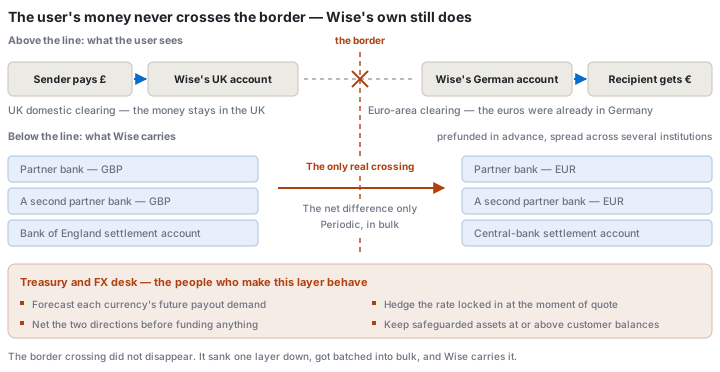
"The money never crosses the border" is a statement about the user, not about Wise. Somebody still crosses. All the model decides is who, how often, and in what size.
5. The Two Models, Side by Side
| Dimension | Correspondent banking (the SWIFT path) | Local-in, local-out (the Wise path) |
|---|---|---|
| How the money travels | Hop by hop, genuinely crossing borders | Collected and paid out locally on each side; the money never crosses |
| Parties taking a cut in the middle | 2–4 intermediary banks | 0 |
| How the middle squares up | Cleared transfer by transfer | Internal netting, plus periodic bulk rebalancing |
| Arrival speed | 1–5 business days | Seconds to a few hours |
| Cost to the user | 13%+ on average (bank channel) | About 0.5%–1% |
| Is the arrival amount certain? | No — intermediaries may deduct fees along the way | Yes — locked in before the money leaves |
| Prefunded money in every country? | Not needed — it uses the correspondents' accounts | Required — a pile parked in every country |
| A license in every country? | Not needed — it borrows the banks' licenses | Required — applied for country by country |
Wise sweeps the first six rows and loses the last two outright.
6. The Most Important Tool in This Chapter
Wise didn't eliminate the cost. It moved the cost from one place to another.
| Cost item | Who bears it in the correspondent model | Who bears it in the Wise model |
|---|---|---|
| Per-hop intermediary fees | The user | Gone |
| The 1-to-5-day wait | The user | Gone |
| Opportunity cost and FX risk of prefunded money in each country | The correspondent banks | Wise itself |
| Licenses and compliance in each country | The banks | Wise itself |
The first two rows are the user's gain; the last two are Wise's bill — the same four costs, just carried by someone else.
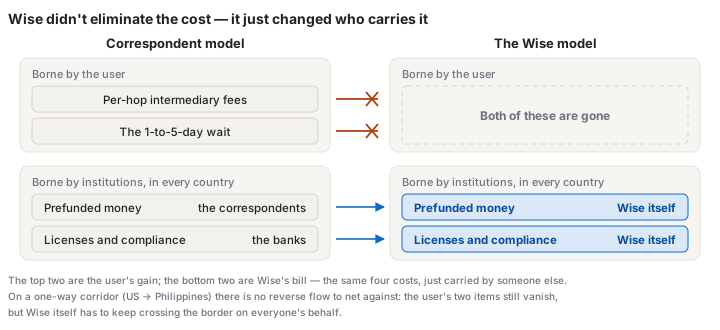
The top half gets crossed out; the bottom half changes hands. The shape of this picture is the measuring stick itself: first see which costs disappeared, then see who the rest landed on.
Run the previous chapter's 20-country numbers: the opportunity cost of prefunded money alone is on the order of $5 million a year. Wise traded away "slow and expensive" and took on "parked capital plus license burden."
That gives you a measuring stick you can reuse forever:
Judge any payments innovation by asking the same question: where did it move the cost from, and to? Who bears it in the new spot?
Because payments is an industry constrained by physics on one side and rules on the other, cost rarely vanishes into thin air. Most of the time it just changes bearer and changes shape.
This measuring stick is the core tool when you come to judge stablecoins. By then you should be able to answer: which of these items does a stablecoin cut, and which does it add?
7. Where the Model Hits Its Ceiling
The Wise model is strong, but it has three limits it can't engineer away:
| Limit | Why |
|---|---|
| A corridor needs volume both ways | If a corridor (one specific pair of sending and receiving countries) flows only one way, there is nothing to net against; every transfer needs a real rebalancing move, and the advantage disappears |
| Every new country is a heavy investment | License + prefunded money + local bank relationships; the marginal cost doesn't fall with scale |
| Niche countries don't work | Thin volume, hard licenses, weak local clearing infrastructure — the unit economics never close |
The third is the one that bites. It is why Wise covers the main corridors of a few dozen countries, not every country on earth.
The previous chapter made this point when covering rebalancing cost: on the US-to-Philippines corridor, money flows almost entirely one way — overseas workers sending money home, with next to nothing coming back. There, that flow was a fixed overhead. Here, it breaks Wise's model outright.
Run the UK–Germany math on this corridor: the dollar account Wise keeps at its US bank piles ever higher, while the peso account at its Philippine bank only ever pays out. On the UK–Germany corridor, 94% of the funding need cancels naturally against reverse flow; on this one, what cancels is close to zero.
The pesos draining out have no reverse flow to refill them, so Wise falls back on the first of the previous chapter's three refill methods: periodically convert the dollars piling up in the US into pesos and haul them to the Philippines down the traditional cross-border channel from the chapter on no global central bank.
In other words, on a one-way corridor, "the money never crosses a border" is true only for the user. Wise itself has to keep crossing it on everyone's behalf.
8. The Question This Chapter Leaves Open
That closes Part IV. The full difficulty of cross-border, and both existing answers to it, are now on the table:
- The correspondent model: no prefunded money required, at the price of slowness and per-hop fees.
- The local-in, local-out model: fast and cheap, at the price of a large pile of money and a license in every country.
But neither road gets around the same fact: the money has to be sitting at the receiving end in advance. The only difference is whose money sits there — in the correspondent model the correspondents park it; in the Wise model Wise parks its own, at the $5-million-a-year opportunity cost computed above.
Which raises a very natural question:
Is there an asset that can move instantly between any two parties on earth, with no pile of money parked in every country?
If there is, the heaviest of the previous chapter's four costs gets cut away.
The answer to that question is what Part VI is about. But something has to come first — which companies actually handle this money today, what they earn on it, and how they lose on it. Without that, you can't judge where a new technology should cut in.
That is Part V: the player map, neobanks, risk, and ledgering. The next chapter answers the first question — behind each of these mechanisms, who exactly is collecting the fee.
9. Self-check questions
- One of Wise's corridors suddenly turns sharply one-way (say a country hits a crisis and capital floods out). What concrete problems does Wise run into?
- Use this chapter's measuring stick — where did the cost move, and who bears it in the new spot — on this claim: a company advertises "zero-fee cross-border transfers." Which three places might its cost have moved to?
- Why is Wise's netting the mechanism from clearing and settlement in a different setting? What do the two share, and how do they differ?
- A Singapore-based Wise user can hold a ringgit balance but cannot get Malaysian local account details. Which layer does each of those hit?
10. Answers
Answer for yourself before reading on.
The accounts Wise pays out of drain fast, while money piles up in the accounts collecting funds. Netting stops working: every transfer now needs a real rebalancing move, and the move itself rides the traditional cross-border channel — slow and expensive. Meanwhile rebalancing can't keep pace with payouts, and a queue forms: users have paid, recipients haven't received. In practice, the company temporarily raises the corridor's fees or limits, using price to choke off the flow — at bottom this is liquidity risk; the course files it under that name when it reaches the five risks of payments.
Three candidates:
- Into the FX spread. Zero fee, worse exchange rate. The most common move.
- Into speed. Route everything down the cheapest, slowest channel; the cost drops, and arrival takes days.
- Onto its own balance sheet. Buy the user experience with prefunded money and advances, subsidized by scale or by another line of business.
The test is still the previous chapter's: compare the amount paid with the amount received, and ignore the fee column.
What they share: both use two-way flows to cancel each other out, compressing the money that actually has to move down to the net difference — and slashing settlement cost with it.
Where they differ is the layer the offsetting happens on:
- The netting in clearing and settlement happens between banks, through a clearing institution. The participants are independent firms, so they need a center they all trust — and a settlement asset.
- Wise nets on the internal ledger of one company. No outside trust is needed, because both sides of the books are its own.
That is also why it can be faster: the step where independent institutions have to reach agreement is gone.
Holding a balance hits the first layer — can this money be obtained anywhere, and kept there. Wise has a local entity and local bank accounts in Malaysia, so ringgit can be kept, so the balance works; that money has been inside Malaysia the whole time. Local account details hit a different layer: to hand a user an account number others can pay into by ordinary domestic transfer, Wise needs the matching license in that country and a connection to its clearing, which is a separate permission. Nothing links the two layers, which is how you get "can hold, cannot be paid locally."
Looking back, that is the concrete shape of the "a license in every country?" row in this chapter's comparison table. A license is not one thing but a stack of permissions cut by capability, and each one you hold lets you do exactly one of them.
Previous: Chapter 18 · The Four Sources of Cross-Border Cost Next: Chapter 20 · The Industry Role Map: Who Makes Money in the Middle