The Root Problem of Cross-Border: There Is No Global Central Bank
Part IV · Cross-Border and Regional Clearing Rails (Chapters 13–19) Builds on: Chapter 2 (clearing and settlement), Chapter 3 (central bank reserves, the hierarchy of money), Chapter 12 (every country clears on its own; across borders, only push and pull) New concepts in this chapter: correspondent banking, nostro and vostro, SWIFT, multi-hop fees, CIPS, de-risking
1. The Question the Previous Chapter Left Open
The tour of push rails around the world crossed five currency zones and ended on one conclusion: every currency zone has grown its own complete set of clearing pipes, and settlement always comes to rest on the books of its own central bank. The previous chapter then tightened the frame one more notch: step outside the border, and only two roads go everywhere.
Now put the payer in the US and the payee in the Philippines. The dollars live on the Fed's ledger. The pesos live on the Philippine central bank's ledger. Between those two ledgers there is no connection of any kind.
No global central bank means no settlement layer that everyone shares.
This chapter takes the push road: how, in practice, two systems that cannot talk to each other got stitched together.
2. Nail Down the Constraint First
The hierarchy of money showed why interbank settlement is solvable at all: there exists something every bank accepts unconditionally, issued by someone who cannot welch on it — central bank reserves.
Across borders, no such thing exists. The reason is not technology. It is sovereignty:
| Problem | What it means |
|---|---|
| No global central bank | No institution can issue a settlement asset that every country accepts unconditionally |
| Central banks serve domestic institutions only | A Philippine bank has no account at the Fed and cannot hold dollar reserves |
| National ledgers cannot see each other | Nowhere on the Fed's ledger is there a line for "a bank in the Philippines" |
So the most basic move in the nature of payment — one line down, one line up, on the same ledger — simply cannot be performed across a border.
3. The Solution: A Middleman with Accounts on Both Sides
If the Philippine bank cannot get onto the Fed's ledger, then have it open an account at a US bank that is already on the Fed's ledger.
This is correspondent banking — the arrangement in which banks open accounts with one another and handle local collections and payouts on each other's behalf.
Two words you must keep straight. They name the same account, seen from opposite sides:
| Term | Who uses it | Which account they mean | Mnemonic |
|---|---|---|---|
| Nostro account | The bank that opened it | Our account, held at your bank | Latin "ours" — our money, sitting at your place |
| Vostro account | The bank that hosts it | Your account, held at our bank | Latin "yours" — your money, sitting at our place |
The dollar account a Philippine bank opens at a New York bank is nostro to the Philippine bank and vostro to the New York bank. One account, two names.
With that account in place, a cross-border payment becomes a string of local bookkeeping moves:
- The payer's US bank moves the money into the Philippine bank's US account (a transfer inside the US, over Fedwire or ACH).
- The Philippine bank sees dollars appear in its New York account, and credits the payee's account with the equivalent in pesos — inside the Philippines.
The money never crosses the border. Only information does.
This is the "full circle" from the hierarchy of money again: the new problem — cross-border — decomposed into two old problems straight out of the nature of payment, each side editing its own local ledger.
4. The Big Misconception: SWIFT Doesn't Move Money
Between step 1 and step 2 above, someone has to tell the Philippine bank: "the money has arrived — pay it out to Juan dela Cruz."
The thing that carries that message is SWIFT.
SWIFT is a network banks use to send each other messages in a standard format. It does not clear, does not settle, and holds no funds.
An analogy: SWIFT is the banks' private telegraph system. A telegram can tell the other side what to do. A telegram is not money.
| SWIFT | Correspondent accounts | |
|---|---|---|
| Role | Carries the instructions | Holds the funds, takes the actual bookings |
| Analogy | Telegraph | Ledger |
| What a remittance loses without it | The other side doesn't know who to pay out to | No money moves at all |
Why is this misconception so widespread? Because the news says a country was "kicked off SWIFT," and that sounds like severing the money channel. What actually gets severed is the instruction channel — banks lose their standard way of talking to each other, and moving money becomes operationally very hard. Similar effect, entirely different mechanism.
Later, the course puts SWIFT, Visa, and CPN side by side in one table. By then you should be able to say at a glance: SWIFT does messages only; Visa does messages plus rules; CPN does messages plus rules plus a settlement asset.
5. A Worked Example: $1,000 from the US to the Philippines
Say the payer uses a community bank in the US and the payee uses a smaller bank in the Philippines. The two banks have no account relationship with each other.
Every hop consists of two things: an instruction travels to the next bank over SWIFT, and money is posted across an account the two banks keep with each other. All four hops charge a fee.
| Hop | From → to | What travels (over SWIFT) | How the money moves (which pre-placed balance gets touched) | Fee |
|---|---|---|---|---|
| 1 | Community bank → big US bank | The community bank sends a message: "please pay this out" | Debited from the USD account the community bank keeps at the big bank; both are in the US, so this is a domestic move | Outbound fee, 25 |
| 2 | Big US bank → Asian intermediary | The big bank forwards the same payment message | Credited to the USD account the intermediary keeps at the big bank — no money moves; a pre-placed balance gets rewritten | Intermediary fee, 15 |
| 3 | Asian intermediary → big Philippine bank | The intermediary forwards the same payment message | Credited to the USD account the Philippine bank keeps at the intermediary | Intermediary fee, 10 |
| 4 | Big Philippine bank → the payee's smaller bank | The big Philippine bank instructs: "credit the payee" | The big Philippine bank fronts the payee out of pesos it keeps ready locally, converting the USD to pesos along the way | Crediting fee, 5; FX spread charged separately |
Read the "what travels" column against the "how the money moves" column: the information crosses borders the whole way down the chain; the money only ever gets booked domestically, or across accounts banks keep with each other. Not one dollar actually flies over the Pacific.
Those bookings on the mutual accounts only record who owes whom — in the words of clearing and settlement, that is clearing. Only when the debts are truly extinguished, in money both sides accept unconditionally, does it count as settlement.
Settlement here happens by currency, in two separate halves. The dollar half's debts (hops 1 through 3 move nothing but dollars) pile up and are eventually settled in reserves on the Fed's ledger; the peso half settles on the Philippine central bank's ledger. Neither half ever leaves its own country.
Between the two halves runs the seam where the currency changes. No ledger on earth holds both dollars and pesos, so this remittance will never see the moment of being "finally settled on one shared ledger." Both sides of the seam are held up by commercial banks owing each other, propped on pre-placed balances. When this chapter's title says there is no global central bank, the concrete thing that's missing is this ledger both currencies could share.
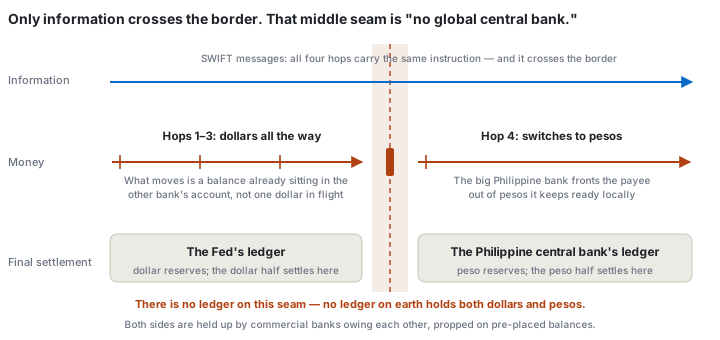
Look at the money row: both arrows stop short of the seam. Only the information line above passes through.
Now run down the "how the money moves" column once more. What moves at every hop is never fresh money flowing in — it is a balance that was already sitting in some account beforehand: the community bank's dollars at the big bank, the dollar positions the intermediary and the big Philippine bank each maintain, the pesos in the big Philippine bank's till.
Money that lies there quietly, waiting to be moved, is prefunded liquidity (RTP's prefunded pool, from the four US rails, is one species of it). For payments to land in real time, every link in the chain has to park a sum there in advance, waiting. The course prices that out later as the heaviest hidden cost in the entire cross-border industry.
What lands:
1000 − 25 − 15 − 10 − 5 = 945 USD
Then converted to pesos at a 2% spread:
945 × (1 − 2%) = 926.1 USD worth of pesos
The payee actually receives 926.1. The payer believes he sent 1,000. Total leakage: 7.4%.
Cross-check: World Bank statistics put the global average cost of a remittance at about 6.5% in 2025 — bank channels averaging over 13%, digital channels around 3.5%. The 7.4% above lands between the bank number and the digital number. The magnitude checks out.
Two extra pieces of bad news:
- Time. Any hop can trigger manual review — payee name spelling, address format, a near match on a sanctions list. Across four hops, 1 to 5 business days is common.
- Opacity. At hop 1, the payer cannot know how much each of the next three hops will take. The "$25 fee" he sees when sending covers hop 1 only.
6. The Push Rail the Renminbi Built for Itself: CIPS
The chain above contains an implicit fact worth pulling into the open: cross-border payment in any currency ultimately comes back to the clearing system of that currency's home country. Dollar payments, however far they roam, land on the Fed's ledger in the end. So what about the renminbi?
The answer is CIPS, the Cross-border Interbank Payment System, live since 2015, built under the People's Bank of China and operated by a dedicated company in Shanghai. What it does: clearing and settlement for cross-border renminbi, coming to rest on the Chinese central bank's ledger.
| SWIFT + correspondents | CIPS | |
|---|---|---|
| Currencies covered | All of them | Renminbi only |
| What it does | Messages only; never touches the money | Clearing plus settlement; money actually moves inside the system |
| Settlement asset | Each country's own central bank money, or correspondent deposits | Renminbi, landing on the Chinese central bank's ledger |
| How you participate | Member banks open accounts with each other | Direct participants hold accounts inside the system; indirect participants (overseas banks, thousands of them) connect through a direct participant |
Two things are worth seeing clearly.
First, indirect participation is the correspondent model, embedded. An overseas bank going through CIPS is really keeping its renminbi account at some direct participant — the nostro logic from earlier in this chapter holds unchanged, only the chain is shorter: two hops at most, and you are on the Chinese central bank's ledger.
Second, CIPS does not dodge the no-global-central-bank constraint. It is head-on evidence of it. It can do clearing and settlement in a single system precisely because it serves a single currency and every settlement comes back to a single sovereign ledger. It is not a third global road — a global road has to serve every currency; CIPS paved a dedicated cross-border entrance for exactly one.
One practical detail on the messaging side: CIPS carries its own messaging channel (direct participants can connect by dedicated line), but instructions from a large share of indirect participants still reach their direct participant over SWIFT. So the "kicked off SWIFT" discussion in section 4 needs one more line: CIPS reduces the dependence on SWIFT; it does not remove it — unless both sides of the transaction are directly connected.
7. A Worsening Trend: The Correspondent Network Is Shrinking
Look back at the four-hop fee table: more hops means more cost and more delay. So why not cut down the hops?
Because the big banks are busy cutting correspondent relationships themselves. The reason is compliance:
| The big bank's position | Consequence |
|---|---|
| It must run sanctions screening and anti-money-laundering checks on every transaction its correspondents' customers make | High compliance cost |
| If any correspondent's customer turns out to be sanctioned or laundering money, the big bank itself takes the massive fine | Asymmetric risk |
| Small countries and small banks bring low volume; the revenue can't cover the risk | Easier to walk away |
So big banks simply terminate correspondent relationships with smaller banks in high-risk regions. This is called de-risking.
The result is counterintuitive: the technology keeps improving, yet in many less-developed regions the cost of cross-border payments is going up — fewer routes remain usable, and the channels that survive have more pricing power.
World Bank data bears this out: Sub-Saharan Africa is the most expensive receiving region in the world, averaging above 8%; South Asia is the cheapest, around 5.5%. The gap is not made by technology. It is made by the number of channels.
8. The Question This Chapter Leaves Open
At this point, how cross-border actually runs has been told in full: correspondents open the accounts, SWIFT carries the messages, every hop books locally.
But in the example above, 1,000 turned into 926 — 7.4% lost. Where exactly did that money go?
The four-hop table listed only the four visible fees and one spread. The real cost structure is more complicated than that — and the biggest item is one the payer never sees at all.
Ahead: the four sources of cross-border cost.
9. Self-check questions
- State the relationship between nostro and vostro in one sentence.
- What exactly does "kicking a country off SWIFT" cut off? Why does it still work?
- Why does de-risking make remittances to less-developed regions more expensive? Explain with the four-hop fee table.
10. Answers
Answer for yourself before reading on.
- Two names for one account; the only difference is which side you stand on. The account we open at your bank, we call nostro and you call vostro — and the other way around.
- It cuts the instruction channel, not the money channel. SWIFT holds no funds and does no clearing or settlement; a cut-off bank still owns its balances at correspondent banks around the world. But without the standard messaging channel, it has no efficient way to tell the other side "pay this person, this amount, on this instruction." Operations fall back to phone calls, telex, and confirming payments one by one by hand; efficiency and workable volume collapse. So the effect is dramatic — but the mechanism is communication paralysis, not frozen funds.
- De-risking has the big banks terminating correspondent relationships with smaller banks in high-risk regions, so fewer intermediaries remain available. The hop count doesn't necessarily fall — the choice of paths does. Surviving channels gain pricing power and charge more per hop; meanwhile, fewer direct connections mean more payments have to go the long way around, so hop counts actually rise. Both forces push costs up — which is how technological progress and rising costs manage to happen at the same time.
Previous: Chapter 12 · Domestic and Global: Fragmented at Home, Two Roads Across Borders Next: Chapter 14 · Inside a Remittance Message: What the Fields Decide