Case Studies: Nine Companies on the Grid
Part V · Players and Risks (Chapters 20–25) Builds on: Chapter 6 (money follows risk), Chapter 12 (local clearing and the two global channels), Chapter 18 (the four cost sources), Chapter 19 (where the cost moved), Chapter 20 (the three questions, the industry grid) New concepts in this chapter: none. This chapter teaches nothing new — it only takes the tools already built and reads real companies with them.
This is a practice chapter. The previous chapter built the grid; this one fills the squares with people — and tests, along the way, how well the measuring sticks in your hand actually work.
1. The Question the Previous Chapter Left Open
The previous chapter laid out the industry map and handed over the three questions for judging any payments company: does it hold a license, does money cross its books, and what losses does it eat.
But a map is abstract. When it comes to due diligence, competitor analysis, or deciding who to partner with, what you face is one specific company after another.
This chapter picks nine and reads them against each other: four pairs, and one on its own at the end. Every company gets the same four dimensions:
| Dimension | What it answers |
|---|---|
| What the product does | Which square's capability it is actually selling |
| Where the edge is | The one thing others find hard to copy |
| What licenses it holds | The first of the previous chapter's three questions |
| Who it sells to | The customer base decides every design trade-off it makes |
Why pairs instead of one profile at a time? Because reading one company alone, all you remember is its slogan. Put two side by side and the difference surfaces — and behind the difference there is always a structural reason.
2. Cross-Border: Wise and Airwallex
| Wise | Airwallex | |
|---|---|---|
| What the product does | Multi-currency accounts; cross-border remittances for individuals and small businesses; plus Wise Platform, which opens the capability to banks and platforms | Business multi-currency accounts, cross-border collections and payouts, card issuing, embedding financial capability into clients' products |
| Where the edge is | Licensed in dozens of countries itself, plugged directly into local clearing — including direct nonbank access to the UK's instant payments | Coverage of Asia-Pacific corridors, the China-linked ones above all; a product line built out into a full B2B financial infrastructure |
| What licenses it holds | Its own, across jurisdictions: UK, EU, Singapore, Australia, Japan, many US states, and more | Likewise its own, across jurisdictions: Australia, UK, EU, Singapore, Hong Kong, many US states, and more |
| Who it sells to | Mostly individuals and small businesses; platform clients second | Platforms, cross-border e-commerce, B2B companies |
The contrast: the two run nearly identical technical routes. The split is the customer base.
The Wise model covered the local-in, local-out machinery. Wise and Airwallex walk the same road — licensed country by country, prefunded money parked, local clearing plugged in — which means both carry what that chapter called "parked capital plus license burden."
The difference is who they sell to, and the customer base decides what the product looks like:
- Serve individuals and small businesses, and what's wanted is a transparent rate, predictable fees, a simple interface.
- Serve platforms and B2B, and what's wanted is API power, bulk payouts, and issuing accounts and cards onward to their own customers.
The latter is the horizontal bundler position from the role map — the capabilities of several squares, packed into one set of APIs and sold. What Airwallex does in the cross-border square is exactly what BaaS (banking-as-a-service — a bank's licensed powers, bundled and opened to unlicensed companies) does in the card-issuing square.
And a quick return to domestic and global: these two companies exist precisely because national clearing systems don't talk to each other. What they sell is "I have already plumbed the local pipes of a few dozen countries for you."
3. Neobanks: Revolut and Chime
| Revolut | Chime | |
|---|---|---|
| What the product does | Accounts, cards, FX, investing, lending — expanding toward a full-service bank | Checking and savings accounts, a debit card, early paycheck access, credit building |
| Where the edge is | An extremely wide product line, plus its own banking license — it can take deposits and lend | Product polish and acquisition efficiency aimed at mainstream working America |
| What licenses it holds | Its own: a Lithuanian banking license passporting across the European Economic Area; a UK banking license approved in 2024, phasing in | None: accounts sit at partner banks; Chime itself is the program manager |
| Who it sells to | Consumers and small businesses, mostly in Europe | Mass-market US consumers |
The contrast: same square, two license paths — and the choice was forced by the rules.
Interchange supplied the two numbers this arithmetic needs:
- In Europe, debit interchange is capped at 0.2% — no company lives on card income alone. Earning means doing more business — FX, investing, lending — and that business takes a license. So holding your own becomes the better deal.
- In the US, Durbin binds only issuers with more than $10 billion in assets; small banks are exempt. Issue through a small bank, and the interchange share alone can carry a company. If you can make money without a license, why go apply for the hardest license there is?
One more layer: what a license is worth depends on what it lets you do, multiplied by how much market it travels in. One European banking license passports across the entire European Economic Area — a big multiplier. A US money transmitter license is applied for state by state — a small one. Naturally the two sides compute opposite answers. (The course states this yardstick formally when it reaches the compliance skeleton, and tests it against six jurisdictions.)
So "Revolut licensed, Chime unlicensed" is not a difference in corporate personality. It is two optimal answers computed under two rulebooks.
Now stack on a layer of risk. Revenue in the Chime-style model leans on that small-bank exemption, and as interchange covered, the whole of Regulation II (the rule that sets the debit interchange cap) is in litigation right now. A piece of this business model stands on a rule that may cease to exist.
4. Acquiring: Adyen and Checkout.com
| Adyen | Checkout.com | |
|---|---|---|
| What the product does | A single platform, self-built from gateway to acquiring; one system online and offline | Acquiring and payment processing, with the emphasis on tailoring to the client and optimizing authorization rates |
| Where the edge is | One platform covering the globe; the chain is its own, so costs run low and the data is complete | Depth in hard regions and hard industries; flexible integration and risk controls |
| What licenses it holds | A Dutch banking license, plus licenses in several other jurisdictions | Payment licenses in the UK, the EU, and elsewhere |
| Who it sells to | Large multinationals | High-growth digital businesses, plus harder-to-serve territory like the Middle East and crypto |
The contrast: both hold licenses, money crosses both sets of books, both carry acquiring risk. The difference is the game plan.
By the rule from interchange, they eat the same kind of losses, so the band of rates they can take is the same kind too. What actually separates them is the battlefield each picked:
- Adyen picked big clients on one unified platform: few clients, each of them large, with standardization and scale grinding the costs down.
- Checkout.com picked the hard-to-crack regions and industries: places the global players cover badly and authorization rates run low — and where clients pay a premium for a solution.
The second plugs straight into the conclusion of domestic and global: authorization rates are localization's most tangible moat. Whoever can push authorization rates up in a hard market holds the pricing power.
(The role map compared Stripe and Adyen; that pair's axis was licensed-or-not. Here both hold licenses, so the axis becomes which market to fight in. One square can split along more than one line.)
5. On-Chain Infrastructure: Bridge and BVNK — and Their Shared Ending
| Bridge | BVNK | |
|---|---|---|
| What the product does | On- and off-ramps between fiat and stablecoins; stablecoin issuance; stablecoin accounts | Enterprise-grade stablecoin collections, payouts, and settlement infrastructure |
| Where the edge is | Ramps turned into an API, so non-crypto companies can collect and pay in stablecoins too | B2B stablecoin payment flows and compliance capability |
| What licenses it holds | Money transmitter licenses across many US states, among others | Payment licenses in the UK and the EU, among others |
| Who it sells to | Platforms and fintechs that need stablecoin capability | Businesses with cross-border settlement needs |
What this pair is really about is not what they do. It is what happened to them next.
| Company | How it ended |
|---|---|
| Bridge | Acquired by Stripe for about $1.1 billion; the deal has closed, and Bridge now runs inside Stripe, powering its stablecoin accounts and issuance |
| BVNK | Mastercard announced its acquisition in March 2026 — up to about $1.8 billion including contingent consideration — expected to close within 2026 |
(Deal statuses move fast; check the current announcements when you need them.)
The two most representative stablecoin infrastructure companies: one bought by the biggest acquiring-side player, one bought by a card network.
An incumbent facing a new technology usually has three responses: lobby it dead, build a better one itself, or simply buy whoever built it. What happened here is the third — and it happened fast.
This matters for judging the stablecoin field:
The stablecoin infrastructure layer is being absorbed by the existing payment giants, not replacing them.
Ramps, compliance, accounts — that work was always the old guard's strength. The new companies built the product and the customers, but the step to scale takes exactly what they lack: the license network and the merchant relationships — which is precisely what the buyers already hold. This is the law from the role map cashing in one more time: a defect in the infrastructure grew a layer of business, and then the owners of the infrastructure took the layer back.
6. Small Is Beautiful: Fiat24
The eight companies so far are all scale players. Last, a small team — and a different question: when the giants have already filled the squares, how does a small team find a position?
| Dimension | Fiat24 |
|---|---|
| What the product does | A bank account turned into an on-chain asset: the account itself is an on-chain token, paired with an IBAN and a Visa card, with fiat and on-chain assets moving inside one account |
| Where the edge is | Not "a crypto company with a bank partner bolted on" — it holds a Swiss license itself and builds the account directly on-chain, a combination still vanishingly rare |
| What licenses it holds | The Swiss FINMA fintech license |
| Who it sells to | Individuals and small businesses that shuttle often between chain and fiat |
The position is chosen with precision. Switzerland's fintech license is "half a banking license," sitting between a payment institution and a bank: it may take public deposits up to a cap, but no lending and no paying interest. And it carries no EU passporting. (When the course reaches the compliance skeleton, this half tier goes into the six-jurisdiction lineup.)
For a company that wants to be a full bank, this license's multiplier is too small. For a company that only wants to hold customer funds legally and run accounts and cards, it is exactly enough — and far easier to get than a banking license.
The small team's play hides right here: don't reach for the biggest license. Find the one that is "just enough, and not worth the giants' trouble."
7. Turn the Nine Cards Sideways
Read one by one, then turned sideways, the nine cards show three patterns.
First: choices that differ inside one square almost always trace back to a difference in rules.
Revolut licensed, Chime not — that is not preference; it is two answers computed from the US and European interchange caps and license reach. This is the method from interchange: when markets differ, go find the difference in the rules.
Draw the three license choices above onto one picture, and the multiplication becomes the area of a rectangle:
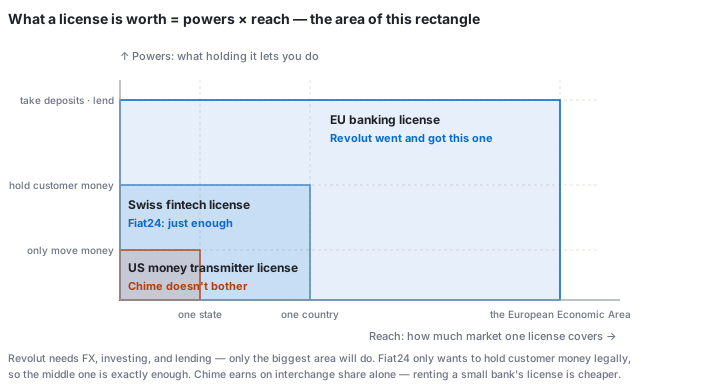
Move the same company to another jurisdiction and the answer flips — the previous chapter's Marqeta, unlicensed in the US yet buying a licensed company to enter Europe, was re-running the arithmetic from a different spot on this picture.
Second: the customer base decides the product, not the other way around.
Wise and Airwallex run nearly the same technical route yet ship completely different products, because one serves individuals and the other serves platforms. When you look at a payments company's product design, ask first who it sells to — a lot of "why on earth did they build it that way" answers itself on the spot.
Third: the positions giants buy are usually the piece the giants lack, not the piece the giants can't build.
What Bridge and BVNK built, Stripe and Mastercard could have built themselves — it would just have taken time. What was genuinely scarce was a product already working and customers already on it. For anyone picking a startup direction, this test is practical: is what you're building something the giants can never do, or something they just haven't gotten around to? The endgames are completely different.
8. The Question This Chapter Leaves Open
Nine companies in, one thing runs through them all: every one of them is carefully handling other people's money.
The prefunded money Wise parks country by country; the balances Chime's users keep at its partner banks; the merchant proceeds crossing Adyen's books; the customer fiat and stablecoins in Bridge's hands. None of this money is theirs.
The end of the previous chapter flagged a hazard: the money is at the partner bank, but the ledger of which user has how much sits in the middleman's hands. For this entire class of company, the real line between life and death is not whether the product is good. It is whether the ledger that records whose money is how much can be trusted.
In 2024, more than a hundred thousand American users learned the weight of that sentence with real money. The next chapter dissects the most typical company on this line: the neobank — no license, yet minding money for tens of millions of people.
9. Self-check questions
- Why did Revolut go get its own banking license while Chime didn't? Answer with the rules, not with "strategic preference."
- Wise and Airwallex do nearly the same thing underneath. Why do their products look so different?
- Stripe bought Bridge; Mastercard bought BVNK. What do these two deals say about the question "will stablecoins overthrow the existing payment giants"?
10. Answers
Answer for yourself before reading on.
Because the arithmetic comes out differently in the two places.
Europe caps debit interchange at 0.2%; no company lives on card income alone. Earning means FX, investing, lending — and that business takes a license.
At the same time, one EU banking license passports across the entire European Economic Area: the powers × reach multiplier is large, and worth going for.
US small banks sit outside the Durbin cap, so the interchange share alone supports the business model; and money transmitter licenses are applied for state by state — a tiny multiplier. Skipping the license saves the work and costs nothing in revenue, so you skip it.
So these are two optimal answers forced out by two sets of rules, not two corporate personalities.
Because the customer bases differ.
For individuals and small businesses, the core of the product is a transparent rate, predictable fees, and an interface simple enough. For platforms and B2B companies, the core becomes API power, bulk payouts, and letting clients issue accounts and cards onward to their own users.
The same local-in, local-out foundation, with completely different things built on top. To see why a payments company designed its product the way it did, ask first who it sells to.
That this layer is more likely to be absorbed than to do the replacing.
The two most representative stablecoin infrastructure companies — one now inside the biggest acquiring-side player, one inside a card network. They built the product and the customers, but the road to scale takes a license network, merchant relationships, and global ramp capability — exactly what the buyers already had.
The judgment transfers straight to other fields: whether a new technology overthrows the incumbents depends on whether what it routes around is the incumbents' capability, or only the incumbents' inertia. Route around inertia, and you usually end up bought.
Previous: Chapter 20 · The Industry Role Map: Who Makes Money in the Middle Next: Chapter 22 · Neobank Anatomy: Where Your Money Actually Lives