Neobank Anatomy: Where Your Money Actually Lives
Part V · Players and Risks (Chapters 20–25) Builds on: Chapter 3 (the hierarchy of money, the liability view), Chapter 6 (interchange), Chapter 20 (BaaS, sponsor banks, the information gap) New concepts in this chapter: FBO account, internal ledger, FDIC pass-through insurance, float income, net interest margin
1. The Question the Previous Chapter Left Open
The previous chapter ended by asking: a neobank has an app, accounts, and a card — but most neobanks have no banking license. Where exactly is the users' money, and who answers for it when things go wrong?
Start with the two questions from the hierarchy of money: who owes you? What do they redeem with, and where are the reserves?
2. Where the Money Is: The FBO Account
No license, no taking deposits. So a neobank does this:
- Find a licensed partner bank (the sponsor bank from the previous chapter).
- Open one large account at that bank and pool every user's money into it.
- Keep its own internal ledger recording how much of the pool belongs to each user.
This big account is called an FBO account (For Benefit Of — a pooled account held for the benefit of the company's customers).
| Vantage point | What it sees |
|---|---|
| The partner bank | One account holding $500 million, titled "Company X FBO its customers" |
| The neobank | One internal ledger recording the balances of 500,000 users |
| The user | An app saying they have $3,000 |
Here is the structure that matters: the bank holds the money, but the information about who the money belongs to exists only in the neobank's internal ledger. The bank does not have that ledger.
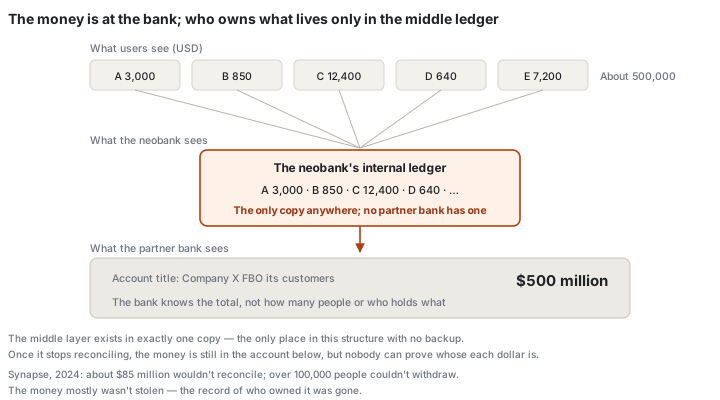
It is drawn as an hourglass because it really is one: both ends have backups; the ledger in the middle exists in exactly one copy.
This is the concrete shape of the information gap from the end of the previous chapter.
3. The Three Structures, Side by Side
| Dimension | Licensed bank | Neobank + partner bank | EMI / payment institution |
|---|---|---|---|
| Who holds the money | Itself | The partner bank | Itself, but it must be held in segregation |
| Whose liability is it (the hierarchy of money) | Its own | The partner bank's — but ownership rests on the neobank's ledger as proof | Its own |
| Deposit insurance | Direct | Passes through to the partner bank — provided the ledger is accurate | Usually none; protection comes from segregation of funds |
| Can it lend? | Yes | No | No |
| Main revenue | Net interest margin (loan interest minus deposit interest) | Interchange share, FX spread, subscription fees, float income | Fees, FX |
| Main regulator | Bank regulators | Indirect, through the partner bank | The payment-institution framework |
The third row's "provided the ledger is accurate" is the core of this chapter — and the whole of the case that follows.
4. Synapse: What Happens When the Ledger Doesn't Reconcile
Synapse was a BaaS middleman, supplying accounts and payment capability to dozens of fintechs, with the money held in FBO accounts at Evolve Bank and a few other partner banks.
In April 2024 it filed for bankruptcy. What came out afterward:
| Fact | Detail |
|---|---|
| Roughly $85 million of customer money didn't reconcile | The bankruptcy trustee's initial finding; later estimates ranged from $65 million to $96 million |
| More than 100,000 end users caught in it | Their apps showed money; they couldn't withdraw it |
| Synapse's ledger was inaccurate or inaccessible | The flow of funds couldn't be reconstructed transfer by transfer |
| Not one partner bank had kept a copy of Synapse's ledger | The banks knew how much money was in the accounts — not who it should go to |
Look at the last two rows. Most of the money was never stolen — it is sitting right there in those bank accounts. The problem is that nobody can prove which dollar belongs to whom.
In the language of the nature of payment: break the ledger and the payment system is broken. That chapter said the essence of payment is editing a ledger; this case shows the other face of the same sentence — when the ledger can't be trusted, the money might as well not exist.
In the language of the hierarchy of money: users thought they held "deposits that pass through to a bank." What they actually held was "trust in Synapse's ledger." One layer lower on the hierarchy than they believed.
Three lessons for product people:
| Lesson | Why |
|---|---|
| The ledger must be independently reconstructable by a third party | A ledger only you can read is no ledger at all |
| Reconcile every day, and drive every difference to zero | Small accumulated breaks become, under stress, a black hole nothing can be recovered from |
| Eligibility for FDIC pass-through insurance depends on ledger quality | Having an FBO account does not confer the protection by itself |
How to actually get there — double-entry bookkeeping, daily reconciliation, breaks driven to zero — is unpacked when the course reaches ledgers and reconciliation. This chapter's job is to make the consequences stick.
5. How a Neobank Makes Money
Go back to the split table in interchange. Out of a $100 purchase, the issuer keeps $1.80.
That is why nearly every neobank is in a hurry to issue a card.
| Revenue source | Mechanism | Character |
|---|---|---|
| Interchange share | Every swipe hands the neobank a slice of the issuing side's $1.80 | Grows linearly with user activity; the main income for most neobanks |
| FX spread | The spread when users spend abroad or convert currency (the four cost sources) | Very high margin, but depends on users going abroad |
| Subscription fees | A monthly charge for higher limits, better rates, extra perks | Stable income; more common in Europe |
| Float income | Interest earned on user balances sitting in the accounts | Substantial when rates are high; near zero when they're low |
Two structural weaknesses you have to know about:
First, the US Durbin Amendment has an exemption. As covered in interchange, issuers with more than $10 billion in assets have debit interchange capped at the 21-cent tier; small banks are uncapped. So neobanks deliberately pick small partner banks to issue through — not a technology choice, a regulatory arbitrage.
The arbitrage exists only because the cap does. And as interchange noted, the whole of Regulation II has been struck down in court and survives, for now, on a stay. If the cap finally disappears, big banks' debit interchange comes uncapped too — and the small banks' relative edge disappears with it. A whole crop of US neobanks would have to redo their revenue math.
Second, float income is acutely sensitive to interest rates. On $1 billion of user balances, 5% rates pay $50 million a year; 0.5% rates pay $5 million. The company controls none of this, yet it can be a large share of profit. When a neobank's profit doubles or halves within two years, that often has nothing to do with anything the neobank did.
6. Why European and US Neobanks Look Nothing Alike
Take the method from interchange — when product shapes differ, look for the rule difference first — and run it one more time.
| US | Europe | |
|---|---|---|
| Debit interchange | Uncapped for small banks; substantial | Capped at 0.2% |
| Can interchange alone sustain the company? | Yes | No |
| So the main revenue is | Interchange | Subscription fees, FX, value-added services |
| Product shape | Free account + cash back, monetized through card volume | Tiered subscriptions, with the free tier visibly limited |
The same kind of company sells "free with cash back" in the US and a paid membership in Europe. That is not two product teams with different taste. It is the 0.2% cap doing the shaping.
7. The Question This Chapter Leaves Open
What the Synapse case exposed is ledger risk. But ledger risk is only one of the risks a neobank faces.
A user tricked into transferring money out; a merchant that takes the money and runs; a day when too many users withdraw at once for the money to be moved in time; a payment whose recipient turns out to be on a sanctions list — these are different types of risk, with different triggers, different bearers, and different defenses.
Before you design any control, you have to sort the risks. The next chapter sorts them into five kinds.
8. Self-check questions
- Using the liability view from the hierarchy of money, state precisely whose liability the balance in a neobank user's app is.
- A neobank holds $2 billion in user balances, and float income is 40% of its profit. Rates fall from 5% to 2%, all else unchanged. How hard is its profit hit?
- Why do European neobanks lean harder on subscription fees? Answer in one sentence — and "different user habits" is not allowed.
9. Answers
Answer for yourself before reading on.
Nominally it is the partner bank's liability — the money really is deposited at that licensed bank. But whether the user can enforce that claim depends on whether the neobank's internal ledger can prove how much of the pool is theirs. So in practice the user carries two layers of risk at once: credit risk on the partner bank, and the risk that the neobank's ledger can't be trusted. The second layer is the one that actually failed in the Synapse case — and most users never knew it existed.
Step by step:
- Original float income = $2 billion × 5% = $100 million.
- That is 40% of profit, so original profit = $100 million ÷ 40% = $250 million.
- New float income = $2 billion × 2% = $40 million — a drop of $60 million.
- New profit = $250 million − $60 million = $190 million, down 24%.
Cross-check: float income itself fell 60%, and it was 40% of profit, so the hit to total profit is 60% × 40% = 24% — matches.
Because the EU caps debit interchange at 0.2%, card income alone cannot feed a company, so the revenue has to come from somewhere else. The regulatory ceiling set the business model; preference didn't.
Previous: Chapter 21 · Case Studies: Nine Companies on the Grid Next: Chapter 23 · The Five Risks of Payments