Customer Distribution: All Licensed, Yet Serving Entirely Different People
Part II · Products (Chapters 2–9) Builds on: Banking Circle and Wise New concepts in this chapter: the three circles of customer identity, the three jobs that count as touching crypto
1. Why This Section Sits Here
Banking Circle and Wise are done. Their licence portfolios could hardly be further apart — one takes the heaviest licence available in every jurisdiction, the other refuses to hold a banking licence at all — but reading them by licence alone invites a wrong conclusion: that a heavier licence simply means more capability, and everything else is a matter of degree.
The truth is that they are in different businesses, and they are fundamentally not serving the same people. This section puts four companies on one picture and looks at where their customer boundaries differ. Two of them are the subjects of chapters still ahead, and make their first appearance here:
- Revolut, the subject of the next chapter: the neobank with the longest product line (a retail bank that is an app with no branches), one app holding accounts, cards, remittances, crypto trading and stocks, serving ordinary individuals and small businesses. It does serve businesses, but only their own payments needs — it does not do BaaS (Banking as a Service: renting out your licence's capabilities to another firm so that firm can open accounts and issue cards to its own users), which is why the licensed circle has always been closed to it.
- Fiat24, the company the course closes on (Chapter 9): an on-chain bank held up by a Swiss light banking licence, where the account is an NFT and the customers are on-chain natives and the users of wallet apps. What it sells is BaaS — the difference being that its customers need no licence of their own: a Web3 app plugs in and can open a Swiss bank account and issue a card to each of its own users.
2. The Customer Boundaries of the Four Companies
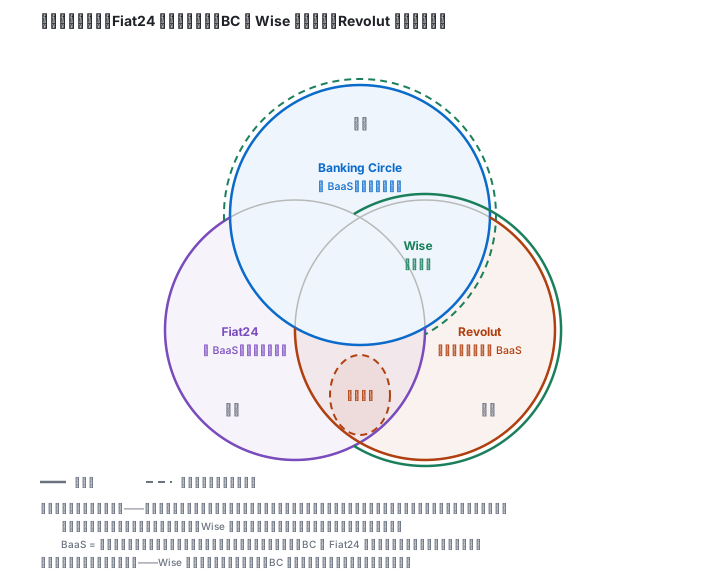
The three circles are who the customer is, not what line of business they are in: institutions that hold licences of their own, on-chain native users, and ordinary individuals and small businesses. One customer can fall inside two circles at once — a licensed crypto firm sits in the overlap of licensed and crypto.
3. Five Differences
One: the crypto circle is the dividing line, but "touching crypto" is really three separate things
When a firm says it does crypto, it can mean three things whose entry bars differ by orders of magnitude. The three are not sequential and do not form a ladder — they are simply three different jobs, which is why they are called the first, second and third job below. Do not confuse them with the ①②③④ yardstick in Rule 1:
| Which job | What it is | What it takes |
|---|---|---|
| The first: issue the coin yourself | Take euros in, mint a token pegged 1:1 on-chain | EU: you must already be a bank or an EMI (MiCA Article 48 limits issuers to those two), and a payment licence does not reach |
| The second: let customers buy, sell, hold and move coin | Users buy coin in your app, keep it there, send it out | EU: a separate CASP authorisation |
| The third: bank crypto firms and move their money | Collect user deposits and pay out user withdrawals for an exchange | No crypto licence of any kind — in regulatory terms this is the same job as banking a coffee chain, provided your money laundering controls match the risk this customer brings |
The third job is the one most often misjudged: it is not a question of eligibility, it is a question of cost and appetite.
Read the picture against these three jobs and each company's position becomes clear. Banking Circle is eligible for all three and does all three. Fiat24 does half of the second: it lets users sell coin to it for fiat, but it does not let them buy and it does not hold coin in custody — which is why the crypto cell on its map in Chapter 9 reads "covered" rather than showing a separate licence. Wise is barred only from the first — its EU entity holds a payment licence — while the other two it could do and chooses not to. A licence explains "cannot". It does not explain "can and will not", and for that you need the next difference.
Two: whether your customers are licensed decides how heavy your own licence has to be
Wise's own crypto policy draws the line in plain sight:
| Allowed | Not allowed |
|---|---|
| Spending at a crypto platform with a Wise card | Buying or holding crypto inside a Wise account |
| Receiving money from a licensed UK or EU exchange | Sending money to a crypto exchange |
The two allowed rows have one thing in common: a licensed entity stands at the far end of the chain. In the two forbidden rows, Wise faces an unlicensed counterparty directly.
Take the same €500,000 of crypto-related money going through AML review: what it costs to handle is completely different at the two firms.
At Banking Circle, the party standing opposite it is a licensed exchange, and the work is institutional due diligence: check the counterparty's licences, its AML programme, its audit reports, its governance structure. The exchange's own licensing obligations require it to know its users, and that work is not redone on BC's books. Its institutional customers number in the hundreds, so one deep review each is finite work.
At Wise, the party standing opposite it is an unlicensed retail user in person, with no second licensed entity anywhere in the chain — so the on-chain source of funds, the counterparty address and the cross-chain path are all Wise's to trace, across tens of millions of such customers.
One side multiplies its compliance cost by a number of institutions, the other by a number of users — that is not a difference in efficiency, it is a difference in order of magnitude. Which gives the rule: the less licensed your customers are, the more licensed you have to be, and the more it costs you. It is the most counter-intuitive line in the course.
Three: Wise has the strangest shape — across two circles, and completely clear of the third
It serves licensed institutions (Wise Platform, wholesaling to banks) and ordinary users (personal remittances) at the same time, and hands crypto over whole. That is a deliberate choice, not a gap in capability — a company that sits directly inside the clearing systems of seven countries would have no trouble getting a crypto licence.
What it actually wants is a different thing: stablecoins as a clearing pipe, not crypto assets as a customer holding. When its trust charter application was refused in 2026 and it announced it would refile under the GENIUS framework, the target was clearing access, not letting users buy coin in the app.
Four: Revolut's dashed patch is worth looking at on its own
Crypto trading lands in the overlap between crypto and ordinary users, drawn as a dashed patch because it is not the main front — it is a feature added for retail customers Revolut already had, not a bid for on-chain natives. Same crypto column, and for Fiat24 it is the entire company while for Revolut it is one line on a product list. Whether a company treats a cell as its main front or as something bolted on tells you more than whether it occupies that cell at all.
Five: Fiat24 took the most expensive route
Its position is the lightest licence tier with counterparties who hold no licence at all — the cost multiplier from the second difference is applied to its user count: every wallet app that integrates lifts the whole burden of due diligence, monitoring and support by a notch, and none of it can be pushed back onto the counterparty, because the counterparty holds no licence itself. At the other end, the compliance capacity a Swiss FinTech licence buys has a hard ceiling: the CHF 100 million deposit cap is written into the statute, and one jurisdiction on one licence leaves nowhere to spread the load.
Cost tracks user count while capacity is pinned to the licence — when those two lines cross is decided by where the company sits on the picture, not by how well it is run. Put another way: your customer boundary decides not only what you can do, but how long you can keep doing it.
4. What the picture counts, and what it does not
As you read each of the companies ahead, three questions to come back to:
- Are its customers licensed themselves? — this decides how heavy its own licence has to be, and which number its compliance cost gets multiplied by.
- Is it inside the crypto circle? Which of the three jobs is it doing? Is that the whole company, or one thing bolted on?
- Where does its boundary overlap the company next to it, and where do the two come apart? — the overlaps are competition, and the separations are usually one licence's doing.
But this picture counts cost, not behaviour. Firms that do the work and firms that refuse it can stand on the same spot: Banking Circle's position carries the lowest cost, and yet the large correspondent banks standing on that same spot mostly do none of the three jobs — the institutions that spent the past few years refusing crypto firms accounts en masse are exactly the ones holding the heaviest licences. Revolut runs the other way: retail customers, high cost, and more than two hundred coins on offer. What actually decides it is risk appetite and strategy, and that variable cannot be read off the picture — only inferred backwards from behaviour.
So narrow down what you use it for: it does not predict whether a company will do something; it tells you what that company would pay to do it, and where that cost gives way first. Fiat24 is the sample that gave way in front of us.
Two more limits: the picture draws customer identity and not geography — Wise is thick in both developed and developing markets while Banking Circle is mostly in developed ones, and none of that shows; and the shading carries no information about size.
5. Sources
- The three jobs and the EU rules behind them: commentary on MiCA Article 48 (EMT issuers limited to banks and EMIs), full text of MiCA Article 60 (the notification route for entities already licensed)
- Wise's crypto policy (the four allowed and forbidden lines): Wise's position on cryptocurrency
- Banking Circle holding all three licences, and stablecoin settlement: CASP authorisation announcement (2026-04-27), digital assets for institutions page
- What the Swiss FinTech licence allows on crypto: FINMA licence guidance
- Fiat24's four rounds of tightening in 2026: Aiying compliance analysis, Wu Blockchain [reported]
Previous: Chapter 3 · Wise: Eighty Light Licences Stitched into One Network Next: Chapter 5 · Revolut: One Anchor Licence per Region, Replicated Region by Region