Revolut: One Anchor Licence per Region, Replicated Region by Region
Part II · Products (Chapters 2–9) Builds on: Chapter 0 (what each of the six columns covers, the four-tier yardstick, the marking conventions); question one in the EU section of ten jurisdictions in detail (what a single EMI can hold up, and how a neobank evolves) New concepts in this chapter: the partner bank model, the mobilisation stage, on-ramp and off-ramp, the regulatory sandbox
1. What It Does
Revolut (founded in London in 2015) is a neobank — a retail bank that is an app with no branches — and it carries the longest product line of the seven companies in this course: one app holding accounts and cards, remittances and FX, merchant acquiring (Revolut Business / Revolut Pay), crypto trading, stock trading, credit and insurance. Read that list against the six columns and it spans four of them: accounts and deposits run on a banking licence, pay-ins and pay-outs on a payment licence or a banking licence, crypto trading on a crypto-asset services licence, and stocks and credit both land in the lending and securities column (on an investment firm licence and a lending licence respectively, or straight on the banking licence). The longer the product line, the longer the licence bill: every product category added is one more licence to obtain in every jurisdiction it trades in.
Revolut's answer works on two levels. Inside a region it upgrades: start on a payment licence and build up the balances of individual and small business customers; a payment licence locks revenue to the fee side, so once those balances are big enough that net interest margin and lending are worth earning, swap up to the heaviest local banking licence and arrange the remaining functional licences around that anchor. Across regions it replicates: once one jurisdiction is standing on its own feet, carry the same go-and-get-the-anchor-licence process into the next jurisdiction and run it through again. Ten years of anchors: a Lithuanian banking licence radiating across the EU (specialised bank licence 2018, full licence 2021), a UK banking licence (full in 2026), a Mexican banking licence (open for business in 2026), an Australian deposit-taking licence (2026-07), and a local bank acquisition in Argentina (awaiting approval) — the US is the one large market still running on a partner bank (trading with the business booked under a licensed bank's name: the licence is theirs, the product is yours).
2. Revolut's Licence Map
Start with where it holds the licences — four blocks of dark shading settled, four striped areas in flight:
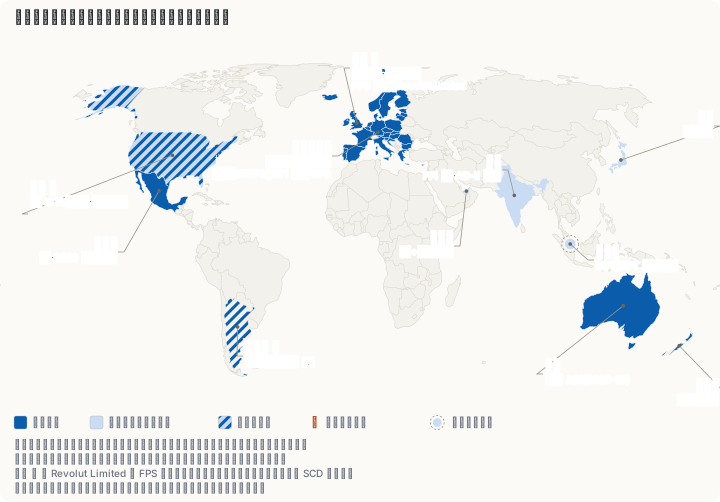
The marking conventions carry over from Appendix B of the licence overview: ✅ held, ❌ no licence record found in public sources, 🟡 applied for or in transition, covered = covered by a heavier licence; anything unknown is written [?] and goes into the list at the end of the chapter. The legend for the world map: dark = banking licence, light = payment licence (including e-money), striped = applied for or in transition, ◉ = direct participation in central bank clearing.
| Jurisdiction | Banking licence | Central bank clearing access | Payment licence (including e-money) | Crypto-asset services | Crypto issuance | Lending and securities |
|---|---|---|---|---|---|---|
| EU | ✅ Revolut Bank UAB in Lithuania (specialised bank licence 2018-12 → full ECB licence 2021, passporting across the 30 EEA countries) | ✅ Direct SEPA participation: STEP2 batch clearing plus RT1 instant clearing (2023-02); connected to TIPS, the ECB's instant settlement platform | covered (the predecessor Lithuanian EMI has been folded into the banking licence) | ✅ MiCA CASP (CySEC, the Cypriot regulator, 2025-10) | ❌ (no EMT issuance eligibility; the issuing moves are the UK sandbox and the US application — see section 5) | ✅ Lithuanian investment firm licence (passportable under MiFID) plus insurance brokerage |
| UK | ✅ Full banking licence (a restricted licence first, 2024-07, entering mobilisation: open for business, with deposits and scale capped; converted to the full licence on meeting the standard, 2026-03-11) | ✅ Direct participation in FPS (Faster Payments, UK) (on the Pay.UK register; settlement type [?]) | ✅ EMI e-money institution licence (FCA 900562; customers being migrated to the bank entity) | ✅ FCA crypto registration (2022; in transition to the new authorisation regime) | ❌ No issuance eligibility yet; in the FCA's first stablecoin sandbox cohort, with a sterling stablecoin in test (see section 5) | ✅ Revolut Trading Ltd (directly authorised 2024-11) |
| Switzerland | ❌ (a representative office; the regulatory standing of the local card-issuing entity is [?]) | ❌ | ❌ | ❌ | ❌ | ❌ |
| US | 🟡 National bank charter filed with the OCC and the FDIC, 2026-03; for now it runs on partner banks (Lead Bank for card issuing and holding balances, Cross River for savings) | ❌ (routed through the partner bank) | ✅ MTLs across multiple states (state list [?]) | ❌ No standalone crypto licence found; the state-level route needs checking [?] | ❌ | ✅ Revolut Securities Inc (FINRA broker-dealer) |
| Singapore | ❌ | ❌ | ✅ MPI (covering accounts, remittance, acquiring and e-money) | 🟡 DPT ticked inside the same MPI; no date found for the in-principle approval converting to the real thing [?] | ❌ | ❌ |
| Hong Kong | ❌ (does not trade there) | ❌ | ❌ | ❌ | ❌ | ❌ |
| Mainland China | ❌ | ❌ | ❌ | ❌ | ❌ | ❌ |
| Brazil | ❌ (a banking licence is an intention only [reported]) | ❌ | ❌ No IP payment institution licence — the permission to issue e-money rides inside the SCD (see reading three) | ❌ | ❌ | ✅ SCD direct credit company licence (2023-05) |
| Argentina | 🟡 Acquisition of Banco Cetelem (announced 2025-06, central bank approval pending [reported]) | ❌ | ❌ | ❌ | ❌ | ❌ |
| Philippines | 🟡 Digital bank licence applied for [reported] | ❌ | ✅ RTC remittance and transfer company licence [reported] | ❌ | ❌ | ❌ |
Outside the table (the points that fall beyond the ten jurisdictions): the Mexican banking licence (approved 2024, fully open 2026-01, the first bank it built itself outside Europe); the Australian ADI (authorised deposit-taking institution — Australia's banking licence; APRA, the Australian prudential regulator, 2026-07-21) plus an Australian credit licence (ACL); Japan's Type II funds transfer business (remittance up to JPY 1 million per transaction) and electronic payment intermediary business (the open banking permission to initiate payments and read account information at banks on the user's behalf); India's full PPI prepaid instrument authorisation (2025-04) plus an AD-II (authorised dealer category II) FX licence; the UAE's twin stored value and retail payment services licences (approved 2026-06); and a New Zealand bank registration under application.
This map has five readings.
One: the evolution path, walked twice. Ten jurisdictions in detail sets the standard path for a neobank: start on a payment licence to prove out customer acquisition, then swap up to a banking licence once you are big enough to earn the net interest margin. Revolut has walked it end to end twice.
The EU run took four steps. From 2015 to 2017 it held no licence of its own at all: it traded as a distributor under the UK EMI of Optimal Payments (later renamed Paysafe), and its cards were issued under that firm's Mastercard principal membership — the prototype of the route in Rule 2 that trades on a licensed institution's status. In 2018-05 it got a UK EMI of its own, authorised by the FCA, the UK conduct regulator. That December, to keep the EU market after Brexit (the passport on a UK licence would lapse when it came), it stood up a separate entity in Lithuania and took an EMI and a specialised bank licence in one go. In 2021 the ECB raised the specialised licence to a full one, and Revolut Bank UAB now covers the 30 countries of the European Economic Area (the 27 EU member states plus Iceland, Liechtenstein and Norway).
The UK run took three steps: its own EMI (2018-05) → a restricted banking licence (2024-07) → the full licence (2026-03-11). The 20 months in between were mobilisation, the opening period the PRA, the UK prudential regulator, sets for new banks: the licence is granted and the doors can open, but total deposits and business scale are capped until every part of the build meets the standard and the licence converts to a full one. What meeting the standard tests is whether capital, governance and risk control have actually been built — customer numbers are not a reason to grant a licence; what they decide is whether the licence is worth going for. Revolut is the only one of the seven companies in this course to have walked that opening period end to end, with a public regulatory record at both the entry and the exit.
For the user, what an upgrade changes is the legal identity of the money: under the EMI the balance was e-money under safeguarding (client money kept separate from the institution's own funds); under the banking licence it becomes a deposit, covered by FSCS protection (the UK's deposit guarantee scheme, limit £120,000, raised from £85,000 in 2025-12).
Two: clearing access follows the licence upgrade. In the EMI years Revolut's euro clearing was routed through CENTROlink, the Bank of Lithuania's gateway; with the banking licence in hand it has participated directly in SEPA as a member since 2023-02 (STEP2 for batch clearing, RT1 for instant), and connects to TIPS. Wise is the exact counterpoint: Wise will not be a bank, and stitches its network together out of a central bank gateway plus direct participation applied for country by country; Revolut takes the banking licence and walks in the front door as a member. Both roads end at direct participation, on different cost structures.
Three: Brazil is counter-intuitive — the entry licence is a lending licence. What Revolut took in Brazil in 2023-05 was an SCD (the light licence for lending your own capital, the dedicated lending channel for fintechs described in the Brazil section of ten jurisdictions in detail), and the payment cell in the table is empty. An empty cell does not mean nothing is carrying the business: the SCD itself comes with one further permission — issuing e-money — and Brazil's global account, plus the Brazilian real account added in 2025, both hang off it. Enter on whatever licence comes quickest, and fill in the payment and banking licences afterwards [reported]. The licence menu is there to be worked: the licence you enter on need not be the anchor.
Four: the most 🟡 of any company in the course. A US national bank charter (filed 2026-03), a bank purchase in Argentina (awaiting approval), a Philippine digital bank licence (applied for [reported]) — as of writing, Revolut has more applications in flight than any of the seven companies. A licence map is a live thing: the moment those three 🟡 come through, three more blocks of dark shading appear on it.
Five: the shape in which a capability is opened up tells you what the firm wants from it. Two direction words first: on-ramp is fiat coming in and turning into an on-chain asset (going on-chain); off-ramp is an on-chain asset going out and turning back into fiat (coming off-chain). The direction is stated relative to the blockchain, not to whose books the money lands on — which is easy to read backwards. A wallet that plugs into someone's off-ramp can perfectly well have the fiat from a sale land back in that user's balance at the same firm: the money is coming in, not going out.
Revolut's crypto capability is not reserved for its own app; it is exposed as an interface third parties can call (the Crypto Ramp API), open on both the buy and the sell side. A wallet plugs in and its users can buy crypto, or sell it back into fiat, without leaving the wallet's own interface.
How far that opening goes is settled by one hard constraint written into the interface: fiat proceeds from a sale have exactly one destination — the user's own Revolut account, and cannot be paid out to another bank. The buy side likewise requires a Revolut account first, since the only payment methods are card, Revolut balance, Apple Pay and Google Pay. So what is opened up is a channel, not a licence: a partner can embed Revolut inside its own interface, but the user and the account relationship that come out the other side belong to Revolut. (The constraint sits on the interface's payout_methods field, whose only current value is revolut; source at the end of the chapter.) This is exactly what the previous chapter means by "not doing BaaS" — BaaS is renting your licence's capabilities to someone else so they can open accounts and issue cards to their own users in their own name, and Revolut has never handed over the account relationship on any of its channels.
Set that against the Liquidation Address in the next chapter on Bridge — a permanent on-chain receiving address where arriving stablecoins are automatically settled into fiat and paid into a bank account. Same off-ramp, two different answers: one requires the recipient to open an account with you first, the other is purely a pipe, with the money landing in the customer's own bank account.
This reading travels to other firms: a ✅ on the map states what the regulator permits, not whether the firm means to run that permission as retail or as wholesale. To judge that, look at the interface it opens to outsiders and ask whose books the money is finally allowed to land on.
How Each Licence Gets Used
Full Lithuanian banking licence (Revolut Bank UAB; specialised bank licence 2018-12, raised to a full licence by the ECB in 2021) — the anchor for the EU region, and everything else derives from it: deposit-taking eligibility turns balances into deposits and unlocks the net interest margin and lending; passporting makes one licence cover 30 countries; bank status is what let it participate directly in SEPA from 2023-02. The predecessor Lithuanian EMI has been folded into this entity, which is why the EU payment cell in the table reads covered rather than held.
Full UK banking licence (PRA and FCA; mobilisation from 2024-07, full licence 2026-03-11) — the anchor for the home market, currently taking over the customers of the old EMI entity. The FPS direct participation that comes with it puts sterling pay-ins and pay-outs on the local instant rails without hanging off another bank (settlement type to be confirmed [?]).
US: MTLs across multiple states plus partner banks (Lead Bank for card issuing and holding balances, Cross River for savings) — the stopgap in the largest single market. An MTL only grants the right to move money on a customer's behalf; card issuing, holding the balances and savings all have to sit under a licensed bank's name. That layer is exactly what the national bank charter filed in 2026-03 is meant to replace.
Mexican banking licence (approved 2024, fully open 2026-01); the Australian ADI plus the ACL credit licence (Australian Credit Licence, the permission to lend; APRA and ASIC, 2026-07-21) — two finished pieces of the replicate layer: no passport to borrow, one licence per country obtained from scratch, and what it buys is full local functionality — local-currency accounts, local cards, local credit.
Singapore MPI (with DPT), India's full PPI plus AD-II, and the Japanese and UAE payment licences — the group that stops at tier ② (may hold client funds, may not lend): enter on a payment licence to run accounts and FX, and stay clear of deposit-taking. An anchor licence in these jurisdictions is a question for after the market proves out, which is why they sit light on the map.
Functional licences: the Lithuanian investment firm licence and insurance brokerage, Revolut Trading Ltd (UK), Revolut Securities Inc (US), the SCD (Brazil) — the ring arranged around each anchor. The division of labour is clean: the anchor licence decides where the customer's money is allowed to rest, and the functional licences decide what else can be sold on top of that account — stocks, insurance, and, running the other way, credit lent to the customer.
3. User Stories
All three scenarios are payment only; stocks, credit and crypto trading run on the investment firm licence, the lending licence and the crypto-asset services licence respectively, and are not opened up here.
1. EEA user: one Lithuanian IBAN as the main account. As an Italian working in Berlin, I want an account that can receive a German salary, spend across Europe and send money to friends instantly, so that I never have to open a fresh banking relationship in each country. Salary arrives over SEPA (the bank's direct participation), card spending runs over Visa and Mastercard (the issuing permission that comes with the banking licence), and transfers between Revolut users are instant entries on its own ledger. Depends on: the Lithuanian banking licence, passporting, and direct SEPA participation.
2. UK user: same app, and the money changes legal identity. As a UK user who opened an account back in 2023, my balance after the 2026 migration stops being safeguarded EMI e-money and becomes a bank deposit, which brings FSCS protection with it. Nothing about paying day to day changes; what changes is how the money comes back if the institution fails — from going to the segregated account to collect my own share, to the deposit guarantee paying out up to the limit. Depends on: the full UK banking licence.
3. European merchant: acquiring and accounts from the same firm. As a cross-border e-commerce business, I want to take euro and sterling receipts through Revolut Business, hold multi-currency balances and pay my suppliers, so that collecting, holding and paying out all happen inside one system. Depends on: the banking licence (EU) or the EMI plus acquiring permission (UK), and direct participation in SEPA and FPS.
4. Summary of Advantages
- The leverage happens once: one Lithuanian licence prising open 30 countries is the best cash-in anywhere of Rule 2 (a licence's geographic reach tracks how integrated the regulation is). The UK, Mexico, Australia and Argentina are all one licence per country, with no leverage at all — what that buys instead is full local functionality in each.
- What it replicates is the process, not the leverage: four jurisdictions, four anchor licences, and the same path each time — enter on a payment licence or a partner bank to prove out customer acquisition, apply for the heaviest local licence, then migrate the customers and the clearing access into the new entity. What can be copied is that sequence of moves, not the one piece of leverage.
- Several layers of revenue off the same user: Revolut occupies five of the six columns, missing only crypto issuance. In revenue terms: the banking licence pays the net interest margin between deposits and loans, the payment and banking licences together pay fees and the FX spread, the crypto-asset services licence pays a cut of every trade, and the investment firm licence pays commission. Set against Wise — licences almost all at tiers ① and ②, digging into the payments column alone — Revolut trades regulatory complexity for revenue per user (ARPU, average revenue per user).
- The banking licence changes the kind of revenue, not just the amount: deposit-taking eligibility unlocks two revenue lines, net interest margin and lending, where the EMI-era model was locked to the fee side — the EU section of ten jurisdictions in detail writes that up as the EMI's hard boundary: client funds segregated 1:1, no lending, no interest paid on balances. Revolut has crossed that boundary twice, in the EU and the UK, and the price can be read off the clock: the UK licence spent three and a half years just waiting on approval, from filing in 2021-01 to grant in 2024-07.
- Its crypto business already has formal regulatory standing: the EU MiCA CASP and the UK FCA crypto registration are both recognised statuses, with Singapore's DPT still waiting to convert from in-principle approval into the real thing [?]. When the UK swaps crypto registration for authorisation across 2026–2027, holding that standing or not is the line between carrying on and stopping.
- The limit is the US; the price is governance: the largest single market still runs on a partner bank, with a banking licence of its own under review. The other half of the price is governance cost — count the cells in this chapter's table and the notes beneath it and Revolut holds or has applied for licences in thirteen jurisdictions, and every product column it adds is one more rulebook to satisfy in each of the thirteen. That is the standing bill this strategy has to keep paying.
5. Four Shifts in What It Claims to Be (2023 to Now)
The four sections above are a snapshot; this one reads the direction of travel. The four shifts at Banking Circle share one bearing — every step that faces an end user or an end merchant is a step backwards. Revolut's four over the same three years are the mirror image: forward into the user's balance sheet (credit), forward to the merchant's counter (acquiring), forward onto the chain (issuing a coin of its own), and forward out of finance altogether (ATMs and mobile plans). All four run off one engine, the sentence that closed reading five: whatever capability it opens up, the account relationship stays with Revolut — and every step forward hangs one more thing off that relationship.
5.1 Credit: from accounts and cards to a business with a balance sheet
One mechanism first. Advantage 4 in section 4 says the banking licence changes the kind of revenue — deposit-taking unlocks the net interest margin. But that margin does not appear the moment the licence does: deposits are the cheapest funding a bank has, and they only turn into interest income once they are lent out. Take deposits and lend nothing and the licence is half cashed. The heaviest product on a retail bank's asset side is the mortgage — large per loan, measured in decades, secured on property, and the hardest test there is of a bank's risk and servicing operations.
Revolut announced the credit route in 2024-11, at the event marking 50 million customers, listing mortgages, overdrafts and business credit as the next product line [reported]. It landed first in the jurisdiction where the anchor licence is oldest: Lithuania got mortgage refinancing (moving a mortgage held at another bank across) in 2025-05 and purchase mortgages in 2026-01, priced off Euribor, the euro-area benchmark rate — all documented on Revolut's own help pages. Ireland was scheduled for a soft launch in Q3 2025, has slipped repeatedly, and is still not live at the time of writing [reported]. In Australia, the lending permission ACL arrived in the same batch as the ADI in 2026-07 (see the notes under the table in section 2).
The claim advanced from "your everyday account" to "your balance sheet", and the exam changes with it: get a fee business wrong and you lose one transaction; get a credit business wrong and you lose principal. What this means for a reader: to judge whether a neobank's banking licence was worth the three and a half years of waiting (advantage 4 does that arithmetic), do not count the licences it has announced. Find the year a loan book first appears in the accounts — the Lithuanian mortgage is the first point on that curve.
5.2 Acquiring: from a button online to a terminal on the counter
A concept to wake up from another chapter: acquiring is the business of taking card money on a merchant's behalf — the money from the card goes to the acquirer first and is settled on to the merchant after clearing, and the acquirer faces the merchant directly and issues it a merchant ID. Banking Circle used it to draw a line against scheme settlement, and that chapter also records the opposite shift: BC cut the acquiring capability it had bought with the Australian acquisition and retreated to settlement and sponsorship only.
Revolut Business started with acquiring online: an e-commerce gateway and the Revolut Pay button. In 2024-10 it pushed acquiring into the physical world with hardware of its own, the Revolut Terminal, launched in the UK and Ireland and aimed at mid-sized and larger merchants [reported]; smaller ones get Tap to Pay on iPhone, where the phone is the terminal. In 2025 it merged account-to-account, online and in-person collection into a single business account in Australia — a market first by its own account — with Singapore following [reported]; it reports in-person transaction volume quadrupling in a year [reported].
BC cut acquiring, Revolut doubled down, and the retreat and the advance are not a difference in judgement but a difference in who the customer is: acquirers are BC's customers, merchants are Revolut's, and both firms are moving towards their own. What this means for a reader: to read any company's advances and retreats, first ask who it defines as the customer, then check whether the move goes towards that customer. It is expansion that does not point at the customer that should worry you.
5.3 Crypto: from "you can buy coins in the app" to preparing to issue one
Revolut's crypto business traces a complete arc across three years. First the contraction: announced in 2023-08 and effective from 2023-10, crypto was switched off entirely for US customers, the stated reason being regulatory uncertainty [reported]. Then the rebuild, in a different shape: Revolut X, a standalone exchange rather than something folded into the main app, went live in 2024-05 in the UK, reached 30 EEA markets in 2024-11 and got a mobile app in 2025-03 [reported]; the MiCA CASP followed in 2025-10 (the Cyprus licence in the section 2 table), putting the EU trading business on formal regulatory footing.
Last comes the issuance side, starting in two jurisdictions at once. In the UK, the FCA opened a stablecoin regulatory sandbox in 2025-11 — a controlled testing ground marked out by the regulator, where selected firms may run a product live at small scale before the rules are final — and published the first four entrants in 2026-02, Revolut among them. Its test is a stablecoin pegged 1:1 to sterling and backed by sterling reserve assets, which customers can buy, hold and sell inside Revolut and also send out across public crypto networks (per the FCA's own page). In the US, the product plan disclosed alongside the banking licence application in 2026-03 (section 2) lists stablecoin services [reported]. One move in the same window runs the other way: in 2026-07 European customers were told support for USDT ends at the end of August, because a stablecoin without authorisation under MiCA has to come off the shelf [reported].
From "you can buy coins in the app" to preparing to issue one — while the same hand clears unauthorised coins off the shelf. Attack and compliance are two faces of one claim: only inside a regulatory framework, and take every cell inside that framework you can. What this means for a reader: the crypto issuance column in the section 2 table has started to move, and the UK cell now carries a note. But a sandbox is a test, not a licence, and conversion depends on when the UK's stablecoin rules are finalised (it goes in the Open questions list). Set it against Wise: both started in retail, and one has just cracked its ban open while the other is standing at the issuer's door.
5.4 Past the edge: from app-only to ATMs and mobile plans
Section 1 defines a neobank as a retail bank with an app and no branches. Since 2025 Revolut has amended both halves of that definition itself.
The "no branches" half: in 2025-06 it installed ATMs of its own in Spain — piloted in Barcelona, 50 machines across Madrid and Barcelona to start, up to 200 planned nationally, with Portugal scheduled for 2026 (company announcement). The machines do three things: fee-free withdrawals for any Revolut customer regardless of nationality or country of residence, on-the-spot issuance of a physical card, and cross-currency withdrawal at the in-app rate. The second one gives the real intent away — it moves card issuance, an account-opening act, onto the street. The physical card that used to wait on the post now drops out of a machine.
The "retail bank" half: eSIM data plans launched in 2024 and, by the company's account, became its most-used non-banking product. On 2025-04-30 it announced Mobile Plans in the UK and Germany — the press release is headlined as a direct challenge to traditional network providers — with no fixed contract, EU and US roaming included, and more markets to follow (company announcement).
What these two have in common is not revenue but contact surface: the machine on the corner and the number in the user's phone are both high-frequency points of contact, and both hang back off the same account relationship. What this means for a reader: section 1 says every product category added means one more licence in every jurisdiction of operation, and that rule hits its boundary here — a telecoms business belongs to none of the six columns. The licence map explains how the financial footprint grows; it cannot explain where a super-app stops. To judge this kind of move past the edge there is only one test: does it hang off the same account relationship? If it does, it is an acquisition and retention asset. If it does not, that is when it is a distraction.
6. Open Questions
- The list of US states where it holds MTLs, and the state-level licensing route for its crypto business [?].
- The settlement type of its FPS direct participation (settling or not), and how far the migration of the connection to the bank entity has got [?].
- Whether the Banco Cetelem acquisition in Argentina has been approved by the central bank and completed (nothing seen as of writing) [reported].
- Whether the list of applicants for a Philippine digital bank licence officially includes Revolut [reported].
- The regulatory standing of the Swiss card-issuing entity, Revolut Switzerland Payments AG [?].
- The date Singapore's DPT services convert from in-principle approval to the real thing [?].
- The full list of countries, fiat currencies and tokens supported on the Crypto Ramp sell side — the documentation gives sample values only, and the real list comes back from /sell-config; whether payout_methods will ever take a value other than revolut has not been disclosed either [?].
- The route and timing for the UK sterling stablecoin to move from sandbox testing to formal issuance — the FCA's stablecoin rules are not final [?].
- When mortgages go live in Ireland (originally planned within 2025, since delayed repeatedly) [reported].
7. Sources
- Borrowing a licence in the early years: Optimal Payments and Revolut partnership announcement (2015-07)
- UK EMI: FCA register, Revolut Ltd (EMI authorised 2018-05-11)
- Lithuanian licences: specialised bank licence plus EMI, 2018-12 (Bank of Lithuania), full ECB licence, 2021 (Bank of Lithuania)
- UK: full licence announcement (2026-03-11, exiting mobilisation), Pay.UK FPS participant list, Revolut Trading direct authorisation announcement
- Euro clearing: direct SEPA connection announcement (2023-02)
- US: national bank charter application announcement (2026-03-05), Cross River savings agreement (official legal page), FINRA BrokerCheck (Revolut Securities Inc)
- Singapore: MAS financial institutions directory (MPI including DPT)
- Crypto: MiCA CASP granted (CoinDesk) [reported]
- The crypto API (reading five): Crypto Ramp API documentation, the crypto-ramp.yaml OpenAPI source: both sets of endpoints, the payout_methods and payment_methods enums, and the webhook event table
- Crypto in and out on the retail side: receiving crypto from an external address, sending crypto to an external wallet
- Outside the table: Mexico full launch announcement, Australian ADI (APRA), India full PPI announcement, UAE twin licences announcement
- Brazil: SCD granted (Finsiders, from the central bank gazette of 2023-05-24) [reported], the SCD's permitted activities include issuing e-money (Brazilian central bank Res. CMN 4.656/2018 in the original; succeeded by Res. CMN 5.177/2024 from 2025-01)
- Argentina's Cetelem deal and the Philippine application: FinTech Futures, Fintech News PH (both [reported])
- Section 5.1, credit: the mortgages, smart ATMs and business credit roadmap (TechCrunch, 2024-11) [reported], mortgage availability in Lithuania (company help page), the Irish mortgage delay (Irish Times, 2025-11) [reported]
- Section 5.2, acquiring: the Revolut Terminal launch (RTÉ, 2024-10) [reported], the acquiring product page (company), three collection routes in one account in Australia (The Fintech Times) [reported]
- Section 5.3, crypto: the US shutdown (CoinDesk, 2023-08) [reported], Revolut X on mobile and across the EEA (The Block, 2025-03) [reported], the FCA stablecoin sandbox cohort (regulator's page, including its description of Revolut's sterling stablecoin), stablecoins in the US product plan (PYMNTS, 2026-06) [reported], USDT support ending (Crowdfund Insider, 2026-07) [reported]
- Section 5.4, past the edge: the Spanish ATM announcement (2025-06), the Mobile Plans announcement (2025-04-30)
Previous: Chapter 4 · Customer Distribution: All Licensed, Yet Serving Entirely Different People Next: Chapter 6 · Bridge: A State-by-State Patchwork Plus One EU Passport