Circle: Turning Issuance into a Licensed Business
Part II · Products (Chapters 2–9) Builds on: Chapter 0 (what each of the six columns covers, the marking conventions, where the two crypto columns sit under Rule 1); the US section of ten jurisdictions in detail (supervision is not clearing) and the EU section (the status threshold for issuing an EMT) New concepts in this chapter: primary issuance and redemption, reserve custody, a membership-based settlement network
1. What It Does
Circle (founded 2013, NYSE listing 2025-06) is the issuer of USDC, a dollar stablecoin, and EURC, a euro one. The issuer's business model in one line: a user hands over $1 and gets one USDC, that $1 goes into the reserve (cash plus short-dated Treasuries), and the interest on the reserve is the revenue — so an issuer's core asset is not technology, it is the regulatory standing that makes other people willing to hand you their dollars.
Four product blocks:
- Issuance, and minting and redemption in the primary market. The institutional channel is called Circle Mint: an eligible institution goes straight to the issuer and mints or redeems at par, 1:1 — that is the primary market. With it, billion-dollar flows never have to be matched against other buyers and sellers on an exchange (that is the secondary market), so no single large order skews the price.
- CPN (Circle Payments Network): a membership-based cross-border settlement network — the sending institution and the payout institution each handle their own local fiat conversion, while the network runs nothing but member admission, compliance messaging, routing and USDC settlement. The fully managed version, Managed Payments, launched 2026-04.
- The developer stack: wallets, a contract platform, and the cross-chain protocol CCTP — burn a USDC on one chain, mint it again on another, and the same coin travels.
- Arc: a stablecoin-purpose chain of its own (Circle building its own L1), currently on testnet; the mainnet window is reported as summer 2026 [reported], with no official announcement [?].
2. Circle's Licence Map
Start with where it holds the licences — the licence climbed all the way to a federal trust bank, and there is still not a single clearing mark on the map:
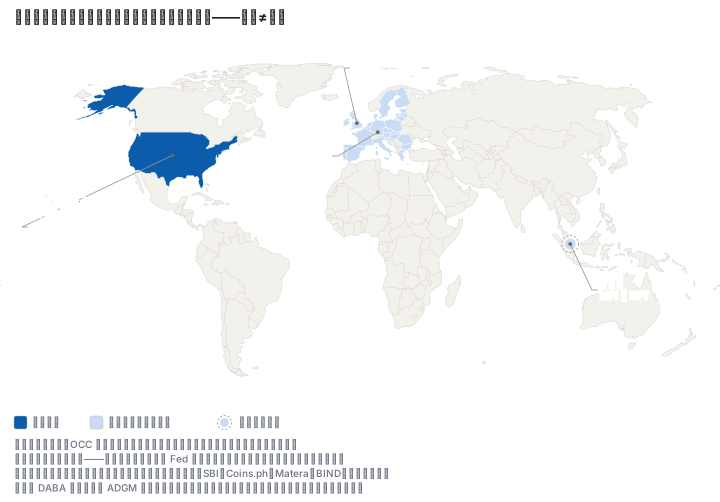
The marking conventions carry over from Appendix B of the licence overview: ✅ held, ❌ no licence record found in public sources, 🟡 applied for or in transition, covered = covered by a heavier licence in the same jurisdiction; anything unknown is written [?] and goes into the list at the end of the chapter. The legend for the world map: dark = banking licence, light = payment licence (including e-money), striped = applied for or in transition, ◉ = direct participation in central bank clearing.
| Jurisdiction | Banking licence | Central bank clearing access | Payment licence (including e-money) | Crypto-asset services | Crypto issuance | Lending and securities |
|---|---|---|---|---|---|---|
| US | ✅ OCC national trust bank charter (final approval 2026-07-10; no deposit-taking, no lending) | ❌ No Federal Reserve master account — supervision is not clearing | ✅ MTLs in 40+ states | ✅ New York BitLicense (first cohort, 2015) plus a Louisiana virtual currency licence | ✅ USDC issued under the existing state framework; 🟡 GENIUS federal issuer status awaiting the final rules | ❌ |
| EU | ❌ | ❌ | ✅ French EMI licence (ACPR, the French prudential regulator; 2024-07-01) | ✅ French CASP authorisation (AMF, the French markets regulator; 2026-04 — custody and transfer of its own coins) | ✅ EMT issuance: USDC and EURC, the first MiCA-compliant issuer | ❌ |
| UK | ❌ | ❌ | ✅ EMI licence (FCA, around 2016 [?]) | ❌ | ❌ (the new authorisation window does not open until 2026-09-30; intentions [?]) | ❌ |
| Switzerland | ❌ | ❌ | ❌ | ❌ | ❌ (lobbying for an equivalence-recognition route [reported]) | ❌ |
| Singapore | ❌ | ❌ | ✅ MPI licence (full licence, 2023-06) | ✅ The same MPI covers DPT (digital payment token) services | ❌ (not inside the MAS stablecoin framework [?]) | ❌ |
| Hong Kong | ❌ | ❌ | ❌ | ❌ | ❌ (Circle was not among the first two licensees; whether it applied [?]) | ❌ |
| Mainland China | ❌ | ❌ | ❌ | ❌ | ❌ | ❌ |
| Brazil | ❌ | ❌ | ❌ (reaches the PIX ecosystem through partners such as Matera [reported]) | ❌ | ❌ | ❌ |
| Argentina | ❌ | ❌ | ❌ | ❌ (distributed through a licensed VASP inside the BIND group [reported]) | ❌ | ❌ |
| Philippines | ❌ | ❌ | ❌ (through Coins.ph, a BSP-licensed EMI and VASP) | ❌ | ❌ | ❌ |
Outside the table: a Bermuda DABA Class F full licence (2019, the hub for international business); an ADGM financial services permission in Abu Dhabi (full scope, 2025-12); Japan's licence sits with a partner — SBI VC Trade obtained "electronic payment instrument" status from Japan's FSA in 2025-03, making USDC the first foreign stablecoin approved to circulate there; and in Mexico the pay-in channel runs over the local payment system, SPEI.
The map reads four ways.
One: an issuer's map runs along two columns. Issuance permission (the crypto issuance column) answers "am I allowed to mint"; the fiat ramp (the payment licence column) answers "can users actually change money in and out". Put plainly: every USDC in circulation is a dollar Circle owes its holder, and the mint-and-redeem channel decides whether the holder can get that dollar back — issuance permission on its own lets you take the debt on without being able to settle it; a ramp on its own means moving other people's money and never earning the reserve interest. On both of Circle's home fronts the two columns are taken as a pair: state MTLs plus a state-level issuance framework in the US, a French EMI plus EMT issuance in the EU. Use the structure as a template: to size up any stablecoin issuer's regulatory standing, check whether those two columns come as a pair. Singapore is the counter-example that proves it — the MPI is in hand (users can change money) but the stablecoin issuance framework has not been entered (it cannot mint), and the test pays off on the spot.
Two: the US row is a specimen of climbing all the way to tier ③, and a live example of supervision not being clearing. From state MTLs (tier ②, from 2015) and a first-cohort BitLicense up to the OCC national trust bank charter finally approved on 2026-07-10 (tier ③: custody, no deposit-taking, no lending) — the line in the US section of ten jurisdictions in detail, that Circle holds an OCC trust charter and still has no Fed access, is about this exact cell: the federal licence is in hand and dollar clearing still has to route through a commercial bank. Not one state licence was handed back: the live foundation under USDC issuance is still the state framework, and federal issuer status waits on the GENIUS final rules (unpublished as of writing [?]). Two weeks later Wise was refused the same class of charter, on the grounds that its anti-money-laundering programme was deficient — which tells you at least one thing: on the same business model, the outcome turns on the compliance programme.
Three: coverage rests on two networks, its own licences and its partners'. In the core markets it holds the licences itself (the US, the EU, the UK, Singapore); in the distribution markets it lets locally licensed firms be the ramp — SBI in Japan, Coins.ph in the Philippines, BIND in Argentina, Matera in Brazil. Circle holds nothing at all in those four places (Japan is not even in the table, it sits outside), and USDC circulates in all four. CPN is that logic turned into an institution: the network admits only licensed financial institutions as members, each member brings its own local licences and compliance obligations, and Circle holds a licence on nobody else's behalf (whether running CPN itself needs a separate licence is not on the public record [?]).
Four: set against Bridge. Bridge, in the previous chapter, pulls the conversion inside itself and its customers need no licence at all; CPN pushes the conversion out to its members, who must be licensed. Same function, placed on opposite sides — Bridge sells "you do not have to understand compliance", CPN sells "you all have compliance already, what you lack is a way to settle with each other". The two are not fighting over the same customers. They are fighting over who owns the point where fiat turns into stablecoin and back.
How Each Licence Gets Used
MTLs in 40+ states plus the BitLicense — the live foundation for issuing and redeeming USDC for US users; holding a BitLicense from the first cohort (2015) is itself ten years of compliance record.
OCC national trust bank charter (First National Digital Currency Bank, N.A.) — two uses: it pulls custody of the USDC reserve into a federally supervised entity of Circle's own (until now it sat spread across several custodian banks — this is the reserve custody named at the head of this chapter), and it offers digital asset custody to institutional clients. It also stakes out a position for GENIUS federal issuer status, since the act leaves a route open to trust companies.
French EMI plus CASP — the EMI lets USDC and EURC be issued as EMTs across the whole EU (the EU section of ten jurisdictions in detail made the point: the threshold for issuing a stablecoin is already being a bank or an EMI, and Circle picked the latter); the CASP fills in custody and transfer of its own coins. Being the first compliant issuer, on 2024-07-01, converted straight into first-mover access to the European market.
Singapore MPI (with DPT ticked) — Circle Mint's fiat mint-and-redeem channel in Asia plus the permission to handle tokens: one licence working two columns (another instance of one licence covering seven activities).
3. User Stories
1. Institutional mint and redeem: in and out through the primary market. As an exchange or a payment orchestrator (a Coinbase, a Bridge), I want to mint and redeem USDC 1:1 at Circle Mint, so that billion-dollar flows do not pay secondary-market slippage (the loss you take when one large order buys the price up or sells it down) and redemption is backed by the issuer's legal promise. — Licences at work: US state MTLs, the Singapore MPI, the French EMI (sorted by where the customer sits); the redemption obligation under the EMT and GENIUS frameworks is the legal form that promise takes.
2. A CPN corridor: licensed institutions as each other's counterparties. As a licensed remittance firm, I want to pay a recipient in the Philippines without any payout capability of my own on the ground, so I send USDC over CPN to a licensed member institution there, which converts it into pesos and pays out over local clearing — and the money lands compliantly without my holding a Philippine licence. — Licences at work: the local licences of the members at each end; Circle supplies the network and the settlement, never the licence.
3. Institutional custody: reserves and assets inside a federal entity. As an institution holding part of its corporate treasury in USDC, I want the assets held at an OCC-supervised trust bank, so that I can tell the board and the auditors exactly where the coins are and who supervises the custodian. — Licence at work: the national trust bank charter.
4. Summary of Advantages
- Compliance is the product: the issuing-side licence stack is laid end to end (state MTLs → a federal national trust bank → the French EMI and CASP → the Singapore MPI). What USDC sells is the credibility of "redeemable 1:1, any time", and the licences are the collateral behind that promise.
- First-mover access as the first MiCA-compliant issuer: from 2024-07 it has been drawing the dividend of a compliance window in Europe — being on the compliant list is a precondition for European exchanges and institutions to buy at all.
- A second curve built on a network: CPN makes the issuer the operator of a settlement network as well, adding network fees alongside reserve interest that rises and falls with the rate cycle.
- Capital efficiency from partner distribution: rather than applying for a licence in every small market, let the locally licensed firm be the ramp — coverage widens without the compliance bill widening with it.
- The limits: no clearing access, so the fiat leg is rented from a bank for good; reserve income rides the interest rate cycle; two new licensing windows, Hong Kong and the UK, have no piece on the board yet; and with the GENIUS final rules still unpublished, federal issuer status stays 🟡 — the most important licence of all has not been granted.
5. Open Questions
- Whether a Federal Reserve master account has formally been applied for [?].
- Whether an application for a Hong Kong stablecoin licence was filed (the HKMA does not publish the list of applicants) [?].
- The exact date the UK EMI licence was granted, and whether the new UK stablecoin authorisation has been applied for [?].
- When the GENIUS final rules land, and where Circle's federal issuer application stands [?].
- Whether the Arc mainnet goes live inside the reported summer 2026 window [?].
- What happens to the state MTLs and the BitLicense once the federal framework takes effect (no surrender plan has been announced) [?].
- Whether operating the CPN network itself requires a licence of its own [?].
- Which route USDC takes once the Singapore stablecoin framework comes into force (today it sits outside the framework) [?].
6. Sources
- OCC final approval announcement (2026-07-10), conditional approval announcement, the GENIUS route, on the company blog
- Licence page on the website (the full record of state MTLs and the BitLicense)
- French EMI and MiCA compliance announcement (2024-07-01), EEA terms page (the CASP entity)
- Singapore MPI announcement, Bermuda DABA blog post, ADGM full licence announcement
- CPN whitepaper (membership admission requirements), CPN Managed Payments announcement (2026-04-08)
- The Japan, Philippines, Argentina and Brazil channels: Circle × SBI announcement, Coins.ph partnership announcement, BIND partnership (Bitcoin.com) [reported], Matera (The Paypers) [reported]
Previous: Chapter 6 · Bridge: A State-by-State Patchwork Plus One EU Passport Next: Chapter 8 · BVNK: Two Non-Bank Licence Categories Plus Direct Euro Clearing Access