Fiat24: One Licence Holding Up a Whole Bank
Part II · Products (Chapters 2–9) Builds on: Chapter 0 (tier ③ under Rule 1, light-licence direct participation under Rule 3); the Switzerland section of ten jurisdictions in detail (the FinTech licence, SROs, the FinIA reform) New concepts in this chapter: the account is the bank's own, tokenised deposit
1. What It Does
Fiat24 (legal entity SR Saphirstein AG, Zurich) calls itself a Web3 bank, and its product shape is the most distinctive of the seven companies in this course. The bank account is an NFT (a non-fungible token — each one unique, and transferable) minted on Arbitrum, an Ethereum layer-2 network; the token number is the account number, and whoever's wallet it lands in is the account holder. The balance is called a Cash Token: legally it is your deposit at this bank, except that the deposit is not recorded in the bank's internal database but on-chain, in token form — that is a tokenised deposit — and it comes in four currencies (CHF24, EUR24, USD24, CNH24). Around it sit a Swiss IBAN for sending and receiving (SEPA, SIC, SWIFT), a Mastercard virtual debit card (debiting the four-currency ledger directly), and one channel for selling crypto: send coin into the official contract — a program deployed on-chain that runs automatically to preset rules — and it lands in your account as fiat within seconds. That channel runs one way only: a user can sell coin to Fiat24 for fiat, but cannot buy coin there, and Fiat24 does not hold coin in custody. The selling fee falls from 1% to 0.125% by the tier of the account NFT, which is set by how many Fiat24 tokens the holder has; the documentation publishes the fee range but not the tier thresholds [?] — so who actually gets which end of that eightfold spread cannot be worked out from public information.
Its distribution model is BaaS for the wallet ecosystem (Banking-as-a-Service: banking capability packaged up for somebody else's app to embed). A wallet app integrates the contracts and the API, and the user opens a Swiss bank account from inside the wallet — publicly named integrations include SafePal, Bitget Wallet, imToken and THORWallet. The positioning in one line: the user is a depositor of the bank directly, not a name attached to a platform's virtual account number — the next section takes that difference apart.
2. Fiat24's Licence Map
Start with where it holds the licence — one cell on the whole map is lit:
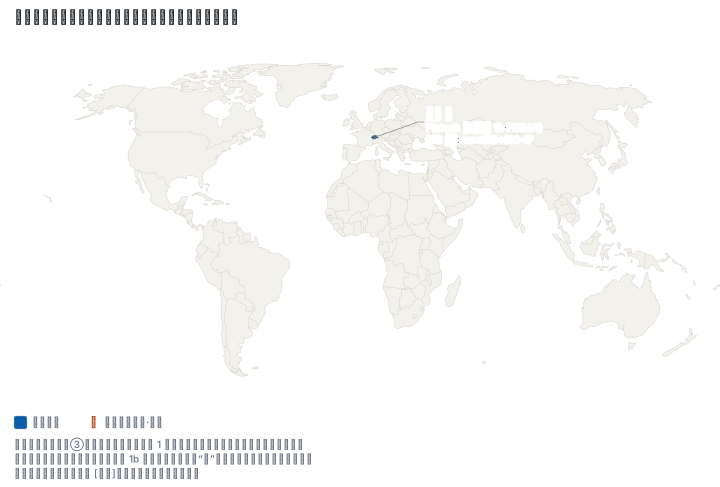
The marking conventions carry over from Appendix B of the licence overview: ✅ held, ❌ no licence record found in public sources, 🟡 applied for or in transition, covered = covered by a heavier licence in the same jurisdiction; anything unknown is written [?] and goes into the list at the end of the chapter. The legend for the world map: dark = banking licence, light = payment licence (including e-money), striped = applied for or in transition, ◉ = direct participation in central bank clearing.
| Jurisdiction | Banking licence | Central bank clearing access | Payment licence (including e-money) | Crypto-asset services | Crypto issuance | Lending and securities |
|---|---|---|---|---|---|---|
| Switzerland | ✅ FinTech licence (Banking Act Art. 1b; FINMA, the Swiss financial regulator; 2021-02-16) | ✅ Direct participation in SIC: euroSIC RTGS (2023-12), SIC-IP instant payments (2025-11); the earliest date it joined Swiss franc RTGS [?] | covered (Switzerland has no payment licence; moving money for customers is inside the Art. 1b licence) | covered (crypto→fiat conversion only, one way, and Fiat24 is itself the counterparty: the user sells the coin to the bank, rather than the bank matching the user's order out in the market; no buying, no custody. The permission is inside the Art. 1b licence — which may take in deposits "or crypto assets" — so no separate SRO membership is needed) | covered (a Cash Token is a tokenised deposit, and the Art. 1b deposit-taking permission covers it; after the FinIA reform it may have to switch licences [?]) | ❌ |
| EU | ❌ (early on, Visa cards were issued through Wallester, an Estonian card issuing service, covering the EEA [reported]) | ❌ | ❌ | ❌ | ❌ | ❌ |
| UK | ❌ | ❌ | ❌ | ❌ | ❌ | ❌ |
| US | ❌ | ❌ | ❌ | ❌ | ❌ | ❌ |
| Singapore | ❌ | ❌ | ❌ | ❌ | ❌ | ❌ |
| Hong Kong | ❌ | ❌ | ❌ | ❌ | ❌ | ❌ |
| Mainland China | ❌ (no new customers since 2026-06 [reported]) | ❌ | ❌ | ❌ | ❌ | ❌ |
| Brazil | ❌ | ❌ | ❌ | ❌ | ❌ | ❌ |
| Argentina | ❌ | ❌ | ❌ | ❌ | ❌ | ❌ |
| Philippines | ❌ | ❌ | ❌ | ❌ | ❌ | ❌ |
The map reads four ways.
One: only one row has anything in it, and that row is nearly full. At a glance this is the thinnest map of the ten jurisdictions: one jurisdiction, one licence. Look closer and the Swiss row fills five of the six columns — banking ✅, clearing ✅, payments covered, crypto services covered, issuance covered. This is what the value of a tier ③ licence under Rule 1 looks like in its specifically Swiss form: one light banking licence that may take deposits but not lend, and that single licence covers deposit-taking (up to CHF 100 million, with the statute saying "deposits or crypto assets" in as many words), direct participation in SIC clearing, moving money for customers, buying crypto off customers against its own book, and writing the deposit itself as an on-chain token — all inside one licence, with no EMI, no SRO and no VASP needed. The title is the claim: one licence holding up a whole bank.
Two: the account is the bank's own. Go back to the question of whose name the money moves in, from Banking Circle. Account services on the market come in three constructions:
| Construction | Whose name | Where the ledger sits | Example |
|---|---|---|---|
| Agency Banking | The customer's own (its own BIC and IBANs) | At the customer, with the bank sponsoring and settling behind it | Banking Circle's Agency Banking customers |
| vIBAN | Borrowed (the virtual account number displays the customer's name) | Under the platform's master account at a bank | Bridge- and Marqeta-style platform accounts |
| The account is the bank's own | The user's own, as a depositor | The bank's own ledger, held directly by the user | Fiat24 |
In the first two the user's counterparty is the platform, and the platform's counterparty is the bank. At Fiat24 the user's counterparty is the licensed bank itself — the account has a final position inside the clearing system, and if the institution fails the user is a depositor of the bank rather than a creditor of a platform. That is the core pitch to the wallet ecosystem: the app holds the interface, and the account belongs to the user.
One limit goes in right away, before "depositor" gets read for more than it is worth: deposits under an Art. 1b licence are not covered by Swiss deposit insurance (esisuisse) — one of the statutory differences between the FinTech licence and a full one, and FINMA requires licence holders to say so plainly to their customers. So what "the user is the depositor" buys is a direct claim and a final position in clearing, not deposit insurance; ranked by protection it sits above a platform's creditor and below the insured depositor of a full bank.
Three: a live example of light-licence direct participation. Rule 3 closed by saying that the Swiss FinTech licence participating directly in SIC proves light-licence direct participation runs stably — the evidence is in this row: the official SIX register lists SR Saphirstein AG with clearing number 83051, on euroSIC RTGS since 2023-12-01 and on SIC-IP instant payments since 2025-11-03. A tier ②/③ institution sitting straight in the clearing layer is unthinkable in the US; in Switzerland it is by design.
Four: its card scheme standing made the same move, from a borrowed name to its own. The early Visa card was a programme run with Wallester, an Estonian card issuing service, limited to the EEA plus Switzerland [reported]; the current card is a virtual debit card issued as a Mastercard principal issuer in its own right, on its own BIN (5481 08) — a rented issuing identity upgraded into an owned one. Question one in the EU section of ten jurisdictions in detail made the point that an EMI is already enough to become a card scheme member; here the same move runs on a tier ③ light banking licence.
3. User Stories
1. The last stop on a crypto user's way out. As an individual earning on-chain, I want to sell stablecoin into fiat and land it in a Swiss IBAN in my own name, so that everything afterwards — SEPA transfers, card spending — happens with me as a bank depositor. How it works: send the coin into the Fiat24 contract (the bank takes the coin onto its own book as counterparty), and Cash Token is credited within seconds at the on-chain quote, at 1%–0.125% by NFT tier. — Licences at work: the Art. 1b licence (deposit-taking plus dealing on its own book) plus SIC/euroSIC (the fiat leg).
2. A bank bolted onto a wallet app. As a self-custody wallet (the user keeps the private key and the platform never touches the assets — a SafePal), I want to give users a Swiss bank account and a card in one tap, so that the wallet stops being a place to park coin and becomes an account that can take a salary and spend it, while I touch no customer money at all. The integration is contracts plus API: the user mints the account NFT and enters a depositor relationship with the bank directly, and the app is never in the money path. — Licences at work: all of them Fiat24's Art. 1b licence; the app holds none. The difference from vIBAN-style BaaS is in the three-row table in the previous section.
3. A card that debits four currencies directly. As a user holding balances in all four of CHF, EUR, USD and CNH, I want a card payment debited straight from the matching currency ledger, so that I never pay the hidden cost of converting into a single balance first. — Licences at work: Mastercard principal issuer standing plus the multi-currency Cash Token ledger.
4. Summary of Advantages
- A different legal standing: the account is the bank's own — the user holds a Swiss bank account directly, which is something a vIBAN-style platform cannot give by construction.
- An on-chain-native core system: the account is an NFT, the balance is a tokenised deposit, and the bank's core ledger is the chain itself — composable with DeFi, since contracts interact with the account directly. A traditional bank builds a blockchain interface onto a bank; Fiat24 runs it the other way and builds a bank interface onto the chain.
- One licence's cost, direct participation's depth: a single light licence buys capability in five of the six columns, plus direct clearing participation and direct issuing membership of a card scheme — the fewest licences of the seven companies, and the highest ratio of columns covered to licences held.
- BaaS for the wallet ecosystem: one integration connects a wallet's entire user base, and the cost of acquiring those users shifts to the integrator — how many it actually reaches has never been reliably disclosed (see item 4 in the Open questions).
- The limits and the risks are the other side of that same licence: the CHF 100 million deposit ceiling is a cap on scale written into the statute; deposits may pay no interest and may not be put to work, so revenue can only come from the fee side (conversion fees, the fee to mint an account number, interchange [?]); one jurisdiction and one licence, with no second jurisdiction to fall back on; the FinIA reform would replace the FinTech licence with a payment institution licence (the new category alone would be allowed to issue payment-type stable tokens — which lands squarely on how a Cash Token gets characterised), and neither the transitional arrangements nor the company's position on them has surfaced [?].
5. Closing the Course: Seven Companies, Seven Strategies, Three Rules
With all seven companies done, put them back side by side on one map and you have seven ways of turning a licence into a product:
- Banking Circle: take the heaviest licence available in every jurisdiction, then break the banking licence into parts and rent them to institutions that cannot reach tier ④.
- Wise: not one banking licence anywhere — eighty tier ① and ② light licences stitched into a single network, with nine clearing connections driving "local" all the way down.
- Revolut: one anchor licence per region, upgraded region by region from tier ② to tier ④; the EU one caught the leverage of passporting, and everywhere else is the same move copied region by region.
- Bridge: 33 licences assembled state by state in the US, one authorisation covering 27 countries in the EU, and clearing and card issuing wholly outsourced — licences can be rented.
- Circle: turn issuance itself into a licensed business, taking the issuance permission and the fiat ramp as a matched pair of columns.
- BVNK: two non-bank licence categories plus direct euro clearing access form a local European loop in BVNK-managed payments; in self-managed payments, the licensing responsibility shifts to the customer.
- Fiat24: one Swiss light banking licence covering five columns of capability, with the user becoming a depositor of the bank directly.
The three rules each get paid off once across the seven. Rule 1 (a licence's weight = what you may do with client money): the seven spread from tier ② to tier ④, and each business model's boundary is drawn at the tier where it stopped —
| Where it stops | Who | Where the revenue ceiling sits at this tier |
|---|---|---|
| ② Hold client funds, no lending | Wise, Bridge, BVNK | The ceiling is fees and the FX spread — neither the net interest margin nor reserve income is in reach |
| ③ Take deposits or hold in custody, no lending | Circle, Fiat24 | The ceiling turns on whether you may use the money: Circle's reserves can go into short-dated government paper, and reserve interest is its main revenue; Fiat24's Art. 1b licence forbids paying interest on deposits or deploying them, so its ceiling is fees, the same as tier ② |
| ④ Take deposits and lend | Banking Circle, Revolut | No ceiling — the net interest margin and credit are both in range. This is the top of the yardstick |
Both Bridge and Circle are climbing towards ③: Bridge's national trust charter is a conditional approval and not yet final, Circle's is final, which is why Bridge is still recorded at ② today and Circle at ③. Take no deposits and you earn no net interest margin — nobody gets around that one.
Rule 2 (geographic reach = how integrated the regulation is): the same job takes one authorisation in the EU and a state-by-state patchwork in the US, and Bridge alone shows both extremes inside a single company.
Rule 3 (the clearing door is sinking): Wise was first through every door as it opened, Fiat24 proves a tier ③ light licence can sit stably in the clearing layer, and the American door has still not opened — which is why US payment innovation grew on top of the borrow-a-bank model.
Finish this course and you should be holding a yardstick you can carry anywhere. Meet a new company and ask three questions: what may it do with client money (that fixes the tier), in how many countries is the licence valid (that fixes the geography), and how many layers away from the clearing layer does it sit (that fixes cost and speed). Put the three answers together and the shape of the product is very nearly decided for you.
6. Open Questions
- The earliest date it joined Swiss franc SIC RTGS (the official filings show only euroSIC in 2023-12 and SIC-IP in 2025-11; the press says it was in by 2021–22 [reported]).
- The old "Visa Principal Member" claim has no official backing — the evidence points to the Wallester programme instead; and the exact date the Visa card was retired [?].
- The full whitelist of countries served, and whether US residents can open an account [?].
- An up-to-date, reliable disclosure of user numbers and deposit size [?] (the official pointer is an on-chain Dune dashboard).
- The NFT tier thresholds — the documentation publishes the 1% to 0.125% fee range but never says how many tokens each tier takes [?].
- Whether card interchange amounts to real revenue [?] — advantage 5 lists it as one possible fee-side line, with nothing disclosed behind it.
- Fiat24's formal position on the FinIA amendment, and its plan for switching licences [?].
7. Sources
- FINMA guidance on the FinTech licence (deposits or crypto assets; no interest, no lending)
- SIX bank master file amendments: euroSIC 2023-12 (IID 83051), SIC-IP 2025-11
- Fiat24 legal and licensing page (docs), the Swiss IBAN and clearing, the Mastercard debit card (own BIN), crypto top-up fees, the account NFT explained
- Year in review (the Mastercard launch, integration case studies), the Wallester × Fiat24 Visa card (2023) [reported]
- The FinIA amendment consultation (Loyens & Loeff analysis), the new payment institution licence analysed (CapLaw)
Previous: Chapter 8 · BVNK: Two Non-Bank Licence Categories Plus Direct Euro Clearing Access Next: Chapter 10 · Appendix: The Customer Map — From Need to Provider