Bridge: A State-by-State Patchwork Plus One EU Passport
Part II · Products (Chapters 2–9) Builds on: Chapter 0 (what each of the six columns covers, the marking conventions, the four-tier yardstick from Rule 1); Banking Circle (the carrier of several of the fiat legs in this chapter; a "leg" is the local pay-in or pay-out segment at one end of a cross-border transaction) New concepts in this chapter: stablecoin orchestration, Virtual Accounts and Liquidation Addresses, white-label issuance
1. What It Does
Bridge (founded 2022, bought by Stripe in 2025-02 for about $1.1 billion) is in the business of stablecoin orchestration. Orchestration means packaging the whole chain — fiat comes in → becomes a stablecoin (an on-chain token pegged to a fiat currency such as the dollar, with a promise to redeem 1:1) → moves on-chain → turns back into fiat and goes out — into one set of APIs. A customer passes KYB (business identity verification) and plugs in, holding no licence of its own.
Two product lines, each built on one minimal component. The orchestration line: Virtual Accounts — permanent fiat receiving details issued to the customer (a US dollar account number, a euro IBAN), where anything paid in lands automatically as a stablecoin balance; and Liquidation Addresses — permanent on-chain receiving addresses, where stablecoin arriving is automatically converted into fiat and paid into a bank account. The issuance line: USDB, its own stablecoin, plus Open Issuance, the white-label issuance platform launched in 2025-09 — MetaMask's mUSD, Phantom's CASH and Klarna's KlarnaUSD are all issued on it, with reserves managed by BlackRock, Fidelity and others.
Above the two lines sits one more thing, a card: the Bridge–Visa stablecoin card converts the user's stablecoin balance into fiat in real time to fund the charge as they pay. The issuing bank is Lead Bank in the US. It launched across six Latin American countries in 2025-04, and the 2026-03 announcement puts it live in 18 markets, with a plan to reach 100+ countries within the year.
Scale (from Stripe's 2025 annual letter, published 2026-02): Bridge's annual transaction volume quadrupled, and stablecoin payment volume ran to roughly $400 billion, 60% of it B2B. Distribution leans heavily on Stripe's front end: Stripe's stablecoin merchant collections, and its stablecoin financial accounts (SFA) covering 101 countries, both run on Bridge underneath.
2. Bridge's Licence Map
Start with where it holds the licences — the whole footprint comes in two colours:
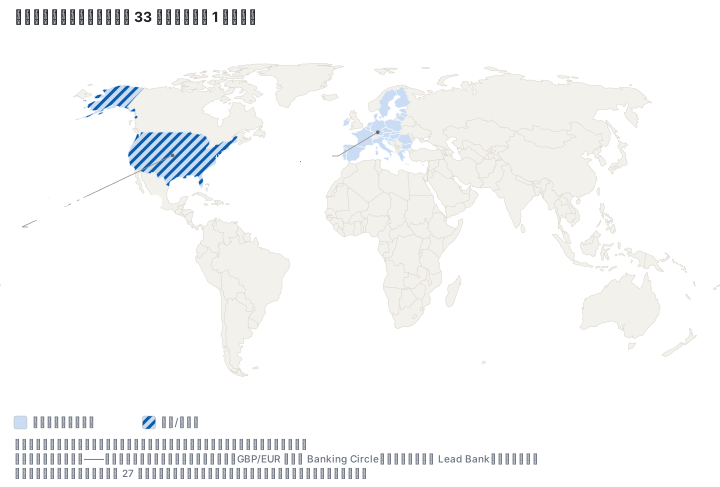
The marking conventions carry over from Appendix B of the licence overview: ✅ held, ❌ no licence record found in public sources, 🟡 applied for or in transition, covered = covered by a heavier licence; anything unknown is written [?] and goes into the list at the end of the chapter. The legend for the world map: dark = banking licence, light = payment licence (including e-money), striped = applied for or in transition, ◉ = direct participation in central bank clearing.
| Jurisdiction | Banking licence | Central bank clearing access | Payment licence (including e-money) | Crypto-asset services | Crypto issuance | Lending and securities |
|---|---|---|---|---|---|---|
| US | 🟡 OCC conditional approval for a national trust bank (2026-02-12; not finally approved, not yet open) | ❌ (dollar clearing routed through Lead Bank; no record of a Federal Reserve master account) | ✅ MTLs in 32 states plus DC (New York, California and Texas missing) | ✅ Louisiana virtual currency licence; most states covered by the MTL; no BitLicense | ✅ USDB issued on the state MTLs as its foundation; 🟡 the issuer route under GENIUS (the 2025 US federal stablecoin act) | ❌ |
| EU | ❌ | ❌ (euro clearing runs through Banking Circle) | ✅ Luxembourg EMI (2026-07-02, passporting across 27 countries) | ✅ MiCA CASP (same day, same entity) | ✅ EMI status is itself the eligibility to issue a euro stablecoin (EMT) | ❌ |
| UK | ❌ | ❌ (sterling clearing runs through Banking Circle) | ❌ | ❌ (no FCA registration record found [?]) | ❌ | ❌ |
| Switzerland | ❌ | ❌ | ❌ | ❌ | ❌ | ❌ |
| Singapore | ❌ | ❌ | ❌ (stablecoin collections distributed through Stripe's MPI [?]) | ❌ | ❌ | ❌ |
| Hong Kong | ❌ | ❌ | ❌ | ❌ | ❌ | ❌ |
| Mainland China | ❌ | ❌ | ❌ | ❌ | ❌ | ❌ |
| Brazil | ❌ | ❌ | ❌ | ❌ (no disclosure of whether it filed inside the PSAV application window [?]) | ❌ | ❌ |
| Argentina | ❌ | ❌ | ❌ | ❌ (the CNV register has not been checked line by line [?]) | ❌ | ❌ |
| Philippines | ❌ | ❌ | ❌ (runs through a local partner [reported]) | ❌ | ❌ | ❌ |
Outside the table: the Polish VASP registration is a legacy arrangement; from 2026-07 everything consolidates onto the twin EMI and CASP authorisations of the Luxembourg entity.
This map has four readings.
One: the US and EU licence structures are the most extreme pairing of Rule 2 anywhere. The same business: on the US side it takes 33 licences obtained state by state (MTLs in 32 states plus Washington DC, with several big states still missing); on the EU side one filing in one jurisdiction — Luxembourg's EMI and CASP came from the same entity on the same day, one authorisation covering all 27 EU member states. How integrated the regulation is decides a licence's geographic reach — here are both extreme values of that rule, inside one company.
Two: the issuance column is the four-tier yardstick in motion. USDB is issued today on the state MTLs (tier ②: you may hold client money but not lend it) — the OCC's approval decision confirms it in black and white. The conditionally approved national trust bank (tier ③: you may take deposits or hold in custody but not lend) and the GENIUS issuer licence now being stood up (a purpose-built tier ③) are its next stop. Regulators are moving stablecoin issuance from tier ② up to tier ③, and Bridge is the sample caught mid-move: the conditional approval states in as many words that stablecoin activity must cease or be divested if it does not conform to GENIUS and its implementing rules.
Three: cards and clearing are entirely outsourced — the blanks are the dependencies. Bridge holds no banking licence and no clearing access, and still issues cards in 18 markets and takes money in and pays it out across the EU, the UK and the US: card issuing rented from Lead Bank (the Visa issuer); the dollar cash leg rented from Lead Bank; European, UK and Australian clearing rented from Banking Circle (local EUR and GBP clearing, USD over SWIFT, AUD planned over NPP, Australia's instant rails); reserve management rented from BlackRock and Fidelity. Read the table above and the UK row is empty while sterling still gets paid — because that leg is drawn on BC's map. Licences can be rented too: this is the orchestration edition of Rule 2's borrow-a-bank model.
Four: outside the US and the EU, no licences at all. The local-currency legs in emerging markets (Argentina, Mexico, Nigeria and the rest) are stitched together country by country out of liquidity and clearing partners [reported] — which is where the real cost of this business sits, and where new licensing frameworks like Brazil's PSAV virtual asset service provider licence will eventually force a choice: hold a local licence, or find a local partner.
How Each Licence Gets Used
MTLs in 32 states plus DC (held by Bridge Building Inc) — the working foundation today for two things: pay-in and pay-out orchestration, and USDB issuance. Collecting fiat for a customer, converting it into stablecoin, paying fiat out — every step of that is money transmission. New York, California and Texas are absent (either in application or under some exemption, to be confirmed [?]), which means business in those states has to route around them or run restricted.
OCC conditional approval for a national trust bank (2026-02-12) — three approved lines of business: digital asset custody (in a fiduciary capacity), stablecoin issuance and orchestration, and reserve management; a trust charter, no deposit-taking, no FDIC. The value is vertical integration: once finally approved, the functions scattered today across state licences and custody partners come inside one federally supervised entity, and it stakes out eligibility as a GENIUS issuer.
Luxembourg EMI plus MiCA CASP (2026-07-02, Bridge Building S.A.) — the EMI solves two things: issuing customers named IBANs that work across 27 countries (the European leg of the Virtual Account), and gaining EMT eligibility to issue a euro stablecoin (as the EU section of ten jurisdictions in detail puts it: what gates stablecoin issuance is your status). The third thing — exchange and custody — comes from the CASP the same entity obtained on the same day under MiCA, the EU's crypto-asset regulation. The EU stack is upgraded from renting BC's name to trading in its own name and renting BC's rails.
3. User Stories
All three scenarios are payment only. Each ends by naming whose licence is doing the work.
1. Emerging-market business: two receiving identities, one stablecoin treasury. As a SaaS exporter in Argentina, I want a US account number to receive dollar ACH payments and a euro IBAN to receive SEPA, with everything arriving converted automatically into USDC, so that I can sidestep local-currency swings and the queue for FX approvals and keep my global income in one treasury. — Licences at work: Bridge's US MTLs (the dollar leg plus conversion) and Bridge's Luxembourg EMI (the euro IBAN); rented: Lead Bank (the dollar account), Banking Circle (SEPA clearing [?]).
2. Payroll platform: stablecoin as the middle rail. As a platform paying contractors in 70+ countries (a Remote.com type [reported]), I want employers to pay in local currency and contractors to choose between local currency and USDC, so that each end uses whatever form suits it. Employer fiat comes in and converts to USDC to carry the cross-border segment; for anyone taking local currency, Europe and the UK pay out over SEPA and FPS (BC's rails) and other markets go through local partners. — Licences at work: Bridge's MTLs and EMI (conversion and orchestration); rented: the clearing partners at both ends.
3. Latin American user: spending a USDC balance straight off a card. As a freelancer in Buenos Aires, my income is in USDC and I want a Visa card that can spend it directly, so that I skip the step of converting to pesos and putting them in a bank first. At the moment of the tap, Bridge converts the USDC into fiat to fund the charge, and Lead Bank stands as issuer and settles with Visa. — Licences at work: Lead Bank's US banking licence (issuing) plus Bridge's conversion and orchestration; whether issuing outside the US needs a local BIN sponsor (the licensed bank lending out its card number range and its issuing permission) has not been worked out [?].
4. Summary of Advantages
- The whole chain behind one API: the licence shell, the bank pieces at both ends, conversion and custody all delivered as one package, and the customer walks in holding no licence at all — where by contrast Circle's CPN cross-border settlement network requires its members to be licensed themselves (see the next chapter for the comparison).
- Stripe distribution: stablecoin business accounts in 101 countries, a take-stablecoins switch in the merchant dashboard, integration with Stripe Issuing — customer acquisition cost spread across the parent, which is leverage no independent orchestrator has.
- Issuance turned into a platform: Open Issuance makes issuing a stablecoin a standard product (the issuing foundation, reserve management — the custody and deployment of the assets backing it 1:1 — and mint and redeem at par, which is to say the primary market), landing Bridge the picks-and-shovels business of an era where everyone issues a coin.
- A regulatory upgrade in flight: the conditionally approved national trust bank plus a GENIUS-ready posture stake out a position in the window while stablecoin issuance supervision moves from the states to the federal level.
- The limits: the critical capabilities are rented (card issuing, clearing, dollar cash), so partner concentration is a real risk; three big US states are missing; and outside the US and the EU it holds nothing at all, so the cost of stitching together emerging-market legs never leaves the books.
5. Open Questions
- Why New York, California and Texas MTLs are absent (in application, or an exemption structure) [?].
- The date of the OCC's final approval and of opening; whether the national trust bank has applied for a Federal Reserve master account [?].
- Whether an application was filed inside Brazil's PSAV window (open until 2026-10-29); a line-by-line check of the Argentine CNV register [?].
- The full list of partner banks behind the dollar Virtual Accounts (beyond Lead Bank) [?].
- Whether card issuing outside the US needs a local BIN sponsor, and how far Lead Bank's coverage extends [?].
- Whether the entire euro leg's SEPA clearing runs on Banking Circle [?] — user story 1 records it that way, but no announcement from either side confirms it line by line.
6. Sources
- Bridge's official licence list (US), non-US licence list
- OCC conditional approval decision CD#1365, Bridge's own announcement blog
- MiCA and EMI twin authorisation announcement (2026-07-02), AMF CASP white list
- Banking Circle carrier announcement, Visa announcement, 18 markets to 100+ countries, the card's integration with Stripe Issuing
- Open Issuance launch (Stripe blog), Stripe's 2025 annual letter (transaction volume, KlarnaUSD, Tempo), acquisition completed (Stripe newsroom)
Previous: Chapter 5 · Revolut: One Anchor Licence per Region, Replicated Region by Region Next: Chapter 7 · Circle: Turning Issuance into a Licensed Business