BVNK: Two Non-Bank Licence Categories Plus Direct Euro Clearing Access
Part II · Products (Chapters 2–9) Builds on: Chapter 0 (what each of the six columns covers, and the marking conventions); Bridge (stablecoin orchestration and partner banks); the previous chapter (stablecoin issuance and redemption) New concepts in this chapter: BVNK-managed and self-managed delivery models (separating the licence layer from the software layer)
1. What It Does
Start with one business payment that begins in fiat and arrives in stablecoin. The payer funds a payment account; the provider converts the fiat into a third-party stablecoin and sends it to the recipient's wallet. If the recipient ultimately wants fiat, another conversion and local payout leg must follow. BVNK orchestrates that stablecoin payment: one API connects fiat accounts, conversion, on-chain transfers, compliance checks, liquidity routing and exception handling into a route that can actually run.
BVNK does not issue its own stablecoin and it is not a bank. Third-party issuers such as Circle still handle stablecoin issuance and final redemption; banks still safeguard the customer fiat represented by e-money. A BVNK "named virtual account" can identify an incoming payment with its own account details and, where the product supports it, display the customer's name. The word "named" does not by itself make the customer a direct depositor of the partner bank.
The product has two delivery models. They use similar orchestration capabilities, but differ in who stands in the money flow and bears the regulated responsibilities.
| Delivery model | Who handles regulated movement of funds | Who controls custody, keys and liquidity | What BVNK delivers |
|---|---|---|---|
| BVNK-managed payments | BVNK's licensed entities and partner banks divide the work by market | BVNK and its selected custody and liquidity providers | Accounts, wallets, conversion, pay-in and payout through the Portal, APIs or Embedded |
| Self-managed payments | The customer uses its own licences, compliance processes and providers | The customer chooses its custody and liquidity providers; keys and data remain in its environment | Layer1 software for wallet management, reconciliation, routing and exception handling |
The licence map below therefore explains only the BVNK-managed model: it shows where BVNK and its partners bear responsibility. A self-managed customer has a different licence map of its own. What Layer1 can do cannot be inferred from the cells occupied by BVNK's licences.
BVNK's typical customer is a PSP or platform, not an end user. Worldpay embeds BVNK-powered stablecoin payouts into its existing payment platform, while Deel lets employees and contractors in more than 100 markets choose stablecoin payroll. One institutional integration can therefore bring the customer's own network with it. On BVNK's figures, annualised stablecoin payment volume reached $30 billion at the end of 2025, across 2.8 million transactions and at 2.3 times the previous year's level. Those figures establish processing scale; on their own, they do not show that BVNK is cheaper, faster or more broadly regulated than its peers.
On 2026-03-17, Mastercard announced an agreement to acquire BVNK for up to $1.8 billion, including $300 million of contingent consideration; the deal closed on 2026-08-03. Mastercard described the value of the transaction as connecting on-chain assets with fiat rails, which fits BVNK's orchestration role. It does not prove that BVNK's licence strategy caused the acquisition. At signing, BVNK said that existing platform access, integrations and customer relationships would remain unchanged, and that it would retain the operational independence needed to execute its roadmap after closing. The long-term boundaries of its products and APIs will still be determined by what happens in practice.
2. BVNK's Licence Map
First look at where the managed model places responsibility: three areas of light shading, one clearing symbol and no banking licence anywhere on the map.
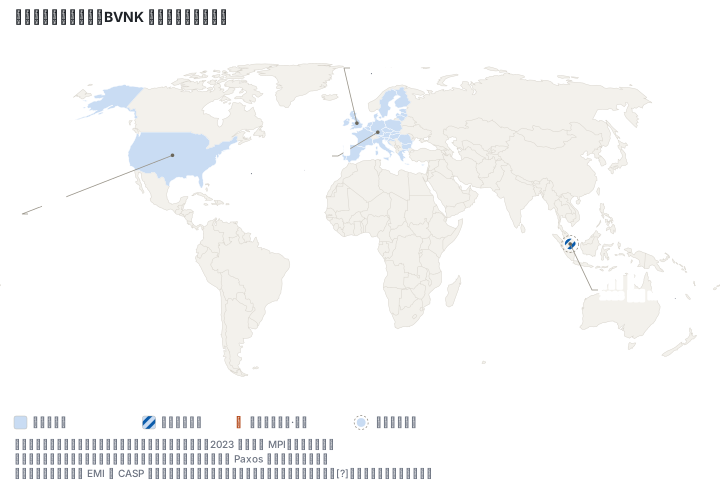
The marking conventions carry over from Appendix B of the licence overview: ✅ held, ❌ no licence record found in public sources, 🟡 applied for or in transition, and covered = covered by a heavier licence in the same jurisdiction. Anything unknown is marked [?] and included in the list at the end. On the world map, dark shading means a banking licence, light shading a non-bank permission (including payments, e-money and cryptoasset services), stripes an application or unresolved status, and ◉ access to a central-bank clearing rail.
| Jurisdiction | Banking licence | Central-bank clearing access | Payment licence (including e-money) | Cryptoasset services | Crypto issuance | Lending and securities |
|---|---|---|---|---|---|---|
| EU | ❌ | ✅ A direct participant in the Bank of Lithuania's CENTROlink system, with access to SCT and SCT Inst (announced 2026-01); this is access to a retail payment system, not BVNK taking its own seat in T2 | ✅ Maltese EMI (System Pay Services (Malta) Limited) | ✅ A Maltese MiCA CASP authorisation held by the same entity (2026-02-16, passportable across the EEA) | ✅ The Maltese EMI meets MiCA's entity requirement for an EMT issuer; no EMT white paper or actual issuance has been found | ❌ |
| UK | ❌ | ❌ | ✅ EMI (System Pay Services Ltd, FCA 901057) | ❌ — BVNK's current licence page lists no FCA crypto registration or authorisation, and its terms say its digital-asset services are not FCA-regulated | ❌ | ❌ |
| Switzerland | ❌ | ❌ | ❌ | ❌ | ❌ | ❌ |
| US | ❌ (banking services use partners including Lead Bank and Cross River) | ❌ | ✅ MTLs or equivalent authorisations in 38 states, the District of Columbia and Puerto Rico: 40 jurisdictions in total; plus FinCEN MSB registration | ✅ Delivered through BVNK's own state licences or equivalent authorisations together with partner licences; Paxos supplies the required licences and infrastructure in New York, while BVNK lists no BitLicense of its own | ❌ | ❌ |
| Singapore | ❌ | ❌ | 🟡 MPI application filed in 2023-05; current public lists do not confirm approval, and the application status is undisclosed [?] | ❌ | ❌ | ❌ |
| Hong Kong | ❌ | ❌ | ❌ | ❌ | ❌ | ❌ |
| Mainland China | ❌ | ❌ | ❌ | ❌ | ❌ | ❌ |
| Brazil | ❌ | ❌ | ❌ | ❌ | ❌ | ❌ |
| Argentina | ❌ | ❌ | ❌ | ❌ | ❌ | ❌ |
| Philippines | ❌ | ❌ | ❌ | ❌ | ❌ | ❌ |
Outside the table, BVNK announced a VASP registration with the Bank of Spain in 2022, but its current official licence page no longer lists it. Public sources do not establish whether it was formally cancelled or migrated into the Maltese CASP [?].
The map has four useful readings.
First, follow responsibility through one payment before counting licences. An EMI, or state MTLs in the US, covers the fiat payment leg; a CASP, the relevant state authorisation or a partner licence covers stablecoin conversion, custody or transfer; and CENTROlink provides fiat clearing access in Europe, while partner banks perform much of that role elsewhere. The "two non-bank licence categories" in the title summarise regulated capabilities for payments and e-money on one side and digital-asset services on the other; the "direct euro clearing access" is CENTROlink. In practice, those capabilities rest on multiple licences, registrations and state authorisations, not literally two licences.
Nor is the crypto-issuance cell entirely empty: the Maltese EMI meets MiCA's entity requirement for an EMT issuer, but no BVNK EMT white paper or actual issuance has been found, so third-party issuers still perform issuance and redemption in the current product. This stack is not a minimum formula that every stablecoin PSP must copy.
Second, Europe forms a local loop, not an independent end-to-end chain. The same Maltese entity holds both the EMI and CASP, and participates directly in CENTROlink for SCT and SCT Inst. Euro payments, regulated digital-asset services and a euro clearing interface can therefore connect within one platform. This resembles Wise: a light-licence institution reaches SEPA through a central-bank gateway. It reduces reliance on a commercial-bank intermediary at the euro payment interface; it does not give BVNK a wholesale settlement seat in T2 or remove the requirement to safeguard e-money funds with banks.
Third, an empty cell means responsibility has moved, not that the product cannot work. BVNK has a state-licence network in the US, but its dollar accounts and clearing still use partners including Lead Bank and Cross River. Its UK EMI covers fiat e-money services but does not automatically cover digital-asset services. Local payment legs in other markets may also depend on partners. When a cell is empty, the right question is "whose licence map now carries the responsibility?", not "does this product route exist?"
Fourth, the same software can sit behind two different licence maps. In BVNK-managed payments, customers buy a complete service after BVNK and its partners assume the regulated responsibilities. In self-managed payments, the customer connects its own licences, custody and liquidity to Layer1, while BVNK principally supplies the orchestration software. The product capability may look similar, but the regulated responsibility does not sit with the same entity.
The comparison with Bridge's licence map — a US state-licence patchwork, an EU EMI plus CASP, and an empty clearing column — is also clearest when framed as "who controls which leg?"
| Control point | BVNK | Bridge |
|---|---|---|
| European fiat clearing | Direct access through CENTROlink | Primarily uses partner banks, with the exact scope still [?]; the introduction to Banking Circle explains how a "rail wholesaler" rents out clearing capability |
| Stablecoin issuance | Does not issue; uses third-party stablecoins | Own issuance and an issuance platform for customers |
| Boundary between software and licences | Explicitly offers a self-managed model | The principal product covered in this course is packaged orchestration |
| Distribution entry point | Direct institutional sales; access to Mastercard's network after acquisition | Distributed through Stripe's front end |
The two companies have brought different legs into their own systems. That does not establish that an orchestrator must eventually sell to a network giant, and the acquisition result is not causal proof about either licence structure.
How the Stack Fits Together in Three Markets
EU: Maltese EMI + CASP + CENTROlink. The EMI covers e-money accounts and fiat payments, the CASP covers digital-asset services within its authorisation, and CENTROlink supplies payment access to SCT and SCT Inst. Together they connect "euros in — conversion into stablecoin — on-chain payout" inside one platform. The stablecoin is still issued by a third party, and customer fiat still has to be safeguarded with a bank.
UK: the EMI covers only the fiat side. System Pay Services Ltd can provide FCA-regulated e-money services, but that licence cannot be stretched into a crypto permission. BVNK's terms say that its digital-asset services are not regulated by the FCA. That does not mean crypto business in the UK is generally unregulated: in-scope services may already require registration under the Money Laundering Regulations, and financial promotions to UK consumers are restricted. Under the UK FCA crypto-authorisation timetable in ten jurisdictions in detail, applications for the new FSMA authorisation will run from 2026-09-30 to 2027-02-28, with the regime expected to begin on 2027-10-25. Whether BVNK applies, and through which entity, remains unknown [?].
US: state authorisations + partner network. BVNK's official list currently covers 38 states, the District of Columbia and Puerto Rico: 40 directly licensed jurisdictions. FinCEN MSB registration is a federal anti-money-laundering registration, not a nationwide operating licence. Dollar accounts and access to rails such as ACH and Fedwire use bank partners including Lead Bank and Cross River; in New York, Paxos supplies the required licences and infrastructure. State licences, bank partners and crypto-infrastructure partners each carry a different responsibility. "Coverage in all 50 states" does not mean BVNK itself holds a licence in every state.
3. User Stories
1. A European payment platform adds stablecoin payouts. As a European PSP already serving business customers, I want them to send stablecoin from their euro balances to external wallets without building wallets, conversion and on-chain compliance in-house. The customer first funds BVNK's e-money account through SEPA. When it initiates the payout, BVNK converts the euros into a third-party stablecoin and transfers it to the recipient's wallet. — Responsibilities at work: the Maltese EMI covers the e-money account and fiat leg, the CASP covers regulated digital-asset services, CENTROlink provides the euro pay-in and payout interface, and the stablecoin issuer remains responsible for issuance and redemption.
2. A US platform adds dollar collection and stablecoin payout. As a US platform, I want to give a business customer an identifiable dollar virtual account and then pay its balance out in stablecoin. Dollar accounts and local clearing use partner banks including Lead Bank and Cross River; BVNK's state MTLs, equivalent authorisations or applicable partner licences carry the state-by-state money-transmission and digital-asset responsibilities, while the service stack performs conversion and on-chain transfer. — Responsibilities at work: bank partners control the account and clearing position; BVNK and licensed partners handle transfer and orchestration within their respective authorisations. FinCEN MSB registration cannot substitute for a state licence or a banking licence.
3. A licensed institution adopts self-managed infrastructure. As a payment institution that already holds licences and chooses its own custody and liquidity providers, I want to deploy Layer1 in my own environment. I keep control of private keys, assets, risk thresholds and counterparties, while avoiding the work of building multi-chain wallets, reconciliation, routing and exception handling from scratch. — Responsibilities at work: licences, custody, liquidity and regulated decisions remain principally with the customer. BVNK supplies software and configurable compliance tools; connecting the software does not transfer the customer's regulatory responsibilities to BVNK.
4. Summary of Advantages
- Responsibility can be bundled or separated: the same orchestration capabilities can be delivered with BVNK's licences and partner network as a managed service, or as software infrastructure that leaves the principal licensing and asset-control responsibilities with the customer in the self-managed model. BVNK's core asset is not merely a licence inventory, but the ability to separate and recombine the legs of a money flow.
- Three European legs connect more tightly: the Maltese EMI, CASP and CENTROlink connection meet on one platform, reducing reliance on indirect commercial-bank access for euro payments. The boundary is equally important: BVNK is not a direct T2 participant and still needs banks to safeguard customer fiat.
- Non-bank permissions set the commercial boundary: the three rules in the licence overview explain licence weight by asking who is harmed, and how widely, if customer money is at risk; they then define four tiers by what an institution may do with that money. BVNK's core permissions remain around tier ②: it can handle customer funds and digital-asset services, but it has no banking licence with which to lend customer fiat. Although the Maltese EMI meets the entity requirement for an EMT issuer, the absence of actual issuance means BVNK does not currently capture a stablecoin issuer's reserve economics.
- Platform customers amplify distribution: customers such as Worldpay, Deel, Flywire and Rapyd embed BVNK in their own products. A single BVNK integration can therefore carry transactions from downstream merchants, employees or platform users.
- Dependencies set the ceiling: BVNK depends on third-party stablecoin issuers, US bank partners and incomplete direct licence coverage. Questions remain around the new UK authorisation, Singapore's MPI and the service structure in US states where BVNK is not directly licensed. Mastercard now owns the company, but its medium- and long-term approach to third-party access and internal prioritisation remains to be seen.
5. Open Questions
- The status of Singapore's MPI application (filed in 2023; neither BVNK's current public list nor MAS's confirms a licence, and it is not public whether the application remains under review, was withdrawn or changed route) [?].
- The legal entity that provides direct business virtual accounts in EUR, GBP and USD, the entity that provides the currently EUR-only Customer Virtual Accounts, and the end customer's legal status in each model — e-money holder, platform-ledger balance holder, or direct account holder at the partner bank [?].
- Which compliance actions BVNK still performs or observes in the self-managed model, and who owns transaction screening, approvals and suspicious-activity reporting [?].
- BVNK says it covers all 50 US states, while its direct-licence page lists only 40 jurisdictions. Apart from the disclosed Paxos arrangement in New York, which remaining states rely on exemptions, partner arrangements or product restrictions [?]?
- Whether the Bank of Spain VASP registration has formally been cancelled, and whether all existing customers have migrated to the Maltese CASP [?].
- Whether BVNK will apply for the UK's FSMA crypto authorisation during the 2026-09-30 to 2027-02-28 window, and through which entity [?].
- How much euro traffic actually runs through CENTROlink, which scenarios still use partner banks, and how Mastercard's ownership changes the longer-term boundary of API access [?].
6. Sources
- BVNK's official licence page (European entities and US state list), Bank of Lithuania's official list of CENTROlink participants, MiCA CASP announcement, CENTROlink access announcement, Maltese EMI go-live announcement, Article 48 of MiCA on the entity requirement for EMT issuers
- BVNK's explanation of its two delivery models, self-managed product page, Layer1 product description, Virtual Accounts product documentation
- BVNK's 2025 volume and customer figures, Worldpay stablecoin payout announcement, wallet examples including Deel
- FCA: current MLR registration and the new FSMA regime, FCA: the authorisation application window
- Singapore MPI application announcement (2023), described as still in progress in 2025, all-50-state US service and the New York Paxos arrangement, Bank of Spain VASP registration announcement (2022)
- Mastercard acquisition announcement (2026-03-17), completion announcement (2026-08-03), BVNK's statement on customer continuity and operating independence
Previous: Chapter 7 · Circle: Turning Issuance into a Licensed Business Next: Chapter 9 · Fiat24: One Licence Holding Up a Whole Bank